AAR – Paul Howe “Civilian Response to Active Shooter” course

I recently attended the CSAT Civilian Response to Active Shooter course, taught by Paul Howe and his assistant Nick, at the CSAT facility in Nacogdoches, Texas.
The 3 day course taught the core skills necessary to correctly identify and neutralize active shooter threats, provide life-saving medical aid, and perhaps most importantly, link up with arriving police.  A preview of the content of the course is available as a 2 hour video from Panteao Productions.

Completion of a minimum of 16 hours of pistol training from a reputable school is recommended. We were fortunate that all 9 of the students in class had considerably more training than the minimum, including many students who had taken other courses from CSAT.  Three gun skills were essential for the course: ability to shoot accurately (3″ target) at 7 yards, ability to hit an IPSC A-Zone sized steel target at 50-75 yards, and the ability to handle a gun safely in a 360 degree environment. That 3rd skill included constant muzzle direction and trigger finger awareness.  Familiarity with use of a tourniquet was also important.  It was a real pleasure to discover that everyone in class had all the necessary skills. That allowed us to move quickly through the part of the course where the instructors verified we were ready for the core material.

The core material was security, medical and communications, in that order.  More specifically, starting in a vehicle outside the building, exiting the vehicle, entering the building, locating the shooter, rendering medical aid, calling 911, and finally, managing the initial contact with responding officers.

Competition shooters, including IDPA competitors, know the exact course of fire in advance, and have opportunity to rehearse their actions, so they can be executed at high speed when the buzzer goes off.  In the real world, maybe the event will occur in a place where you know the floor plan, and maybe it will happen at a location you are visiting for the first time.  Even if you know the floor plan, as soon as shots are fired, people will be moving.  It’s not possible to plan out every action in detail. Instead, a skill that can’t be learned from any form of competition, or shooting standard exercises with a timer, becomes essential: the ability to have a general plan, taking action toward that plan as quickly as you can assess what’s happening around you and act on it.  It’s a skill that quite honestly most “trained” people who aren’t in first responder jobs get very little practice at, but it’s far more important than shaving a few more tenths off a speed reload, or any other gunhandling/shooting skill.

This course did an excellent job of developing that skill, by taking a crawl/walk/run approach, starting slowly with dry fire drills and small scenarios, with emphasis on having students do the right things, in the right sequence, in the right way. No time pressure was directly applied by the instructors anytime during the course. The goal was to work the problem as quickly as you could, but it was more important to identify the correct “next step” and execute it properly than to make some specific par time.  Skill was built by presenting us with increasingly more complex problems – more rooms, more threats, injuries to others needing attention, injuries to self requiring application of a tourniquet and re-engagement of targets, clearing of malfunctions and reloads one-handed.  The course emphasis the use of a bailout bag that serves as holster, mag pouch, medical kit and storage for other supplies.

The targets used were photographic – an array of hostage rescue head shot images, offering everything from a full head to a 25% head (one eye) on a single 24″ wide target. We were encouraged to take the hardest shot we thought we could make, anytime that target was presented.  A variety of photographic full body targets were used, with many different overlays used on the target’s hands, requiring us to spend a split second identifying the target before shooting. Instructors provided responses, should we choose to give verbal commands or ask questions of the targets.  Steel targets were used for long shots, replicating a situation where a 50-75 yard shot down a hallway might be required.
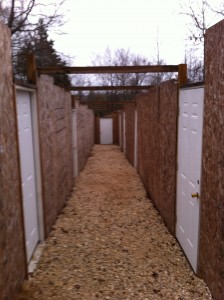
IMG_0501

The facilities and the instructors were excellent.   We were encouraged to ask questions often, and there were many good questions from students throughout the course.  Lost in the political debate over arming teachers, between the gun rights absolutists, insisting that no skills training is needed, and the gun control pessimists, insisting that armed citizens are simply incapable of success against an active shooter, is this course, which defines a baseline level of mechanical skills (gunhandling, shooting and medical), and teaches students the tactics and mental process necessary to save lives.

CSAT only offers this course a few times a year. I highly recommend it, with the strong recommendation that anyone planning to attend should put in some prep time before class day, making sure you can hit the small targets (and long targets) with your pistol, that you can self-apply a tourniquet one handed, and can move indoors with your gun in a safe muzzle-down position (CSAT recommends the “Sul” position).

For more information: visit the CSAT website.

3 Rules, not 4. Maybe just 2 rules.

On several of the blogs I read, people often refer to the “4 rules of gun safety” and quote the rules defined by Jeff Cooper of Gunsite. They are

  1. All guns are always loaded!
  2. Never let the muzzle cover anything you are not willing to destroy!
  3. Keep your finger off the trigger until your sights are on target!
  4. Always be sure of your target!

The NRA has a better set of rules, which are

  1. ALWAYS keep the gun pointed in a safe direction
  2. ALWAYS keep your finger off the trigger until ready to shoot
  3. ALWAYS keep the gun unloaded until ready to use

Why are the NRA rules better? The NRA rules are direct instructions for people to follow, stated as positive absolutes.  They tell you what you _should_ do, in priority order, no less.  That’s why the first rule about “safe direction” is first.  If you screw up and violate NRA rules 2 and 3, if you obeyed rule 1, nothing of consequence, except for your pride, is damaged or destroyed.  When I teach NRA Rule 1, I go into detail about what “safe direction” actually means, because my observation is that a lot of gun owners fail to obey NRA Rule #1 because they don’t understand the word “ALWAYS” and they don’t understand “safe direction”.

In order for a direction to be safe you have to know what’s along the path your bullet will travel, and where it will stop.  That requires more thought than “up in the air” or “down at the ground” or “toward that wall”.  Off the range what you really have to do is determine the safest available direction, and that can change as people, animals and vehicles are in motion.

Cooper’s rule #1 “All guns are always loaded”  sounds good in a vague way, but says nothing.  Is it direction to always keep my gun loaded? or direction to handle my gun as if it were loaded? If it’s the latter, what’s the first thing I should do, if I”m going to handle my gun as if it were loaded?  That would be… ALWAYS point it in a safe direction which is NRA Rule #1.  So Cooper’s Rule #1 says nothing explicitly useful and can be scratched off the list.

Cooper’s rule #2 is “Never let the muzzle cover anything you are not willing to destroy” – which is a negative way of saying “ALWAYS keep the gun pointed in a safe direction”.  The adult learning people claim that you should always teach what you want students to do, not the opposite, so I’ll go with the NRA’s version.

Cooper’s rule #3 is “Keep your finger off the trigger until your sights are on target!” which is basically the same as NRA Rule #2 “ALWAYS keep your finger off the trigger until ready to shoot”. Again, I like the NRA’s rule better, because I do not always need my sights on target to shoot – such as in a retention or extreme close quarters situation. I just need to be ready for the gun to fire.

Cooper rule #4 is “Always be sure of your target!” which repeats the information in Cooper’s Rule #2 and NRA Rule #1.   If you weren’t sure of your target when you followed NRA rule #1 and pointed your gun in a safe direction, then the direction wasn’t safe, was it? Either you understand what a safe direction is, and you continually adjust your muzzle direction as needed, or you don’t, in which case you need to put the gun down until you learn what a safe direction is.  You should have been “sure of your target” back at rule #1 or at Cooper’s rule #2.

NRA Rule #3 is “ALWAYS keep the gun unloaded until ready to use.”.  Do we need this rule?  If we follow NRA Rules 1 and 2, or Cooper rules 2, 3 and 4, at all times, guns will always be pointed in safe directions with fingers off triggers, so there won’t be any negligent discharges.  I tell my students there are two categories of guns: those you are “using” for self-defense, whether they be readily accessible at home or “on or about your person” and all those other guns you have for other reasons: recreation, competition, hunting, collecting, etc.  Keeping all those non-self-defense guns unloaded causes no harm, and may prevent someone incapable of following the first 2 NRA rules from having a negligent discharge.

Cooper supposedly put “All Guns are Always Loaded” as his rule #1 because the #1 mistake people make handling guns is to violate all the other rules under the excuse that “it’s unloaded”. Cooper’s solution was to add a rule and place it first to reinforce that point.  I suggest that perhaps an alternative solution is to just use 2 rules – muzzle and trigger, because there are still gun owners out there (nevermind TV actors and actresses, and anti-gun politicians) who find it hard to follow 3 rules, much less 4, all the time.

No Second Place Winner

Col. Jeff Cooper once wrote that “owning a gun doesn’t make you armed any more than owning a guitar makes you a musician”.

From Wyatt Earp to Rex Applegate to Charles Askins to Bill Jordan to Jim Cirillo to Jeff Cooper to Tom Givens — the message is consistent:  under stress you will do what you’ve trained and practiced to do.
There’s more than 100 years of history, writing and study on the topic of fighting with handguns. Those that study it seriously all come to the same conclusions. That might be important.

Your right to carry and even just having a gun isn’t going to save your life in a real situation.   Either you have trained and practiced realistically with the gear you carry, or you haven’t.
Here’s a simple test:  set up one IDPA target at 5 yards.  Draw from concealment and fire 5 rounds, in 5 seconds, make a group no bigger than 5″.  5 in 5 in 5 at 5.  Bonus points if you can do it in low light.

It’s not about lowering the standards to make it cheaper to get a license, finding ways to avoid taking training classes, or finding the smallest, lightest, feeblest, hard-to-shoot carry gun you can find.
None of things will keep you alive.  A shooting situation is a pass/fail test.  Just as with all other types of tests, those that prepare usually out score those that do not.

The right to carry is worthless if you don’t have the skill and equipment to back it up.  As the great Texas lawman and real world gunfighter Bill Jordan famously observed, there is no second place winner.

Closing the Utah permit loophole in Texas

Rep. Burnam has introduced a bill to address the “Utah CHL loophole” that allows instructors to teach the Utah carry permit class in Texas, and for Texas residents to carry in Texas on a Utah permit – thus avoiding the additional time and expense of getting a Texas CHL.

http://www.star-telegram.com/2011/01/01/2738055/burnam-files-bill-in-legislature.html

The way I would have solved the Utah loophole problem is this:

If you have a Texas drivers’ license and you want to carry in Texas, you should have a Texas carry permit.

The only exemption would be for those that move here and have a valid license from another state (that we have reciprocity with) that has not yet expired.
They should be allowed to carry in Texas using that license until it expires, at which time they need to get a Texas carry permit.

Utah’s program is out of sync with all the other states that issue carry licenses, because they allow Utah-certified instructors to teach Utah permit classes outside their state borders. No other state does this.  This is great from a gun-rights absolutist perspective, because it allows people living in anti-gun states like California, and states like Washington state with poor reciprocity with other states, get carry permits that are recognized in many states.  In a pro-gun, strong-CHL state like Texas, the Utah program creates problems.

When Texas residents get Utah licenses, they aren’t counted in the stats on how many people in Texas have carry permits. That weakens public perception of the popularity of CHL in Texas, and weakens the voice of gun owners to state government.  If everyone in Texas that carries got a Utah permit, it would appear that no one in Texas is “using” the right-to-carry and therefore reforms aren’t needed to improve and simplify our gun laws.   Money is another issue – those getting Utah licenses are sending their money to Utah, when it should be going to our state’s treasury.  We can’t lobby to have our state’s CHL fees reduced if everyone opts out of our state program.

The instructors that are teaching the Utah classes aren’t doing anybody any favors by lying to their students and telling them that it’s a good idea to carry in public and be ignorant of Texas gun laws.  Last time I checked, ignorance is no excuse when you get busted, and “I was trying to save $50 on class tuition” or “I didn’t know how to shoot or operate my gun, so I took the Utah class because it didn’t have any range time” aren’t going to work very well as defenses in court.  As I’ve told people who have called me looking for Utah classes, one hour of a lawyer’s time costs more than the difference between the Texas permit and the Utah permit.  Pay it now, or pay it later.

I teach Texas CHL and a bunch of pre- and post-CHL classes because I actually _care_ whether people that train with me live or die, should they end up in a situation where they need to use a gun to defend themselves.

My friend Tom Givens, who teaches in Memphis and offers 1-2 classes at my range every year, has had 56 students involved in shootings in the past 5 years.  Their “hit ratio” of shots fired that hit their intended targets is over 90% – about triple that of the hit ratio of officers in major police departments.  Like me, he offers multiple classes that go beyond his state’s minimum carry permit requirements. Many of those students involved in shooters were graduates of those post-CHL classes.

An Austin musician was shot to death recently in his own home.    If you read the news articles about the incident, what appears to have happened is this:  the musician had a gun and no training.  An intruder broke in, and he tried to ‘solve the problem’ using his gun.  At some point the musician ended up in a some kind of physical struggle over the gun and got shot in the neck with his own gun.  The intruder also died in the hospital days after the incident.  Training makes a difference–anyone that’s attended our Home Defense Tactics or Personal Tactics Skills classes has learned that the safest response to a home intruder is to take up a position of cover and/or concealment in your safe room, call 911, and be prepared to use deadly force if the intruder enters the safe room.  The risks of searching your home for the intruder, including the likelihood that you could end up in exactly the type of grappling match that occurred (and the possibility you could die as a result) are covered.

Many gun owners believe that all they have to do to be ready for a life-or-death scenario is just to “have a gun”. They believe that under stress, they will instinctively do the right things and hit all their shots. This belief isn’t based on data analysis or study. It’s just more comforting than the alternative, which is to study real situations and discover that those that survive typically have thought about the situation in advance, have a plan, and have equipped and trained themselves appropriately.   Over and over again I’ve been taught that under stress you will do what you’ve trained to do, and you will do it at or below the skill level you have in practice.  In force on force scenario classes and in competitions I have seen trained people freeze up and great shooters miss.   I have heard world champion shooters step off the firing line after winning major events and say “I shot better in practice than I did today”.  Those that believe in the fantasy that they will excel at something they can’t do in practice live a dangerous lie.

Those teaching the Utah classes in Texas are doing so purely out of greed – they aren’t doing any of their students in Texas a favor.  All the large post-CHL level schools in the country basically agree on the basic set of topics and skills that people need to learn to be competently armed.  None of the CHL programs in any state require that level of skill and knowledge.  Arguing about what is “a right” and what is not doesn’t change the hard cold fact that in a real situation tactics, speed, accuracy and power all matter.  An untrained person carrying a .22 derringer they’ve never fired before loose in a pocket is much less likely to survive than someone carrying a Glock 19 in an IWB holster who can draw from concealment and hit the A-Zone at 5 yards in 2 seconds or less 10 times out of 10.

The Utah-Texas instructor quoted in the linked article saying that the live-fire part of the course didn’t matter is 100% WRONG.  He’s graduating people that may not have ever HELD a gun and helping them get carry permits.  The Texas CHL shooting test is not a great standard, but is a basic level of skill.  Someone that’s never shot that leaves a Texas CHL class capable of shooting 70% on the test has some meager skill that might be needed that night to save his/her life– and an awareness that his/her skill is marginal, at best, compared to the others in the class and the state standard.  That same non-shooter attending the Utah class leaves a non-shooter.

Has any Texan that has used the Utah “loophole” been involved in a shooting yet?  Texas law exempts Texas CHL instructors from liability related to the Texas CHL course, but no such liability protection exists in Texas law for those teaching the Utah course.  Since CHL instructors are normally summoned to testify in cases involving their students, it will be interesting to see how that plays out in court in some future test case.  I guess that those that don’t think they need any training or knowledge or skill to be well prepared to win a gunfight aren’t worrying about going to court afterward either.

Bottom line? Burnam’s bill may not be the best solution, but perhaps it will stimulate discussion on how the Utah permit loophole can be closed in Texas.  I note with disappointment that the Texas State Rifle Association is going to oppose this bill and support leaving the Utah loophole open — basically working against the Texas CHL program TSRA lobbied to create, enabling Utah to siphon off the Texas CHL numbers that TSRA uses to back up its lobbying efforts.   Hopefully they are working to get a better bill on the floor this session.