As part of the KR TrainingHistorical Handgun project to increase awareness of the history & evolution of defensive handgun skills, I read and review important books on pistol shooting and related topics.
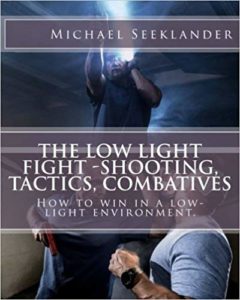
The Low Light Fight – Michael Seeklander (2016)
I’ve been a member of Mike Seeklander’sAmerican Warrior Society for the past several years, and I’ve followed him as a competitor and a trainer long before that, during his time at the US Shooting Academy in Tulsa and, before that, when we shot many of the same major USPSA and Steel Challenge matches in the 1990’s.
Mike has written many excellent books on shooting skills, and this one (The Low Light Fight) is another great read / training manual. Techniques for low light shooting continue to evolve, as flashlights, red dot sights and lasers continue to improve and be re-packaged in many different configurations for handheld and weapon mounted use.
The book is basically split into three parts. The first third of the book has chapters on basics of shooting, tactics and combatives, low light principles, and gear selection. These topics define the core building blocks on which specific skills are explained and applied. The middle third of the book focuses on tactics: the 1-3 yard threat, building & room search, and engaging threats in low light. The final third covers a topic of great value to the serious student: dry fire and live fire drills that can be used to develop and evaluate low light skills. Most other books on low light shooting end with demonstration and explanation of tactics and skills.
Much of the material in Mike’s book aligns with the curriculum of the low light shooting class I teach each year for KR Training. Graduates of my low light course would find this book valuable as a review of concepts taught in the course, and guidance for how to maintain those skills.
If you aren’t already a subscriber to receive this newsletter each month, you can subscribe here or follow this blog. You can also follow KR Training on Facebook or Twitter for more frequent posts and information.
NOVEMBER SPECIAL
Caleb Causey is coming to the A-Zone November 10th to teach his one day TacMedEDC course. It’s a great one day class covering material that goes beyond the “Stop the Bleed” course or any online first aid course. Just like shooting skills, medic skills deteriorate if you don’t practice them.
If you are a graduate of any Lone Star Medics course, you can attend this class for half price ($100).
VOTE
Election day is Tuesday, November 6th. As you might expect, I’m in favor of my students voting for candidates that will vote to expand gun rights and who will vote against proposed gun bans and restrictions. The days when both major parties ran candidates that were “B” rated (or higher) by the NRA appear to be over, and now most races (particularly at the state level) are between “A” and “F” rated candidates. The NRA has a website where you can enter your zip code and it will show you the ratings for candidates in all the races you would be voting on. (It doesn’t require you to provide contact information and using it will not cause you get unwanted junk mail or email.)
NEWS
September and October were incredibly busy months for the KR Training team, with full classes every weekend the weather allowed, multiple trips to other states to teach road courses, and a record number of weekday private lessons.
Due to an agreement with range neighbors, KR Training runs NO live fire classes on weekends during November and December (deer season). During those months live fire training is only available in the weekday private lesson format & pricing.
We will resume our normal schedule of weekend courses in January 2019. We are still scheduling classes taught by visiting trainers, and confirming dates that the KR Training team will be teaching on the road. In the November and December newsletters we will be announcing more classes added to the schedule for 2019.
We are still confirming speakers and finalizing plans for both days of the annual Preparedness events we run the first weekend of January each year. Saturday’s event will include medical, chainsaw, fitness and other non-firearm topics. Sunday’s event will be firearms specific and cover some topics not covered in regular KR Training classes.
UPCOMING EVENTS AND CLASSES
All events at the A-Zone Range unless noted otherwise
In October, Karl taught two classes for FPF Training in northern Virginia – a one day Historical Handgun course and a one day Advanced Handgun (expanded AT-6) course. The final day of that trip was spent at NRA headquarters meeting with NRA Museum director Jim Supica doing research for Karl’s Historical Handgun book (in progress). There will be a blog post (or two) about this trip on the KR Training blog in early November.
The blog-o-rama section where we include links to all the articles I shared to the KR Training Facebook page is on hiatus this month but will return in the November newsletter. Follow KR Training on Facebook or Instagram to see that content as we post it.
2018-2019 SCHEDULE
Registration is open for all classes on the KR Training schedule, including those already scheduled for 2019. In November and December we take a break from offering weekend live fire classes due to deer season, but weekday private lessons will be available on a limited basis.
Thank you for sending your friends and family to train with us. Your referrals keep our classes full and help us continue to offer in-demand classes that specifically address the needs of responsible armed citizens. Remember, now you can train with even more purpose through the KR Training Defensive Pistol Skills Program. Start working to earn your coin now.
We look forward to training you!
Karl, Penny and the KR Training team
Flying back from teaching the Historical Handgun and Advanced Handgun classes in Virginia last weekend, I was thinking about how the Texas License to Carry course of fire could be modified to be a better standard, but still retaining most of the characteristics of the original drill.
The Texas License to Carry course of fire is here. The target was changed to the B-27 from the original Texas CHL target (shown in the pictures in the linked article) years ago. The change to the B-27 was a step in the wrong direction, as the original target modeled human anatomy better than the B-27 did.
Target and Scoring
My modified drill will use the IDPA target, which retains the characteristics of the original CHL target, with smaller (and more anatomically correct) scoring zones.
Scoring will also be done with IDPA “points down”, so simple addition/subtraction is all that’s needed to score it. The drill is a total of 25 rounds (half of the original LTC 50 rounds). To score it, just count points down. 25 (down zero) is maximum score. 18 (70%) is passing, 20 is 80%, 23 is 90% which would be considered “instructor level”.
Misses and late shots are -5.
Unlike the Texas “License to Carry” test, this version of the drill actually tests drawing from concealment.
3 yards
The original test was:
From ready, two handed, one shot in 2 seconds (5x)
From ready, two handed, two shots in 3 seconds (5x)
From ready, two handed, five shots in 10 seconds (1x)
The modified test is:
From ready, ONE handed, one shot in 2 seconds (2x)
Gun holstered, dominant hand on gun, support hand on chest, TWO handed, one shot in the HEAD in 2 seconds (2x)
Hands at sides. On signal step left, draw and fire 2 shots in 3 seconds
Hands at sides. On signal, step right, draw and fire 2 shots in 3 seconds
Hands at sides. On signal, draw and shoot 2 head shots in 3 seconds
The modified LTC test is more difficult than the original Texas LTC test, but not as difficult as the KR Training 3 Seconds or Less Test, which we use as the standard in our Defensive Pistol Skills program.
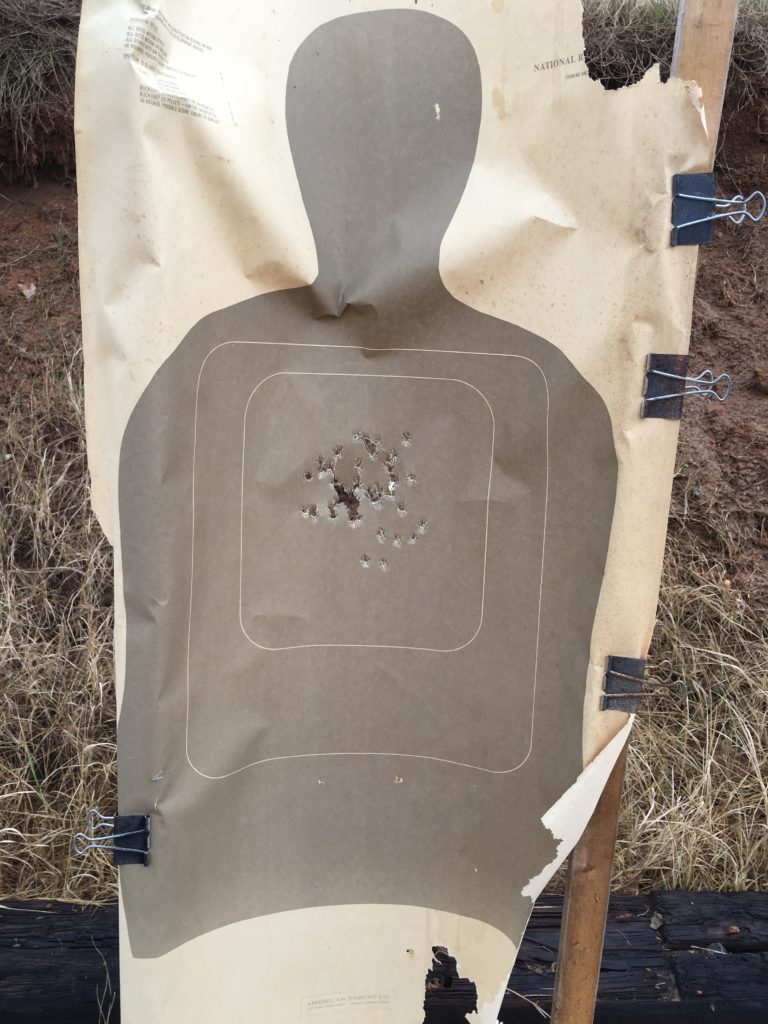
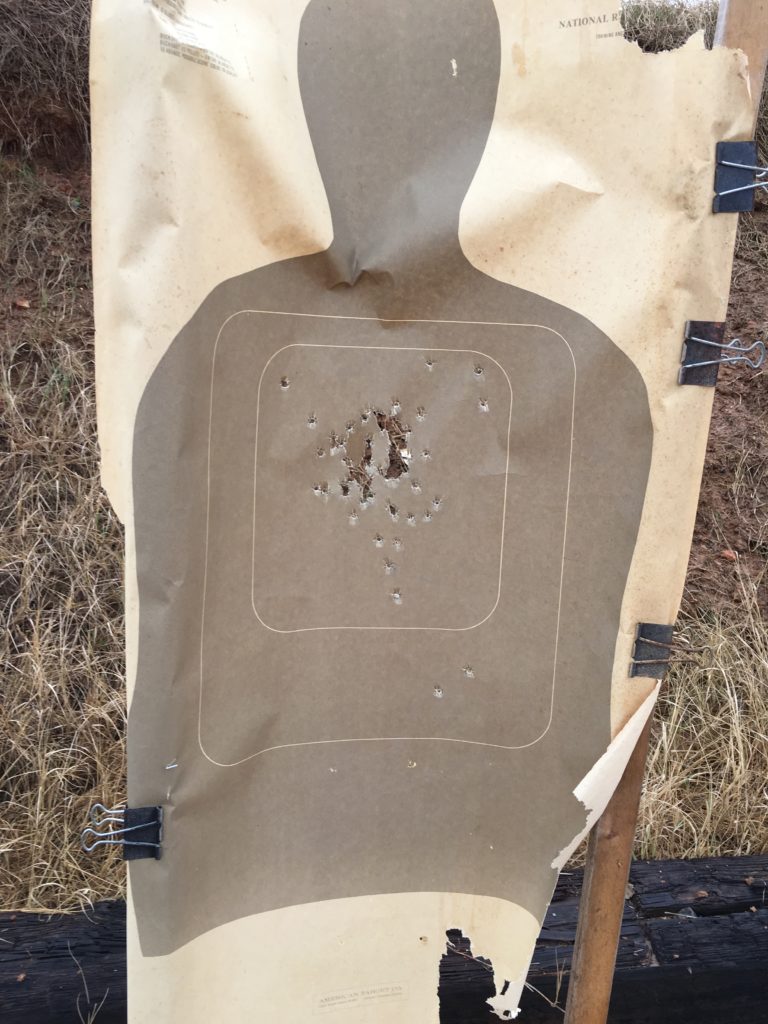
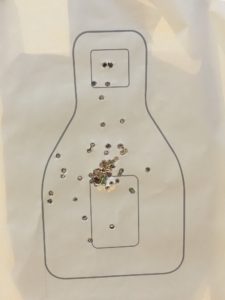
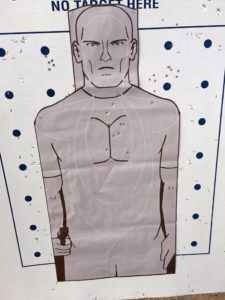
The videos and target shown in this blog were first take, with no warm up, no dry fire. I just put on my daily carry gear, walked outside, set up the camera and ran the drill. Scored 23/25, with one head shot fired at 3 yards with a poor sight picture, and one shot at 15 yards going a little high out of the zero ring.
The drill can always be made more difficult by shortening the time limits or using a smaller target for those wanting a bigger challenge. My purpose in developing this modified version of the drill is to give those that stopped their training with the carry permit course (about 99% of Texas permit holders never take any training beyond the state minimum) a course of fire that’s short and challenging enough it could be run multiple times during a 100 round practice that included drawing from concealment. Those running the drill at ranges that don’t allow drawing should cut a full second off every string time (except for the strong hand only that starts from the ready position).
October is always a busy month for KR Training, as we take advantage of cooler weather before we hit our annual November/December “no live fire classes on weekends during hunting season” break. The last 4 days have been a busy blur of classes and events, planned and unplanned.
Friday October 12 – Force on Force Instructor class
All day Friday, October 12, I ran a session of my Force on Force Instructor course. This class teaches instructors how to plan, script, and conduct live action scenario based training. It’s a skill set that has almost no overlap with traditional “live fire” instructor training, since the purpose of scenario based training is mainly to develop skills not taught or tested in live fire classes, including
recognize pre-fight cues
identify potential threats
manage unknown contacts
avoid or de-escalate potential violence incidents without shooting
take actions prior to violence occurring to gain better position
make legally justifiable and appropriate use of force decisions
interact with bystanders, witnesses, and first responders after the incident occurs
These are often discussed in lectures. Properly run scenario based force on force training provides opportunities to practice those skills, interacting with live roleplayers. Successful scenario based training requires detailed scenario design, careful scripting of roleplayers, and attention to safety.
There are very few programs around the country that offer scenario based FOF training, and even fewer programs that provide training to instructors in how to run that type of training. My approach is to integrate the instructor training with scenario based training classes. Instructor trainees attend one day of lecture & exercises with me, and assist with one or more days of scenario based training courses. This gives them the opportunity to see how I run the scenarios, and to work all the different instructor jobs (exercise coordinator, roleplayer, safety officer) in an environment where they can get coaching and feedback on their performance of those jobs.
This fall’s class had 3 students: an LTC/Rangemaster certified instructor, a Texas law enforcement instructor (that already was using scenarios for his Taser, baton and OC classes), and a Federal law enforcement officer. The small class size gave them ample opportunities on Saturday (and Sunday) to participate in every aspect of the training. All 3 did extremely well.
Friday night I rushed back to College Station to play a 2 hour solo piano show at a local restaurant, then right back to the A-Zone that night, to get ready for the marathon of classes the next day.
Saturday October 13 – Defensive Pistol 2, Advanced Training 2, Low Light Shooting 1
Once each spring and fall, we run 3 classes back to back in one day. The 3 classes are intended to taken as an 11 hour block of training, but we split them up into three separate events because many have limited funds, time, or stamina. The three classes are a four hour live fire class (Defensive Pistol Skills 2), a four hour scenario class (Advanced Training 2), and a three hour low light shooting class.
Instructor and podcaster Bob Mayne (Handgun World Podcast) attended the DPS-2 class, and discussed it in this podcast.
DPS-2 picks up where DPS-1 ends – reviewing concealment draw and general defensive handgun skills, adding in shooting from cover, shooting while moving, one handed shooting, the ‘tabletop’ drawstroke, malfunctions, and reloads. Additionally, every shooter got a run in the shoot house.
Advanced Training 2 is our original scenario class. In 4 hours students get to observe and/or participate in as many as 18 scenarios. Some use Simunition and Airsoft guns (outdoors), and some are conducted indoors using SIRT pistols, red guns and other props. The outdoor scenarios provide opportunity to fire projectiles at others (and be shot at); the indoor scenarios provide opportunity to learn and practice reading faces and body language without the barriers of full face masks and other safety gear that has to be used for the Airsoft/Simunition work. Both variations of scenario based training have value.
In the second half of the class, students take over all the roleplaying jobs in multiplayer scenarios simulating convenience store and restaurant situations. Roles include employees of the business, customers and criminals – so everyone got to play an armed citizen several times, but also got to see scenarios from the perspective of the unarmed bystander or criminal offender.
Interest in this type of training has increased in recent years. We discuss it in many of our classes to educate students about the value of it and explain how it’s conducted. Those efforts appear to be paying off, as this fall’s AT-2 class filled up with a wait list.
Running quality force on force scenario training requires a lot of gear and a lot of staff. It takes 6 people to run the four hour AT-2 course, with activities running in parallel in two locations, and the amount of prep time (and clean up time) involved is a lot more than the typical square range everybody-gets-one-target live fire classes most instructors run.
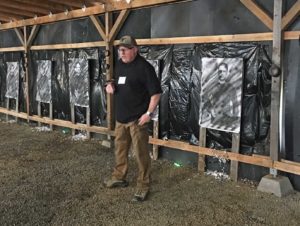
We offer the Low Light Shooting class once each spring and fall, on dates when the moon is small and the sun sets early (March and October). Longtime KR Training instructor John Kochan (20+ years on the KR Training team) compresses the history of tactical lights and low light shooting into an information rich hour that goes all the way back to lanterns and double action revolvers with no night sights.
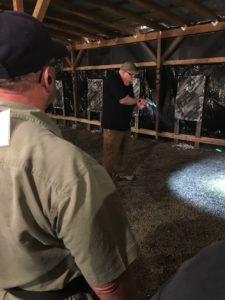
After John’s lecture we get out on the range, running drills without flashlights as the sun sets, until it’s too dark to see. This part of the class is important, as it provides useful knowledge about what can and cannot be done without artificial light. Then we move on to techniques using a handheld flashlight, including steel targets at 10-15 yards, one handed, working around cover in many different positions.
Posted by KR Training on Tuesday, October 16, 2018
Students also get another run in the shoot house in low light, and participate in a ‘red gun’ scenario indoors. Like the AT-2 course, this class takes 4-6 instructors to conduct, for a 3 hour class, to provide all the multiple events running in parallel. This reduces student down time and makes it possible to expose students to a wide variety of low light training in a short period.
Stray Dogs Join the Class
Around lunchtime Saturday, two stray dogs wandered up to the range house.
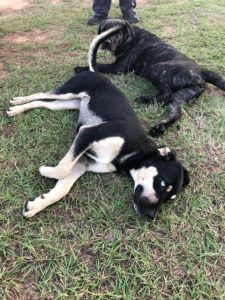
No tags, no collars. Tired and hungry but not starving. Nails clipped, teeth brushed – looked like they belonged to somebody. Friendly. They hung around during the AT-2 class, and we managed to get glow stick necklaces around their necks before it got dark. I took some pics, sent to all the neighbors I had contact info for, and hoped that someone was missing them and would come get them. When we started the live fire part of the low light class, one dog stayed on site and went and hid, the other took off and disappeared. When class ended, the one that hid, took off in search of her dog friend.
Sunday October 14 – AT-7 and Low Light Shooting 2
I have two other force on force scenario-based classes in my program: AT-5 (Tactics Laboratory) and AT-7 (More Scenarios). AT-7 hadn’t been offered in the last 2 years, so I put it on the calendar for Sunday, to give my force on force instructor trainees more opportunity to practice their skills, and for students wanting that course to attend. The AT-7 course presents scenarios originally developed for sessions at Rangemaster Tactical Conferences, including scenarios I developed with Paul Gomez and Caleb Causey that incorporate medical skills. We were too busy training to take pics or video for this class. Had a great group of students, sold out class, and the rain stayed away the whole afternoon.
One of the stray dogs returned Sunday morning and stuck around the rest of the day. One of my neighbors brought some dog food down, and to avoid her running off during the low light 2 class that night, we managed to get her in the classroom building, which has a dog door and fenced back yard. Nobody had responded to any of my texts or emails regarding lost dogs. I decided to keep that dog at the range house Sunday night so I could take her to the Giddings Animal Shelter the next day.
Low Light Shooting 2 was the final course of the 3 day weekend run. Three more hours of more complex low light shooting drills, including scored low light shooting tests from the KR Training and Rangemaster programs, multiple runs in the shoot house (one with handheld light, one with weapon mounted light), and work indoors with weapon mounted lights. The focus of the weapon mounted light work was on learning to use the light to assess unknown contacts without muzzling them. It takes additional concentration on muzzle direction to use a weapon mounted light. That class wrapped up Sunday night around 10 pm. It was a very long weekend. But wait, there’s more…
Monday October 15 – Dogs, Music and Video Simulator
The one stray that showed up Sunday was happy to hang out with me that night at the A-Zone. Overnight the temperature dropped from the 70’s down to the 40’s, with heavy rain. When I got up Monday morning, the other dog that had wandered off Saturday night was back. I got that dog in, dried her off, fed her what was left of the dog food the neighbor had brought, and decided to take both of them to the Giddings shelter, since I had a long day on the road in Austin planned.
If anyone is interested in adopting two adult females, very well behaved, friendly – they are currently at the Giddings Animal Shelter and will be eligible for adoption this weekend. They are holding them hoping someone looking for them will contact them. I sent pics of the dogs to a KR Training student that is also a Lee County Sheriff’s deputy, and he was going to get the pics to their dispatchers in case someone called. Still don’t know if these dogs were dumped or ran off from someone that was maybe visiting a neighbor. Several students in the Sunday class offered various forms of help – and may relocate the dogs to an Austin no-kill shelter this weekend.
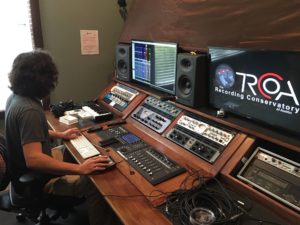
My next stop Monday was the Recording Conservatory of Austin. KR Training student (and groundskeeper) Wade D is studying to be a recording studio engineer, and he invited me into the studio to record some tracks he could use for a project. I was able to do 7 songs (keys and vocals), and we are going to finish the project with me bringing in some guest musicians to my home studio, recording those tracks, sending to him and he’ll mix and master the complete package. I’ll be sharing those online as we get them completed.
My next stop Monday afternoon was to see a demo of the Immersive Training Solutions simulator. They have a projection screen/video/laser mobile training system that includes marksmanship drills and scenario training. We are discussing bringing their equipment to the A-Zone to enhance some KR Training classes in 2019, if we can work out logistics and costs.
Final stop was rehearsal with Johnny D and the Genotones. I’ve been a part of that occasional Austin-based band since the early 2000’s, playing 1-2 shows a year with them. We have a private party coming up October 29th. This year’s version of the band includes Houston-based luthier/guitar guru David Hazlett and Austin singer Julianne Banks. We were able to get everyone together for one long rehearsal to knock the rust off.
Tuesday – October 16th
I’m at the A-zone this morning, cleaning up from 4 days of classes, and getting my gear packed for a 5 day trip to the Washington DC area, to teach a one day Historical Handgun class, a one day (sold out) Advanced Handgun course (both hosted by John Murphy of FPF Training, who will be coming to KR Training in February 2019) tour the NRA museum, meet with NRA Training Department personnel, and spend some time with my wife Penny, who recently started a 6 month “Special Advisor” job with the Department of the Interior that will keep her up in the DC area until spring 2019.
When I get back from that trip I’ll do another AAR about that.
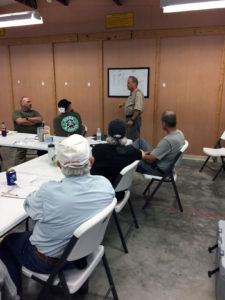
On Sept 29-30, instructors from KR Training and RW Training co-taught a session of the state certified School Safety/Active Shooter course to a mixed group of teachers, church security personnel and interested armed citizens. The class was held at the Golden Triangle Gun Club near Beaumont, Texas. Our students had a wide range of experience, from frequent USPSA/IDPA competitors, facilitators with “A Girl and a Gun” chapters, military combat veterans, to carry permit holders with no other training.
BACKGROUND
In 2013, Texas passed a bill that would authorize armed teachers at K-12 schools if they passed a special training course. In 2017, the Texas Department of Public Safety began certifying a limited number of License to Carry instructors in the new course. This course content is general enough that it has value to anyone interested in active shooter response, and as a state-certified, state-developed course, the training it provides will be more legally defensible in court than other un-certified courses offered by private sector schools. The KR Training version of the course includes two additional live fire qualification courses: the shooting test from the NRA Defensive Pistol class, and the annual qualification course of fire used by a major Texas city’s police department. This provides graduates of the course additional documentation that they meet a national standard higher than the Texas License to Carry class (the NRA test), and a standard equivalent to what a typical responding police officer in our state has met.
DAY ONE
With heavy rain expected for much of the day, the class started indoors with presentation of lecture material on the characteristics of active shooters, supported by case studies and video from specific incidents.
By the afternoon the rain had decreased and we were able to get to the range to shoot the qualification course of fire and the “Shooting Under Duress” block of drills, which used photorealistic targets showing school safety & active shooter scenarios.
Predictions of more rain turned out to be incorrect, and skies cleared, allowing us to run the remaining parts of the Shooting Under Duress module, including shooting at 50 yards. Drawing from a holster is not required in the official state curriculum, but since most teachers (and church security personnel and other armed citizens) are likely to be carrying concealed in a holster, our version of the course included additional training in proper draw technique (dry and live fire). We also used an assessment of each student’s gear as a way to discuss holster selection and position. Several students had the usual problems of wearing a holster designed to be worn behind the hip, with a forward cant, at their strong side, forcing the wrist into an awkward angle, or using an AIWB holster that placed the gun so low to the belt that a full firing grip could not be established with the gun holstered, or wearing a holster that closed up when the gun was drawn. We ended up loaning several students holsters for this part of the course.
After everyone had demonstrated that their open carry draw technique was safe and fast enough for the drills to follow, we ran everyone through the qualification course of fire from a major Texas city.
The passing score for this test, which included firing at 3, 7, 15 and 25 yards, was 70%. All 12 of the students in the course passed on their first attempt with a score of 85% or higher, including some that were shooting small / subcompact guns like the SIG P365.
We also ran the NRA Defensive Pistol shooting test, which required the students to draw from concealment. I’ve used this test as the “national” standard in this course several times now. Next time I run the course, I’m going to substitute the current FBI qualification course of fire in place of the NRA test as the national standard students have to meet.
The NRA test over emphasizes reloads, does not include one handed shooting, and (unlike any shooting qualification I can find in any of my review of historical qualification courses), can only be passed with a perfect score of 34 out of 34 in the acceptable hit zone of the NRA D-1 target. The other problem is the D-1 target itself. Overly sanitized, it has minimal relevance to human anatomy, compared to the FBI’s Q target.
All other tests, from the 1930s to the present day, have a maximum point score, with passing threshold at 70% or 80%. Four of the 12 passed the NRA test on the first attempt, many others dropped a few shots. Of the 8 that reshot the test, 4 more passed on the 2nd attempt with the others challenged by the requirement to shoot a perfect 34/34.
The afternoon was spent indoors, finishing up the lecture material and running roleplaying scenarios that taught tactics related to protecting classrooms against active shooters, building evacuation while armed, and interaction with uniformed responders.
SUMMARY
The state-developed, state-certified class was designed to be appropriate for anyone with a carry permit. The course content is relevant to anyone interested in being prepared to survive an active shooter incident, not just teachers. KR Training ran multiple sessions of this course – both the official 2 day state version and shorter non-certificate versions for church security teams – in 2018, and we plan to offer the course in the full 2 day format at the A-Zone in 2019.
I’ll also be presenting a subset of that material in lecture form for the Austin Disaster Relief Network (ADRN) Preparedness Meet Up on November 8th at Riverbend church in Austin. You do not have to be an ADRN member to attend, and it’s free. Anyone in the Austin area interested in this topic is welcome to attend.
If you aren’t already a subscriber to receive this newsletter each month, you can subscribe here or follow this blog. You can also follow KR Training on Facebook or Twitter for more frequent posts and information.
*Must pay in advance, in full to receive discounted prices for combo registrations.
SEPTEMBER SUMMARY
September began with a drive to Ft. Collins, CO and back to be the guest on an upcoming episode of the Outdoor Channel’s Shooting Gallery show, talking about the Historical Handgun course and upcoming book. As soon as I got back, Western author James J. Griffin dropped by for a quick visit. I provide James with technical info about guns and maintain his author website. He writes traditional Western and modern mystery stories about fictional Texas Rangers, and has an exhibit of his Texas Ranger pop culture collection (Western pulp magazines and other items related to the Rangers) on display at the Texas Ranger museum in Waco. Taught 4 classes the one dry weekend we had mid-month, and rescheduled some classes that got rained out. Lots of private lessons, including some for instructor-level students (graduates of NRA, DPS LTC, USCCA and SIG instructor programs), and a special class for a visiting police officer from Argentina. Then I attended 2 days at the Texas Bar’s firearms law course in San Antonio, teaching an evening lecture course at an indoor range in Bulverde, attended the GOA “How to Testify” class held at Texas A&M, and ended the month in Beaumont co-teaching a sold out School Safety/Active Shooter course with Richard Worthey.
COMBATIVE PISTOL 2 (DYNAMIC PISTOL MARKSMANSHIP) – TOM GIVENS OCT 6-7
Tom Givens has trained over 48,000 students over the past 40 years. 64 of them have been successful in armed incidents, with a hit ratio of over 90% (about triple the typical law enforcement officer hit rate). Tom is returning to KR Training in early October to offer his level 2 Dynamic Pistol Marksmanship course. If you’ve taken DPS-2 or a higher level course with us, you are ready for Tom’s level 2 class. This class is also an excellent defensive pistol course for experienced IDPA / USPSA competitors that have never taken a class focusing on defensive pistol skills. It’s not a “how to draw” course. It’s a “how to win a gunfight” class.
HALF PRICE REFRESHER SLOTS
You can come back for any class you’ve taken before, for half price. Repeating a course is a great way to maintain skills for low cost, particularly if you haven’t practiced the skills you learned in our classes due to time, cost, or range limitations. Retake the class with a different gun, or go as moral support for that friend or family member you finally talked into attending.
“LEARN TO TESTIFY” SEMINARS FROM GUN OWNERS OF AMERICA
The KR Training schedule shows most of the classes we plan to offer through late October 2018 and even a few already scheduled for 2019. Registration is open for everything listed. In November and December we take a break from offering weekend live fire classes due to deer season, but weekday private lessons will be available on a limited basis.
KR TRAINING INSULATED TUMBLERS
Now available: 20 oz insulated tumblers with the KR Training Defensive Pistol Skills program logo. These will be on sale for $25 at the A-Zone during all October and November classes. DPS program coin holder price is $20.
Thank you for sending your friends and family to train with us. Your referrals keep our classes full and help us continue to offer in-demand classes that specifically address the needs of responsible armed citizens. Remember, now you can train with even more purpose through the KR Training Defensive Pistol Skills Program. Start working to earn your coin now.
We look forward to training you!
Karl, Penny and the KR Training team
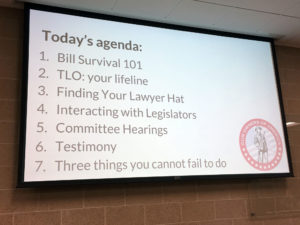
On Sept 26, 2018 I attended the How To Testify seminar taught by Rachel Malone, the Texas Director for Gun Owners of America. The seminar was intended to teach local gun owners how to prepare for, and effectively testify before the state legislature on firearms bills. The content was relevant for any type of public speaking, before city, county, state or even national gov’t meetings or media appearances.
Rachel’s background includes working for the Texas Republican Party and certification as an instructor by the Massad Ayoob Group, giving her great insight into both the firearms and legislative aspects of this topic. She is also a graduate of courses we’ve offered at KR Training. This month she also received the Grassroots Activist of the Year award from the Citizen Committee for the Right to Keep and Bear Arms, which is part of the Second Amendment Foundation.
The idea to offer this type of course all over the state is a brilliant one, and long overdue one. Usually this type of information is only available to those already active in politics, who go to conventions, conferences and other big events. Reaching out to the local grassroots is important. This event was held at a meeting room on the Texas A&M University campus, and many attendees were members of A&M student groups: Young Conservatives of Texas, Texas Open Carry, Turning Point USA, and Students for Concealed Carry.
KEY POINTS
A quick overview of the key points Rachel presented:
She explained how bills originate and the process they go through before being signed into law. In Texas there are many opportunities along the bill’s path for it to be killed, often at the whim of a single legislator who is on the right committee. More than 6000 bills got filed last session, some of them never got sent to committee, many that made it to a committee never got a hearing or a vote, and even bills making it through that process never get on the calendar. That process has to occur in both the House and the Senate, and the content of the bill can be watered down and modified at any step along the path.
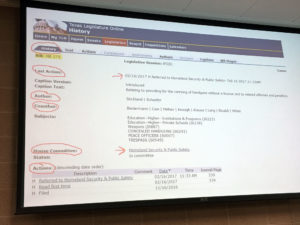
TLO refers to Texas Legislature Online. This state website shows all bills that have been filed, along with multiple screens showing their status, sponsors, and any supporting documents. When the next session starts in January 2019, GOA and Texas State Rifle Association usually send out updates identifying the bills of interest to gun owners. (Every gun owner in Texas should be a member of the Texas State Rifle Association. They do as much or more than NRA to lobby for gun owners at the state level and need your support.)
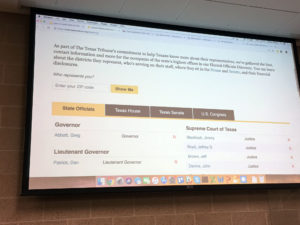
The Texas Tribune website is useful for finding out how to contact your state representatives.
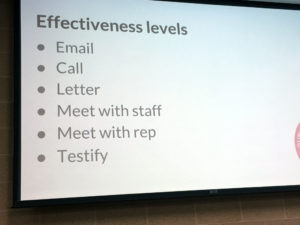
How to Be Effective
Each step on that list is more effective than the one above it. Email is the least effective. Calling/writing letters is more effective, and any in-person effort, whether meeting with staff or the rep at their district office in your area, or meeting with them at the Capitol, is even more effective. Testifying during hearings is also important. It indicates that the issue is important enough to you that you made the effort to show up and speak.
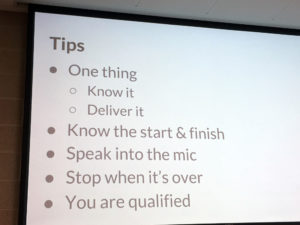
Communication skills are critical. Be professional. Know the specifics of the bill. Have an organized list of key points about the bill, back them up with data if you can. Have a strong closing argument. Typically you only get 2 minutes. Write out what you plan to say, and submit that as written testimony to go with your oral presentation. Practice giving your 2 minute talk so you can manage the time, and stay aware of your time so you can jump to your strong closing argument before you run out of time.
Don’t wing it.
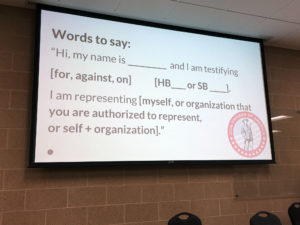
Identify yourself at the start. If you only represent yourself, explain why your opinion matters. Gun owner, competitive shooter, instructor, law enforcement, veteran, gunsmith, carry permit holder, survivor of criminal attack…any thing that adds to your credibility on the issue.
Dress up. Be nice to others that are in the hearing regardless of whether they are with you or against you on the issue. Try to find others on your side of the issue. Sit with them, network with them. Make sure all your electronics are fully charged (backup batteries are a plus) and “be prepared for anything”.
Open carry and concealed carry of handguns are OK at the Capitol. Open carry of long guns is not.
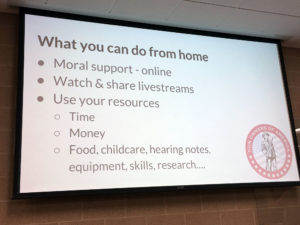
If you can’t get away from regular responsibilities to testify, but know someone that is, give them any support you can. Publicize their effort on social media, maybe it will motivate others to testify or at least call or email in support of the bill.
UPCOMING SESSION
Goals for the upcoming session are to push for constitutional carry, reduction in the number of locations carry is prohibited (particularly limits on teachers that want to carry being denied that option by school districts), and prohibiting state resources from being used to enforce unconstitutional federal firearm laws. If you have other firearms related issues you want promoted in the next session, meeting with lobbyists like Rachel and Teresa is a great way to let them know about those issues.
SUMMARY
Rachel is offering many sessions of this seminar all over the state. Follow the link for a full list. If it’s coming to your area in the near future, you should attend this free event. And if you aren’t already a member of the Gun Owners of America, annual membership is only $20. That money supports Rachel’s efforts in Texas – well worth the small investment in your firearms rights.
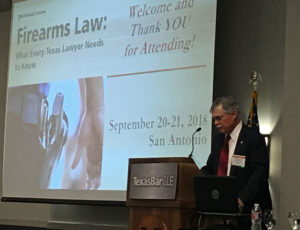
Sept 20-21, 2018 I attended the Texas Bar CLE (continuing legal education) course held in San Antonio, Texas. They put a course on this topic on each year, at different locations around the state, and I’ve attended the past few years. They always have top tier national speakers covering recent content. By attending I picked up another 12 hours of professional development.
Professional Development
Instructors that are serious about excellence seek out professional development (training from others) every year, whether they are required to by a state licensing board or not. Texas requires License To Carry instructors to attend a 1 day training session put on by the state police and reshoot the qualification course of fire (scored by another certified instructor) every 2 years. That’s a higher requirement than most states have, but the quality of the biannual refresher training provided to LTC instructors has plummeted from the high standards set in the early years of the program. The content of the Texas Bar course is much closer to the level and depth of content the state police should be providing to LTC instructors.
You don’t have to be a lawyer to attend. A handful of firearms trainers attended, along with a mix of law enforcement agents, judges and lawyers.
The course comes with a detailed briefing book with long articles written by each presenter, and it’s possible to buy the class notes even if you don’t attend. Check the Texas Bar CLE website or contact them for details.
I am not a lawyer and these summaries should not be considered legal advice.
Part 2 of the quick summaries of the presentations I heard, with key points:
Crossing the Cop
This session focused on knowledge useful for criminal defense attorneys when cross examining police officers. Here are key points the speaker made during his presentation. Some statements are controversial and represent his opinion on this topic.
Police academies tell cops it’s OK to lie to people to get confessions.
Cops are taught to write reports to support charges and convictions. This can often result in information that might be useful being omitted or downplayed
Always investigate the officer’s work history (how many years at current dept, frequent moves to different agencies, what/when training was taken, internal affairs files, employment application.
Investigate the officer’s social media posts, marriage/divorce records and other public information (some cops have criminal records)
May need a subpeona to get unredacted employment and internal affairs files
Always look for what is missing
Question the officer about what was left out of the report
Clayton Cramer – FBI Statistics
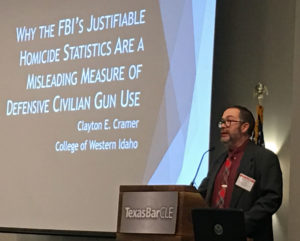
Clayton Cramer discussed why the FBI’s justifiable homicide statistics are a misleading measure of defensive civilian gun use.
The FBI gathers data on justifiable homicide but does not track “justifiable aggravated assault” or lower uses of force. That means defensive gun uses that do not result in death are not tracked at all by the FBI. The FBI does not “classificy a killing as justifiable or excusable solely on claims of self-defense”. Many states limit the ruling of justifiable homicide to felony offenses. A lot of them don’t go into the FBI justifiable homicide data. They show up as murder or non-negligent manslaughter because of the initial police report. This understates justifiable homicides and overstates murders.
Cramer claimed that Civilian Legal Defensive Homicides are typically 7-13% of the annual murder rate. (Murder rate is a subset of the total gun death rate, which includes accidents and suicides. A rough estimate is that out of 10,000 murders annually, 700-1300 are justifiable — out of a national population of over 300 million.)
Bonus knowledge: back in 1974, the Texas Penal Code stated that homicide is justifiable before adultery, provided the killing takes place before the parties to the act have “separated”. (This statute had been removed from the deadly force laws by the time the Texas concealed handgun license began in 1995.)
Firearms in Family Law
Most of this presentation related to situations where a family member may have to give up his or her guns due to mental illness or criminal conviction. If NFA items are involved, transferring them to an FFL (with the appropriate grade of dealer’s license) was recommended as an alternative to giving them to the police to store. Active duty police are allowed to retain their duty guns when under protective family orders that would disarm ‘civilian’ armed citizens. In many jurisdictions, police that are the subject of a case cannot/should not bring their duty guns into the courtroom — that privilege no longer applies when the officer is a defendant.
Firearm Rights Restoration
The next session was on a related topic – the restoration of firearms ownership rights that may have been lost due to mental illness or criminal conviction. That requires the individual to have their record expunged, set aside, pardoned or some other form of civil rights restoration to occur. There are only 1-2 pardons per year in Texas, and the way Texas does it, restoration of firearms rights requires a separate hearing. Historically rights have not been restored unless it was required for the person’s employment. This session was presented by Joshua Prince, who has an excellent legal blog heavy on firearms rights content.
Resilience Training: Performance and Interpersonal Management Skills for a Better Practice, and a Better Life
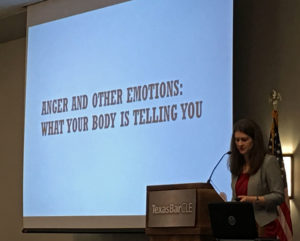
This was presented by a judge. It was solid information about managing stress and anger in a career field that has many opportunities for emotional confrontation. The topic wasn’t specifically related to firearms law, but it was definitely applicable, and included because it counted toward the requirement that all CLE courses include some ethics or ethics-related training.
Top Ways Your Client is Violating State or Federal Gun Laws
In the order they were discussed, not ranked in order of most common violations:
1) Selling reloaded ammo without an ammo manufacturing license. (Generally a bad idea from a liability standpoint. Blow up someone’s gun, or worse, cause an injury, and your homeowner’s insurance or even instructor insurance isn’t going to cover you.)
2) Making or modifying guns to be a prohibited item – such as a short barreled rifle.
3) Possessing, growing, or using marijuana or other drugs illegal under Federal law. Even if they are legal in the state you are in.
4) Committed to a mental facility – makes you a prohibited person. Texas has NICS mental health reporting guidelines and more than likely being committed will prevent you from passing a background check (which also affects carry permit status).
5) Doing a private transfer (no FFL/no background check) to a person you know is prohibited from owning firearms.
6) A spouse or family member that isn’t on your NFA gun trust using that NFA item without you right there with them.
7) The Kubaton (popular self defense item) could be considered an illegal weapon in Texas similar to brass knuckles. Possession could be a class A misdemeanor which would result in loss of carry permit.
8) Loaded gun in your carry on bag at the airport. Texas airports are 3 of the top 10 for this error, nationally. (Worse, most of the guns don’t have a round chambered or even a loaded magazine in the gun. If you are going to carry, carry a gun you can actually use if you need it. And keep up with where your gun is…all the time. Have a locking box in your car, all the time, that you can use to lock up your carry gun when you need to enter a premises where it’s illegal to be armed…or if you find a gun in your carry on bag when you give it one more check in the parking lot of the airport.)
9) Posting evidence of your violations, or discussing acts that would be violations on social media.
10) Running or participating in an illegal gun raffle. There are people that will do gun raffles online – buy tickets and they give the gun away, often making a nice profit. That type of raffle is only legal when run by a very specific list of approved groups: religious societies, volunteer fire/EMS, non profits. Only two raffles can be run per year, not at the same time, with no paid advertising. Specific items must be printed on each ticket: the name of the organization, address, ticket price, date of award, and other information required by law. It’s not only a violation to run a illegal raffle, it’s a violation to participate in it by buying a ticket.
Witness Dynamics
Massad Ayoob wrapped up the event with a session covering Witness Dynamics. Unfortunately due to the long drive back to College Station, I had to leave early and missed Mas’ talk. Looking at the written handouts he provided to all attendees (limited distribution only to those who paid for the training course, sorry), he covered keys to impeaching adverse witnesses in self defense cases.
That includes witnesses that are deliberately lying, have been led, are sincere but mistaken, is a “confabulating” witness. One definition of confabulation is “a memory disturbance, defined as the production of fabricated, distorted or misinterpreted memories about oneself or the world, without the conscious intention to deceive.”
Each requires different approaches, including use of video/audio recordings, expert witnesses, or explanation as to how perceptions can be altered or corrupted during high intensity events.
To learn about that topic, Mas offers his MAG-20 classroom course and the longer Deadly Force Instructor class. I had the opportunity to be an expert witness in a 1st degree felony case (working for the defendant) earlier this year, and the issue of the reliability of witness memory was a factor in the defense. The training I got from Mas on this topic, particularly in the Deadly Force Instructor course, was very valuable.
SUMMARY
Any Texas License to Carry instructor serious about being informed and competent on legal issues should spend “their own dime and their own time” (as Tom Givens often puts it) to attend this course. The content goes far, far beyond the meager/minimal training that occurs in the biannual LTC instructor retraining sessions run by Texas DPS. The class isn’t cheap, but the topic of self defense and deadly force is serious business, and deserves serious study — particularly by those taking money from others who expect their instructor to be a true subject matter expert beyond the state minimum. The tuition for this event was roughly the same as the cost of attending a 2 day live fire class.
The event can be attended by carry permit holders and the general public. It moves around to different major cities each year. The next opportunity will be a video replay of the content from the session I attended, presented in Dallas in early November. Check the Texas Bar CLE website for details.
Sept 20-21, 2018 I attended the Texas Bar CLE (continuing legal education) course held in San Antonio, Texas. They put a course on this topic on each year, at different locations around the state, and I’ve attended the past few years. They always have top tier national speakers covering recent content. By attending I picked up another 12 hours of professional development
You don’t have to be a lawyer to attend. A handful of firearms trainers attended, along with a mix of law enforcement agents, judges and lawyers. From the reaction of the audience to various statements made by presenters (and the number of untucked shirts and jackets being worn), it was clear that most attending were pro-gun. If anyone was there representing any of the gun control groups, they did not advertise that fact.
The course comes with a detailed briefing book with long articles written by each presenter, and it’s possible to buy the class notes even if you don’t attend. Check the Texas Bar CLE website or contact them for details.
I am not a lawyer and these summaries should not be considered legal advice.
Part 1 of the quick summaries of the presentations I heard, with key points:
Stephen Halbrook
Stephen Halbrook is a nationally known constitutional lawyer specializing in 2nd amendment cases. He covered 5 main topics:
The “Heller III” case – which resulted in several parts of the DC carry permit regulations being struck down
The New York State Rifle and Pistol Association case – which upheld assault weapon and magazine bans
Multiple cases that addressed aspects of “carrying outside the home”. There are many and inconsistent rulings from lower courts as to whether the 2nd amendment ‘keep and bear arms’ defines a right to carry outside the home, concealed or open. If the current 4-4 state of the Supreme Court can be tipped to 5-4 in favor of gun rights, there is hope that a SCOTUS ruling would clearly affirm the “outside the home” carry definition.
Applied Challenges to Legal Disabilities – mental commitments and criminal convictions
Status of the Supreme Court – Kavanaugh’s record on 2nd amendment and what it could mean if he is appointed as a justice
Interesting stats: less than 1% of FFL licenses get revoked each year. There’s been a 45% increase in thefts from gun dealers in the past year, which is a major concern. There is a new “FFL Alert” text message system that can send a text message to all FFL dealers in a county, after any gun dealer in that county is robbed or burglarized. There are 300 new assistant US attorney’s dedicated to violent crime prosecution — specifically high rate offenders and crews. The movement of guns from Texas to Mexico remains a big issue, particularly straw purchases and rogue employees of gun dealers. One case study involving a rogue employee of a Houston-area store that sold guns that were used in a major gun battle in Mexico (43 dead) was presented.
Key Issues in Home Defense
Massad Ayoob chaired a panel that included multiple lawyers that worked on a Texas home defense case in which the homeowner’s use of deadly force was no-billed by the grand jury, and was later sued in civil court by his attacker’s widow.
As part of this session, Sabrina Karels presented an overview of homeowner insurance coverage. In Texas a standard homeowner policy does not include coverage for self-defense cases. In the case presented during the panel, the homeowner ended up with a final legal bill of $130K+ for the criminal and civil proceedings — being no-billed on criminal charges and winning the civil case. His attempt to sue his homeowner’s insurance company to recover legal costs failed.
The lesson learned from this panel was: if you are armed for self-defense and don’t have some form of self-defense specific insurance or a membership in the Armed Citizens Legal Defense Network, you need to make that your highest spending priority. It’s much more important than a new gun, the deer lease, practice ammo, or even training.
Firearms in the Law Office
The lunchtime presentation was on “firearms in the law office”. I winced repeatedly during this talk, as the presenter (former law enforcement), advocated for many practices I do not recommend, such as:
Leaving loaded guns of varying makes and calibers unsecured in drawers in multiple rooms of the law office.
Supposedly the point of this was to make the guns accessible to any member of the office staff, should they be needed. But it also results in loaded guns being easy to steal, for any burglar that breaks in, and accessible to clients, cleaning staff, and other unauthorized persons. A much better solution would simply be for all staff to carry the concealed handgun they are most proficient with, so that gun is immediately accessible to them no matter where they are.
Having a variety of guns only makes the situation worse. It’s the sort of decision someone that doesn’t shoot very well would make, not understanding that equipment does make a difference in proficiency. Proficiency can be the difference between life and death. Assuming the “gun in every room” approach was worth doing, having the same kind of gun, in the same caliber, would make more sense — particularly if the gun chosen was one with minimal controls and a relatively easy trigger pull (aka a striker fired 9mm).
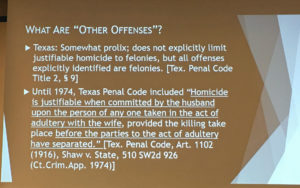
Planning “using a cheap Rossi .38” as the primary defense gun, out of concern that using “the nice Kimber” would result in it being tied up as evidence.
Again this statement implies that the person is unconcerned about proficiency (or capacity) having any effect on the outcome, buying into the “any gun will do” mindset. In running my “small gun” classes over the past 5 years, where students have to shoot their preferred gun and their pocket gun on the same drill, the widest performance gap occurs between those that have a tuned up 1911 as their primary, and a .38 S&W revolver as their pocket gun. The Rossi, likely to have an even longer, grittier trigger than any S&W, is likely to underperform even more in the hands of a shooter used to the very short, crisp trigger of a 1911. My guess is that the presenter has never compared his own shooting skill on the same drill with the two guns. Dunning-Kruger is a powerful drug and convinces many that they will shoot “good enough” should the need arise. Reality is that for most that believe that comforting affirmation, skill, when tested, turns out to be far below realistic standards for speed and accuracy.
Immigration Issues in Gun Laws
This talk focused on issues related to legal immigrants and gaps between state and Federal laws. While it’s possible for foreign nationals on the right type of visa to own guns and even qualify for a Texas carry permit, those in that situation should absolutely locate a lawyer very fluent in this topic to ensure all is in order before proceeding. As with every other aspect of advice, polling random strangers and choosing the most frequently posted answer is not a good way to get the best qualified answer.
Gun Trusts & Estates with Firearms
Takeaways from this session? If you have NFA items, and you want to allow family members access to those items when you are not present, the item needs to be on a gun trust, and they need to be on the trust – even spouses. Make sure your wishes for what is to be done with your guns is clearly stated in your will (which family member gets what). Failure to plan for this – particularly if you have no direct family that would want to inherit the guns) – can be a big headache for those dealing with your affairs after you are gone.
Federal Case Law Update
David Kopel and Joseph Greenlee presented a summary of recent firearms cases in the 9th, 2nd, 5th, 6th, 8th, 10th and 11th circuit courts in the past year. Unfortunately, most of these cases resolved on the anti-gun side.
9th circuit:
California cannot confiscate “high capacity” magazines
Handgun ban in Mariana islands cannot stand
County ban on gun stores upheld
No right to concealed carry
Open carry is individual right not limited to security officers
Stricter rules on police use of force did not violate officers 2nd amendment rights
2nd circuit
NYC may prohibit licensed handgun owners from taking handguns out of the city
Dishonorable discharge status can make someone prohibited to own firearm
5th circuit
FFL cannot sell handguns to citizens of adjoining states
“Fiasco for NFA plaintiff with unrealistic claims”
6th circuit
Burden of proof for self defense may be placed on defendant
Gun ban for domestic violence misdemeanor upheld
No right to sell guns to felons
Others
8th circuit – suppressors and short barreled rights are not indisputably part of 2nd amendment right
10th circuit – qualified immunity for police in arrest for open carry
11th circuit – do not engage in business of selling firearms without a license, including online
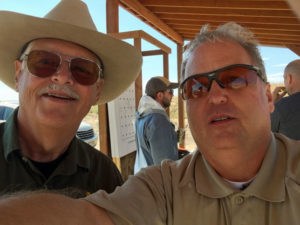
That meeting led to my traveling to the Great Guns range, near Fort Collins, CO on Saturday, Sept 8 to record a Shooting Gallery episode that will air in early 2019. Here’s a short clip, of my “handgun technique history in 30 seconds or less” demo.
Working on a cool SHOTING GALLERY…Karl Rehn’s ”History of Combat Shooting.”Pretty neat stuff!
Posted by Michael Bane on Sunday, September 9, 2018
Michael talks about the episode taping as part of this episode of his Down Range TV podcast.
As part of the episode taping, I had to shoot a bunch of the historical drills using period appropriate guns and holsters, like the FBI 1980’s qual (shooting Weaver with a DA/SA gun), and the current Marine military police qual using an M9 from a drop leg retention holster.
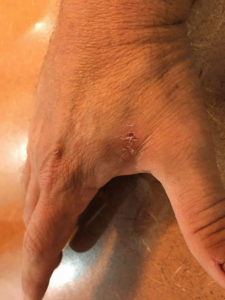
As usual, the tang on the grip safety dug a nice divot out of my hand, after shooting 15 rounds out of it. This is why when shooters began doing a lot more live fire practice, gripping the gun higher and harder, that different (wider and smoother) beavertail grip safeties were created.
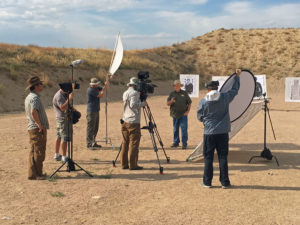
Some photos of the crew in action.
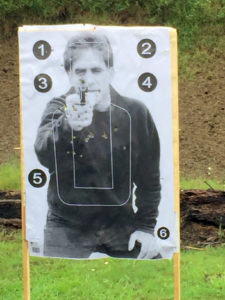
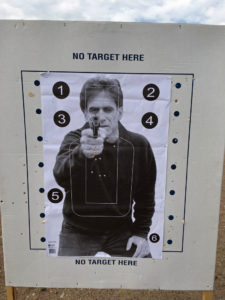
And some pics of some of the different targets we used during the shoot.
And the Marine military police target after I shot part of that test.
The one target I didn’t get a picture of was the 1940’s FBI target. My first take on the hip shooting at 7 yards drill (5 shots in 5 seconds or less) put 5 rounds in a nice 8″ group high center chest – exactly where you would want them. At the end of the day they filmed me re-running that drill using a high speed camera. Hopefully that clip will make into the broadcast episode.
FINISHING THE BOOK
With an expected broadcast date in early 2019, I have even more motivation to get back to work on the book, and get it completed in time for Christmas 2018, or SHOT show 2019. After I get back from teaching the Historical Handgun class in Culpepper, VA in late October, KR Training will take our usual deer season/holiday season break, giving me time to sit down and write.
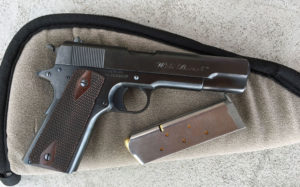
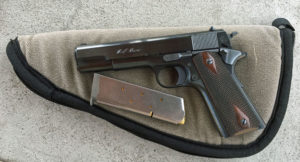
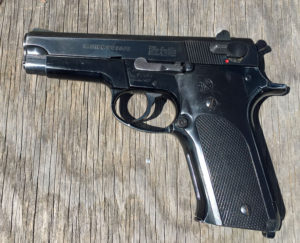
As part of the KR TrainingHistorical Handgun project that teaches the history & evolution of defensive handgun skills, I’ve been purchasing specific guns and holsters associated with specific times in handgun history. The guns will be used in demoing the drills shot in the Historical Handgun course.
I purchased a used 459 that had probably been a cop’s gun. Lots of holster wear. One magazine had lots of rust on the inside, with a rusted spring, likely from riding in a holster in the Texas heat.
The double action trigger pull was well over the 8 lb max on my cheap trigger pull gauge. The single action trigger pull was just under 7 pounds. The sights on the pistol were small. Solid black rear with a serrated, ramped blade that was very difficult to see compared to a squared front post. I painted the front post with some orange fingernail polish before I used the gun to shoot the 1980’s FBI qual for the first time.
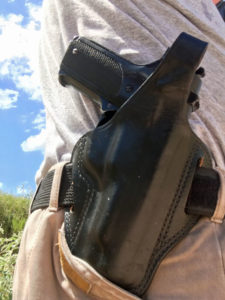
Mireles said the standard holster used by the agents of that time was a DeSantis leather belt holster. I found a ‘vintage’ used Bianchi holster from that period that was very similar in design to use with the gun.
It had a leather snap thumb break – a feature I’m not used to working with.
Shooting the FBI qual
The old FBI quals (from the 1940’s to the 1980’s) all required starting at one distance and running to the next before drawing and firing. When I’ve shot the qual course in classes, that part is usually omitted — but the time to move from one spot to the next is a task that’s included in the par time for that string. So those that have shot the drill without the movement, but with par times unmodified, got additional time the agents did not have. Since I was on the range by myself, I included the movement when I (literally) ran the course of fire, in the 100+ afternoon August heat.
“Old” FBI Pistol Qualification Course (1980’s)
Target: FBI “Q”
Scoring: Hits in or touching “bottle” count 2 points; misses and hits outside bottle count zero points. 50 rounds service ammunition.
Qualification: 85% to qualify; 90% (45 hits) for instructors
STAGE I
18 ROUNDS
Starting Point: 25 yard line
Time Allotted: 75 seconds
Procedure: Start with a fully loaded weapon. On command, shooter draws and fires 6 rounds prone position, decocks, fires 3 rounds strong side kneeling barricade position, 6 rounds strong side standing barricade position, and 3 rounds weak side kneeling barricade position. Upon completing stage I, the shooter will conduct a magazine exchange and holster a loaded weapon.
STAGE II
10 ROUNDS
Starting Point: 25 yard line, on signal run forward to the 15 yard line.
Time Allotted: 2 rounds in 6 seconds, come down to Ready
4 strings of 2 rounds in 3 seconds each, from the Ready, Then
Procedure: Start at the 25 yard line. On command, the shooter moves to the 15 yard line, draws and fires 2 rounds in 6 seconds, decocks, and returns to low ready. The shooter will fire 4 strings of 2 rounds in 3 seconds, decock and return to low ready after each string. Upon completing Stage II, the shooter holsters a loaded weapon [without reloading unless gun capacity is only 10 rds ]
STAGE III
12 ROUNDS
Starting Point: 15 yard line
Time Allotted: 15 seconds
Procedure: Start at the 15 yard line. On command, the shooter moves to the 7 yard line, draws and fires 12 rounds in 15 seconds, to include a reload. Upon completing stage III, the shooter holsters a loaded weapon. Shooter then arranges remaining 10 rounds to have 5 rounds in the weapon and 5 rounds in a spare magazine.
STAGE IV
10 ROUNDS
Starting Point: 7 yard line
Time Allotted: 15 seconds
Procedure: Start at the 7 yard line. On command the shooter moves to the 5 yard line, draws and fires 5 rounds with strong hand only, reloads, transfers the weapon to weak hand and fires 5 rounds weak hand only. Upon completing stage IV, the shooter will unload and holster an empty weapon.
Since I was running the drill by myself, and it involved a lot of movement, I did not take video of the test. Apparently no one else ever has either, since I could not find a youTube video of anyone shooting the old test, with movement, to include here.
Results
Other than checking the zero on the pistol at 25 yards, and a few minutes of dry practice on both DA and SA trigger pulls, I didn’t do a lot of warm up or practice before I shot the drill with the 459. It was also the first time I had shot the FBI drill with the included movement. I passed the drill with 45 hits (90%) at instructor level.
After I shot the drill I did more experimenting with painting the front sight, and ended up changing the orange color with some gold model paint that made the front sight easier to see than the orange did. Running a gold or brass front sight is something recommended in many older books on shooting.
I also realized, after I finished the drill, that I should have been using the Weaver stance as agents were trained to do during that time. When I get around to doing a video of this drill shot with the movement I’ll run the gun with the gold front sight and shoot using the Weaver stance. I also ordered a kit of Wolff springs to replace all the internal springs in the gun and the springs in both magazines, which all likely need replacing. Wolff does offer a reduced power hammer spring that will likely reduce the trigger pull a pound or two. The old gun ran reliably even with the rusted mag spring.
The elements of the test that have faded away in more modern qualification courses of fire – running to position and more shooting at longer distances (25, and even 15 yards is now considered “long” by some), plus the longer heavier trigger pulls on the DA/SA gun made the test more difficult than shooting the current FBI qual with a striker fired gun. Many that advocate for DA/SA guns in the current era are running guns with 6-8 lb DA and 2-4 lb SA pulls, which are considerably easier to shoot than the 10-12 lb DA and 6-8 lb SA factory trigger pulls. I’m going to leave this gun as close to factory as I can stand, so that students (and NRA instructor candidates) can gain experience running a duty-grade trigger.
If you aren’t already a subscriber to receive this newsletter each month, you can subscribe here or follow this blog. You can also follow KR Training on Facebook or Twitter for more frequent posts and information.
*Must pay in advance, in full to receive discounted prices for combo registrations.
COMBATIVE PISTOL 2 (DYNAMIC PISTOL MARKSMANSHIP) – TOM GIVENS OCT 6-7
Tom Givens has trained over 48,000 students over the past 40 years. 64 of them have been successful in armed incidents, with a hit ratio of over 90% (about triple the typical law enforcement officer hit rate). Tom is returning to KR Training in early October to offer his level 2 Dynamic Pistol Marksmanship course. If you’ve taken DPS-2 or a higher level course with us, you are ready for Tom’s level 2 class. This class is also an excellent defensive pistol course for experienced IDPA / USPSA competitors that have never taken a class focusing on defensive pistol skills. It’s not a “how to draw” course. It’s a “how to win a gunfight” class.
HALF PRICE REFRESHER SLOTS
You can come back for any class you’ve taken before, for half price. Repeating a course is a great way to maintain skills for low cost, particularly if you haven’t practiced the skills you learned in our classes due to time, cost, or range limitations. Retake the class with a different gun, or go as moral support for that friend or family member you finally talked into attending.
“LEARN TO TESTIFY” SEMINARS FROM GUN OWNERS OF AMERICA
If you missed the CoolFire/Walther event we ran earlier in August, read the AAR here. The Coolfire kit is a great way to fully simulate live fire at home, using your gun with full recoil simulation and a cycling slide. No more racking the slide to fire multiple dry fire shots! For the month of August 2018, you can save $20 off the purchase of a CoolFire Kit by using the code KR20 at checkout.
Jason Wilson, who has been a regular at the A-zone summer matches the past few years, earned the rank of Grand Master in the Revolver division of the US Practical Shooting Association in August. Many of the scores he shot at the A-Zone matches contributed to that achievement.
KR Training shooting team captain Roy Stedman won Gold in the Senior Classic division, Silver in Classic Overall and Bronze in the shoot offs at the IPSC Pan American Handgun Championship held in Jamaica in August.
The KR Training schedule shows most of the classes we plan to offer through late October 2018 and even a few already scheduled for 2019. Registration is open for everything listed.
Thank you for sending your friends and family to train with us. Your referrals keep our classes full and help us continue to offer in-demand classes that specifically address the needs of responsible armed citizens. Remember, now you can train with even more purpose through the KR Training Defensive Pistol Skills Program. Start working to earn your coin now.
We look forward to training you!
Karl, Penny and the KR Training team
The event held August 4th, from 9-12, was a beta test for a possible new research study, evaluating the relative benefit of the Cool Fire product vs. live fire for shooter development.
All attendees will shot a live fire pre-test, and were then divided into two groups. One group did additional training using the CoolFire product. The other did additional live fire training on the range. At the end of the training block, all attendees re-shot the live fire test. The data was recorded and scores compared to pre-test scores.
About the Coolfire product
Some video of the mixed CoolFire/live fire training part of the event.
Karl Rehn, Dr. David Paulus, and Albert Dvorak (CoolFire inventor) at the A-Zone.
DISCOUNT CODE!
For the month of August 2018, you can save $20 off the purchase of a CoolFire Kit by using the code KR20 at checkout.
TESTING
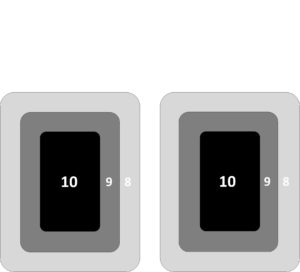
Testing evaluated split times on two different targets (small and large bullseyes), and transitions (side by side rectangular targets). Each was printed on 11×17 paper.
The tests were all shot live fire, starting at a low ready position.
1) Small circle, 5 shots in 4 seconds.
2) Large circle, 5 shots in 4 seconds.
3) Transitions, 1 shot each L-R-L-R-L in 4 seconds
4) Transitions, 1 shot each R-L-R-L-R in 4 seconds.
Total of 20 rounds, 50 points possible on each of the 4 targets.
Targets were scored, and all tests repeated using a 3 second par time for each test.
Par times were set so that shooting a perfect score would be difficult for most shooters at the 4 sec par, and very difficult for most with a 3 sec par. This gave us some room for shooters to improve as a function of training (live or CoolFire) before being re-tested.
All participants used Walther PPQ M2 9mm pistols, loaned to use by Walther for this event. The guns performed well, with no problems. Participants completed a survey form at the end of the event giving us their feedback on both products.
RESULTS
Full results will be published in a paper we’ll submit to a refereed journal.
Initial results indicated that those using the CoolFire product for the training block improved slightly more than those shooting live fire, running the same number and sequence of drills. Our sample set was small (11 in each group) and the training block was only 1 hour — but the general trend is clearly that CoolFire practice offers at least equivalent gains to live fire.
THOUGHTS
I’ve had a unit for several months. I use it in classes all the time as a way to introduce beginners to recoil before they fire live ammo. The laser works with all the different laser-based dry fire products on the market, for those that want that functionality. I put the kit in my backup M&P (I have a clone of my carry gun as a backup) and the kit basically stays in that gun as a classroom and personal training tool. Not everyone has that convenience.
Having an exact duplicate of your primary carry and/or competition gun is very useful, particularly if you shoot major matches or attend multi-day courses. That’s much more convenient than unloading the carry gun, swapping slide and barrel, training, and reassembling & reloading the carry gun.
It simulates the full firing experience better than any other training tool, using your own gun, your trigger, your sights. You can practice reloads and draws with it. (Some holsters may not accommodate the laser that attaches to the barrel.) C02 fill gives you roughly the same number of shots that a full magazine does, and you can get thousands of shots from a 20 oz CO2 tank. Academy Sports will refill C02 tanks for $3.49, and they sell the tanks.
The biggest benefit of the CoolFire kit is recoil simulation. All other dryfire options have no simulated recoil. Reaction to recoil (pre ignition gun movement and followthrough after the shot to see the sights again) is the biggest problem for most shooters. I’ve coached many shooters that can dry fire perfectly but will still flinch and blink shooting live ammo, or fail to followthrough. This provides a way to get used to the gun jumping in your hand without the time and expense of driving to the range.
I occasionally do everything-but-live-fire private classes in students’ homes, either as prep time before a live fire session or for people that don’t yet own their own firearms but want to learn about them. For this application, the CoolFire kit is very useful. The NRA now has a no-live-fire lesson plan instructors can use for this type of training.
A few years ago when I finally made the improvement from Master to Grand Master level in USPSA, one of the key things I changed was cutting down on live fire sessions and replacing them with dry fire sessions. I own my own private range with target stands, steel, props, etc, but it’s 60 minutes from my primary residence – and time is a cost of its own.
COST ANALYSIS
CoolFire kit (with KR20 discount) is under $400.
Tippman 20 oz tank is around $25.
One 20 oz tank fill is $3.50 (round up to $5 to include gas to drive to Academy). A set of dryfire targets from the Ben Stoeger Pro Shop is $10.
So the minimum cost is $440. You’ll get at least 2000 shots for that investment.
9mm ammo can be found for around $0.20 a round. So 2000 rounds of live ammo is $400.
The other $40 can easily be spent on targets, pasters, range fees and gas getting to/from the range.
What about cost for the second 2000 rounds?
Cost to do that training with CoolFire is….$5 to refill the tank.
Cost to do another 2000 rounds of live fire training is another $440.
Those serious about achieving high levels of skill, such as IDPA Master, USPSA Master or USPSA Grand Master are likely to fire far more than 2000 rounds annually, making the cost savings significantly larger.
TIME ANALYSIS
To do live fire practice you have to purchase ammo, load gear in the car, drive to the range, set up targets, shoot the drills, reload magazines, tape targets, shoot more drills, pick up brass, tear down targets, drive home and clean guns.
To do CoolFire practice, you stick some dry fire targets up someplace you have a safe direction (much lower risk of firing a live round unintentionally with the kit, since it’s mechanically impossible to fire live ammo with the kit installed), shoot the drills, refill the barrel w/ C02, shoot more drills, repeat, until your hands are tired or you are bored and want to stop.
In my case, not driving to/from my range, doing dry fire (or now CoolFire) freed up 2 hours just from the commute, plus an extra hour per session from all the other tasks.
“But I need holes in targets to know how I’m shooting!” is a common complaint. It indicates a lack of understanding of the process involved in good shooting. If you aren’t ‘calling’ your shots (predicting where the shots will hit based on the sight picture you saw when the front sight lifted), you’ll never get really good with a pistol. With the recoil simulation of the CoolFire, you can develop the skill to pay attention to your sights, at the moment the sights move, without live ammo. And if you need the additional downrange confirmation, put the (supplied) laser on the kit, and either look for the dot using a target focus (not recommended, as this creates a training scar that teaches you NOT to focus on the sights) or invest in one of the many phone apps,standalone laser targets, or LASR software, to get that confirmation.
One big reason people don’t practice more is lack of time; another is cost. The main reason people don’t dry fire is that they find it boring because of the lack of recoil and noise compared to live fire. The CoolFire kit is one solution that addresses all those issues.
SCENARIO BASED TRAINING USE
A commonly misunderstood concept is that you have to have projectiles flying in order for live action scenario based training to be valuable. Investing in Airsoft guns, Simunition kits and safety gear is expensive (one reason why many live fire instructors do not offer force on force training), and projectile impacts damage structures. Wearing full face gear makes it impossible for roleplayers & students to read the non-verbal cues that come from facial expressions, and decreases the realism of the scenario simulation. Non firing “red guns”, SIRT pistols, or other simulators can be used, but the CoolFire, used for this application, provides a very realistic simulation, with recoil, limited magazine capacity, and some noise. If the scenarios are recorded, or simply if the exercise coordinator is paying attention, and the laser is used on the CoolFire kit, the student’s marksmanship on the “threat” roleplayer(s) can be assessed. Even without hit assessment, the kit provides a way to run full context scenarios, with recoil and noise, in any facility, classroom or home — dramatically decreasing the investment required for instructors or serious shooters to expand their training.
SUMMARY
CoolFire is a great training tool, particularly for instructors and those that plan on shooting more than 2000 rounds a year working to improve their shooting skills. And it’s a great tool for those that don’t currently shoot 2000 rounds a year who are limited by time and cost. It’s a way to do that training for equal (or less) cost in much less time – a longterm investment that will yield more skill and cost benefits the more you use it.
The Massad Ayoob Group’s MAG-180 was held Sunday June 24 through Saturday June 30, 2018, in Ripon, Wisconsin. MAG senior staff instructor, David Maglio, hosted the event.
This was the first time the MAG-180 (formerly known as LFI-4) had been held in eleven years. The MAG-180/LFI-4 is Massad Ayoob’s most advanced class. Approximately a year and a half of planning went into making this class happen, as we trained at four different locations. The prerequisite for the MAG-180 was the MAG-40/LFI-1, MAG-80/LFI-2, and MAG-120/LFI-3.
At the MAG-40, you learn the rules of engagement as an armed citizen and how to shoot Mas’s StressFire technique. In the MAG-80, you start learning how to shoot on the move, shoot at further distances and at faster speeds, and are introduced to handgun retention and disarming techniques. In the MAG-120, we learn to train the way Mas and his cadre of instructors train. In the 180, we perfect our instructing techniques for handgun retention/disarm and Persuader (Kubotan®) while shooting challenging handgun and rifle qualifications. Upon successful completion of the MAG-180, you are certified by Massad Ayoob to teach handgun retention/disarm and Persuader (Kubotan®).
There were 24 students in class, four of whom were women. Students from as far away as Utah, Texas, and Florida made the trek to Wisconsin for the 180. We were split into two teams, and Sonja McCarthy (Gail Pepin’s daughter) and I were the team captains (go girl power!). Your days were divided into five hours on the range and five hours of handgun retention/disarm techniques and Persuader (Kubotan®) instruction.
Day one started out at a slaughterhouse in rural Wisconsin. We were instructed to bring our carry guns and carry ammo with us as we would be shooting a pig in the head for a bullet analysis. I shot my Glock 43 (with Dawson Precision sights) with Federal Hydra-Shok 147gr. (regular velocity). Mas coached us individually on where to shoot the pig in the head, and lucky girl that I am, I got to shoot my pig first. One shot and the pig was down. The head was dissected from the body, and then the head was sawed in half, so we could see first-hand what our EDC ammo was capable of doing to a living creature. Gail Pepin was there to photograph the wound cavities, and she spent the week putting together a great PowerPoint of all of the wound cavities from the heads of the pigs shot by the students.
As there were two teams for the 180, half of the day was spent qualifying at the range and half of the day was spent refining your techniques in handgun retention/disarming and Persuader (Kubotan®). David Maglio and his staff of MAG instructors ran the range, and Steve Denney, Ken Kelly, and Massad Ayoob worked with the students on the hand-to-hand combatives.
Every day at the range started with shooting a cold single-speed MAG qualification for score. On our first day at the range, we shot the MAG qualification at quadruple speed. That means you take the times for the single-speed qualification and divide them by 4. The quad speed qual was shot one student at a time, and you either made the par time or you didn’t. The beauty of Mas’s qualification is that it is rather easy to shoot at single speed, but when you start shooting his qualifications at triple and quadruple speed, the level of difficulty increases exponentially.
We shot umpteen MAG qualifications at single, double, triple, and quadruple speeds – all for score. We shot different law enforcement handgun qualifications including the Wisconsin DOJ, the New Jersey State Police qualification, the DHS/ICE qualification, and the FBI handgun qualification. What was interesting about the Wisconsin DOJ handgun qualification was that you had malfunctions that had to be cleared while on the clock (for example, setting up a double feed), clearing it, and then shooting the designated string of fire. There were also two rifle qualifications and one shotgun (optional) qualification thrown in the mix.
(Here’s a video from a different MAG class showing the pistol qualification run at double speed. Cut the times in half for the quad speed version and the test requires IDPA Expert/USPSA A class or higher skill level to clean.)
All of Mas’s handgun retention and disarming techniques are designed to pass the Bambi versus Godzilla test, meaning a little, petite lady could use these techniques on Mongo and be successful. The techniques are all leveraged based. Since you don’t get to pick who the bad guy/gal is going to be in real life, Mas has you grapple with everyone on your team. I came back to Texas bruised up and sore (I have the photos to prove it). Steve Denney is as patient as they come when it comes to instructing the handgun retention and disarm techniques, and I wish he and I lived closer so I could practice this with him.
Ken Kelly was our main instructor for the Persuader (Kubotan®) training. Sometime between when I took the MAG-120 in December of 2017 and the MAG-180 in June of 2018, Ken had an idea to make “training” Kubotans. These proved to be great training tools, as they allowed us to work through our number 2 wrist locks/thumb locks/snaps/jabs without having the living daylights beat out of us since we still had to finish qualifying on the range.
One of the criteria to pass the MAG-180 was that you had to teach a handgun retention/disarming technique. The students got to pick the technique they wanted to teach, and you were paired up with another person who had also signed up to teach that technique. The technique I chose was the elbow roll-off. The other student who had chosen the elbow roll-off technique to teach was approximately a foot taller than I with at least a foot more of arm length than I. Mas has pictures of me executing this technique on my partner and taking him down. The techniques work when executed correctly.
On Friday evening, we instructed a group of civilians from the local area in Persuader techniques, and I got to meet two of my Facebook friends (shout out to Alex Kogan and Joshua Glazov).
Our high overall shooter (top gun) was a gentleman who had come up from Naples, Florida. I was the high overall woman shooter.
I learned a lot in this class and made many new friends. I only wish Mas had a fifth level class, so I could have a reason to go train with him some more.
This is the third in a series of 3 after-action reports covering the things I saw and did at the conference. Day 1 AAR is here. Day 2 AAR is here.
DAY 3 MORNING
I attended the 4 hour lecture part of John Murphy’s “CCW Skills Beyond the Gun” session. KR Training will be hosting John for two 1-day courses in February 2019. John is a very entertaining, engaging presenter and his class was full of excellent content.
DAY 3 AFTERNOON
I was in the top 16 shootoff, doing well in the first few bouts, but finally getting bumped out (ending up 4th overall) by Chris Harold (3rd), Will Parker (2nd) and Gabe White (1st). John Holschen’s wife Martha won the ladies shootoff (and the ladies’ match). Three of the top 4 shooters in the shootoff (me, Chris and Gabe) were in my Historical Handgun live fire class on Day 2.
It was held on one of the FAS bays that had a Bianchi plate rack and a variety of steel – most of which was used for the shootoff.
The remainder of the final afternoon was spent in a medical class with Dr. Sherman House. I had taken a 2 day medical class from Sherman and Paul Gomez many years ago, and it was great to get more training from Dr. House at the conference. This class included discussion of how to use available items (neck tie and a pen, for example) to render aid when purpose-built medical supplies were not available (tourniquet, pressure dressing).
SUMMARY
About 1/3 the size of the main Tactical Conference held earlier this year, (limited due to capacity of the FAS facility and a smaller number of trainers presenting) the NW Regional event ran very smoothly, with perfect weather and great support from host Marty Hayes and his entire Firearms Academy of Seattle team. Everyone I talked to was excited and interested in the rumor that there might be another NW Regional event in 2020. I took several additional days before and after the conference to enjoy the Pacific Northwest area and escape the Texas summer heat.
This is the second in a series of 3 after-action reports covering the things I saw and did at the conference. Day 1 AAR is here.
DAY 2 MORNING
My shoot time for the competition part of the event was 8 a.m. on day 2. I’m not a morning person, but I did manage to shoot the 40 round course of fire with no penalties or “points down” with a respectable total time – good enough to make the top 16 shootoff the next day.
I audited a part of a pistol class Tom Givens was teaching, waiting for the 10 am session to begin.
The second half of the morning (10-12) was spent taking a low light shooting class from John Holschen. I took a lot of classes from InSights Training in the 1990’s when my day job took me to the Seattle area on a regular basis, and hosted John many times at KR Training in the late 90’s and early 2000’s. The Firearms Academy of Seattle facility has a terrific “dark house” that allows low light training to be conducted in daylight hours, with controlled lighting.
The live fire session was run on a narrow, but long range that gave us the 60 yard distance required for some of the older qualification courses, and barrels we could use as barricades needed for some of the drills. As a result, attendance was limited to a small number of diehard attendees who had brought multiple guns and lots of ammo to run the 400 rounds of drills in the class.
DAY 2 EVENING
Day 2 ended with the traditional TacCon “Trainer’s Meeting” – an event where the presenters and staff have a roundtable discussion about a topic related to trainers and training. This year’s topic was instructor credentials and national organizations.
After teaching half of each of the first 2 days, I was ready for Day 3, when I could just be a student for most of the day, except for the top 16 shootoff coming up day 3 afternoon.
If you aren’t already a subscriber to receive this newsletter each month, you can subscribe here or follow this blog. You can also follow KR Training on Facebook or Twitter for more frequent posts and information.
The event, to be held August 4th from 9-12 at the A-Zone Range, will be a beta test for a possible new research study, evaluating the relative benefit of the CoolFire product vs. live fire for shooter development. All guns and ammo will be provided. Event is open to up to 24 participants. Event cost is $20. Pre-registration and payment in full in advance is required.
KR Training shooting team captain Roy Stedman was 2nd overall in Classic, first Senior, 3rd in the shootoffs and part of the Team USA Classic division win at the 2018 Pan American IPSC Championship held in Jamaica.
As a result of classifier scores submitted from the summer A-Zone matches, Karl Rehn promoted to Grand Master in the Pistol Caliber Carbine Division of USPSA, giving him Grand Master ratings in 5 of USPSA’s 8 divisions.
The KR Training schedule shows most of the classes we plan to offer through late October 2018 and even a few already scheduled for 2019. Registration is open for everything listed.
Thank you for sending your friends and family to train with us. Your referrals keep our classes full and help us continue to offer in-demand classes that specifically address the needs of responsible armed citizens. Remember, now you can train with even more purpose through the KR Training Defensive Pistol Skills Program. Start working to earn your coin now.
We look forward to training you!
Karl, Penny and the KR Training team
This is the first in a series of 3 after-action reports covering the things I saw and did at the conference.
DAY 1 MORNING
Friday morning was spent teaching the 4 hour lecture portion of the Historical Handgun class.
This version of the course included a lot of video, including excerpts from these historical films.
https://youtu.be/3qOaXl-AuDg
DAY 1 AFTERNOON
On the afternoon of day 1 I took a 4 hour handgun skills course from Gabe White. The class was very good, including some unique drills that incorporated several ideas that had been presented in previous TacCon sessions by other trainers: using an ammo tray to simulate a cell phone or other item held in the hands prior to drawing, and using a whistle blown after the ‘gun’ command was given to indicate that the situation had changed (threat no longer immediate) and the draw and fire response should end at the ready position without shots fired.
Day 1 wrapped up with an early birthday party for Tom Givens hosted by Marty and Gila Hayes at their newly completed house on the FAS property. Tom’s birthday was coming up shortly after TacCon, and Lynn (and others) decided it would be fun to celebrate his birthday with all the trainers and staff that were involved with putting on the event.
In early July I offered a summer session of the Beyond the Basics: Pistol class that sold out so quickly that I added a second session, scheduled for Sunday July 22. 11 students undeterred by heat advisories and predictions of triple digit temperatures attended the course.
A lot of curriculum was (and still is) tied closely to the contents of Brian Enos’ excellent Practical Shooting Beyond Fundamentals book. In that book he breaks handgun shooting down into 5 types, based on the target size and distance. The vast majority of handgun shooters fire every shot as a Type 3 (traditional sight picture with moderate speed trigger manipulation) – which produces decent results on targets 0-10 yards (most of the time) but begins to fall apart at longer distances. Most defensive pistol classes spend a majority of time on improving speed at the most common defensive distances (3-5 yards), which is roughly what Brian calls Type 2 shooting – using a rough sight picture with visual focus on the target. Often this is taught simply by requiring the students to shoot faster, which usually produces the desired result as they have to accept less precise sight pictures to make the par times for drills.
The skill that usually falls through the cracks is development of the ability to shoot slower than Type 3: to spend a little more time getting sight alignment more precise, and most importantly manipulate the trigger with more care when a precision shot, for example a head shot at 10 yards, is the goal.
SMOOTH, SLOW and FAST
The phrase “slow is smooth, smooth is fast” is frequently quoted in online discussions about improving handgun skill. It’s wrong. Bad technique executed slowly may not be smooth and it may not produce good results. On a close target, bad technique executed quickly may produce acceptable results. And those expecting to become faster through deliberate, slow, smooth practice may never get faster.
It’s like driving. To learn to drive well at 70 mph, start by learning to drive at slower speeds until your technique is good. Then to learn to handle the car at faster speeds requires actually going faster. Similarly, to learn how to handle the car in rough terrain requires different techniques and slower speeds.
The process to improve is:
1) Understand that targets at different distances and of different sizes require varying degrees of sight alignment and trigger manipulation. Breaking the concept down into different ‘gears’, with specific par time/accuracy goals related to target size/distance seems to help.
2) Practice each type of shooting to meet the speed and accuracy goals.
3) Be able to quickly shift between shooting types, adjusting speed and accuracy as needed to get the required hits.
The majority of the students registered for the course had taken one or more classes from me in the past, and I took advantage of that situation to modify the course curriculum to (a) present some of the concepts in the course differently than I have in the past and (b) split the lecture into two parts, one at the start of class and one mid-class, both to get us all out of the heat and back in the A/C for a break, and to improve the presentation of topics.
What changed?
In the old format, I went through all the fundamentals of marksmanship (gun fit, grip, stance, sight alignment, sight picture, trigger control, follow through) in depth in a single lecture, followed by drills on the range. This time I broke the class into two parts: one focused on isolating each type of shooting as a separate skill, and one where the skills were combined.
The first part of class incorporated segments of the “Super Test” drill, that’s shot on an NRA B-8, with varying time limits for 5, 10 and 15 yards. This particular drill is excellent for defining the relative speeds associated with different target sizes and distances. In the past I had my own drills for this concept, but using the more-widely used Super Test worked very well.
The second part of the class focused on a drill Ben Stoeger calls “Distance Changeup”, where multiple targets at varying ranges have to be engaged, adjusting speed and accuracy as needed.
My class version of it used two targets, as I called a variety of options for each repetition of the drill (using the head and body of each target to give 4 different target sizes/distances).
SUMMARY
A lot of the older lecture material in the course on fundamentals has trickled down into my Basic Pistol 1, Handgun Coaching, and Basic Pistol 2 classes, making it possible to trim some of that content from Beyond the Basics, using that time for more work on higher level concepts. Students attending future sessions of this course will get the updated version of the curriculum, as it seemed to work well in the new format.
I recently purchased an S&W SD9VE to test and evaluate. I’ve gotten questions from students about this gun model, and other shooters and trainers have mentioned it as a decent option for defensive handgun buyers on a limited budget.
Some early observations:
1) It fits in my daily carry holster (Raven “Morrigan“) made for an S&W M&P. I read online that it wouldn’t fit M&P holsters, but the Morrigan has enough flexibility in its design that I’ve been able to use it for my M&P 1.0, a Glock 19, and an M&P Shield without problems.
2) The trigger pull is long and heavy. Not as long as heavy as a double action revolver, but longer and heavier than the factory trigger on the Glock and M&P models. My trigger pull gauge only goes up to 8 pounds, and the SD9VE trigger was heavier than that. Apex makes two parts to upgrade the SD9VE, a spring kit and a flat trigger. I ordered both from Brownells and will write about the install and testing of those parts in the coming weeks.
3) Heavy triggers are harder to shoot. I lubricated the gun, dry fired for about 10 minutes and then headed outside to run the 3 Seconds or Less test with the gun. I ran the test from open carry.
I didn’t check the zero of the pistol with the test ammo (124 gr Armscorp JRN) before I ran the test.
I did black out the rear dots on the sights because I strongly dislike “3 dot” sights.
With most guns I can shoot a perfect score (20 hits in the grey part of the target) on the test, using the 3 second par time. Not so with the SD9VE. From 7 yards, the “2 head shots starting from ready” went wrong. I finished that string in 1.98 seconds (of the available 3 seconds), dropping one shot completely out of the head, low left almost into the body, with the other shot low left into the ‘jaw’ area of the head.
On the one handed strings from 7 yards, I dropped 3 of the 4 rounds below the KRT-2 target, for a score of 16/20 with 3 in the head – good enough to pass at the standards required by our 1st level Defensive Pistol Skills 1 class, but not particularly good overall. More than likely a less skilled shooter would have found it difficult to shoot.
4) Seeing so many shots trending left on the target caused me to take a closer look at the sights. I shot a 5 shot group on the “B” circle on the target, at 7 yards. That produced a nice group left of the point of aim.
I took a closer look at the slide, and noticed that the front sight was off to the right of center line.
5) The other problem I observed is that the gun did not lock back on the last round of any of the 3 magazines that I used during my testing. This may not be a gun problem. If you look at the pistol you’ll see that the slide lock lever is located in a place where a shooter with a high thumbs grip might end up riding the lever, preventing it from moving upward and locking the slide on the last round. I had this problem with the Springfield XD, and it was one of several reasons I stopped shooting and recommending the XD series of pistols to students.
Next time I work with the SD9VE, I will adjust the sights to get the gun zeroed, re-run the 3 Seconds or Less test and a few other baseline tests with it, assess the slide lock issue, install the Apex parts, and re-shoot the baseline drills after I install the Apex parts.