I have a large stack of books that have been read but not reviewed on the blog. One book, “The Fastest Guns Alive: the history of Fast Draw”, by Bob Arganbright, proved to be unobtainable in the used book market. It was a small volume that wasn’t widely distributed. I was able to finally get a look at a copy because the Library of Congress had one. Penny has been working in DC this year, and during a recent visit there I was able to get a Library of Congress reader’s card. I requested that book from the archives, and after a few hours’ wait (the LOC building is a great museum with guided tours with permanent and temporary exhibits), I was able to read it and even scan some of the pages from it.
Even better, I was able to get in contact with Bob, who is writing for American Handgunner and still serving as the unofficial historian of that sport. Here’s an interview he did with Howard Darby that gives a quick overview of holster development. The most popular holsters used in USPSA competition in the 1980’s, before kydex holsters were introduced, were mostly from holster makers with a background in fast draw holsters.
More about the history of fast draw can be found here. In addition to holster design, the popularity of fast draw drove the development of electronic timers. Bob’s book included many references to other resources, such as magazine articles and books. One of those books, which I was able to find, was a 1969 volume titled “The Saga of the Colt Six Shooter” by George Virgines.
The book has several sections: Colt History, 1873-1940, covers the origin of the Colt Peacemaker, the different types, variations, cased, presentation and engraved models. The Historic Colts section is detailed information about distinguished guns and guns used by famous Western actors and actresses.
The final section, Postwar Developments, covers production of the sixgun from 1940-1965. Models, variations, copies, commemorative guns, and a final section on fast draw games and gun tricks. It’s really of greater interest to gun collectors, since most of the content is heavy on lists and dates and descriptions of specific guns. The section on fast draw is nowhere near as complete as Bob’s book. It was an interesting read, though, and will get added to my shooting bookshelf.
The 2019 Rangemaster Tactical Conference was held at the Nolatac Training Facility in New Orleans, March 15-17. I’ve been a part of this conference every year since the early 2000’s, presenting training at 17 of the past 21 events. This is part three of a series of posts summarizing the sessions I attended and observed, and my experiences shooting the match.
The final day started with the shootoff. Actually two shootoffs. In order to get the 22 people tied with the top 5 scores, there was a simple bullseye shootoff (two 5 round strings at 5 and 10 yards). Top 16 scores got in. A few of those that didn’t make the cut were previous match winners and people who had shot perfect scores in the main match. I made it into the top 16 shootoff, but ended up losing in the first tier to former student Hany Mahmoud, who went on to finish 3rd in the shootoff.
Great pic of my draw taken by Tamara KeelAnother Tamara pic from my first run of the shootoff.
Men’s Finals: Rick Remington (1st), Chris Cerino (2nd), Hany Mahmoud (3rd). Women’s Finals: Cindy Bowser (1st), Melody Lauer (2nd), Sara Ryan (3rd). High Lawman: Wayne Dobbs Perfect scores in the main match: Jason Ryan, John Johnston, Ryan McCann, Brian Hill.
This was the first year that shooters using red dot sights were top finishers in both the main match and shootoff. Were their scores significantly better than those running iron sights? The data doesn’t show it. A few of the RDS-using shooters that made the top 22 shootoff, including some with perfect scores in the main match, were among those that didn’t make the top 16.
The only definitive thing that can be said about the RDS aspect of this year’s match is that there were many more red dot sights being used, and just as with irons, in the hands of skilled shooters they can be used effectively and competitively.
After a nutritious lunch of chicken and waffle, I attended John Holschen’s “Surviving the Extreme Event” session. John is a longtime mentor of mine and he always has excellent material. He’s currently teaching for the Heiho Consulting Group and at West Coast Armory North in Everett, WA.
Chicken and Waffle.
One interesting point he raised is that most of the deadliest mass shootings in US history have occurred in the past 3 years.
list of deadliest mass shootings in US history
The final session of the conference was Tiffany Johnson and Aqil Qadir’s session on the Changing Face of the Industry. Hopefully they will present this session at the 2020 TacCon or find a way to get the information out to others. Their presentation received one of the few standing ovations I’ve ever seen at any TacCon. It addressed the changing demographics of the US generally, perceptions of the gun culture from those outside it, race and other diversity issues, and more. You can download their course notes at tiny.cc/save2a
Aqil and TiffanyDownload their lecture notes at tiny.cc/save2a
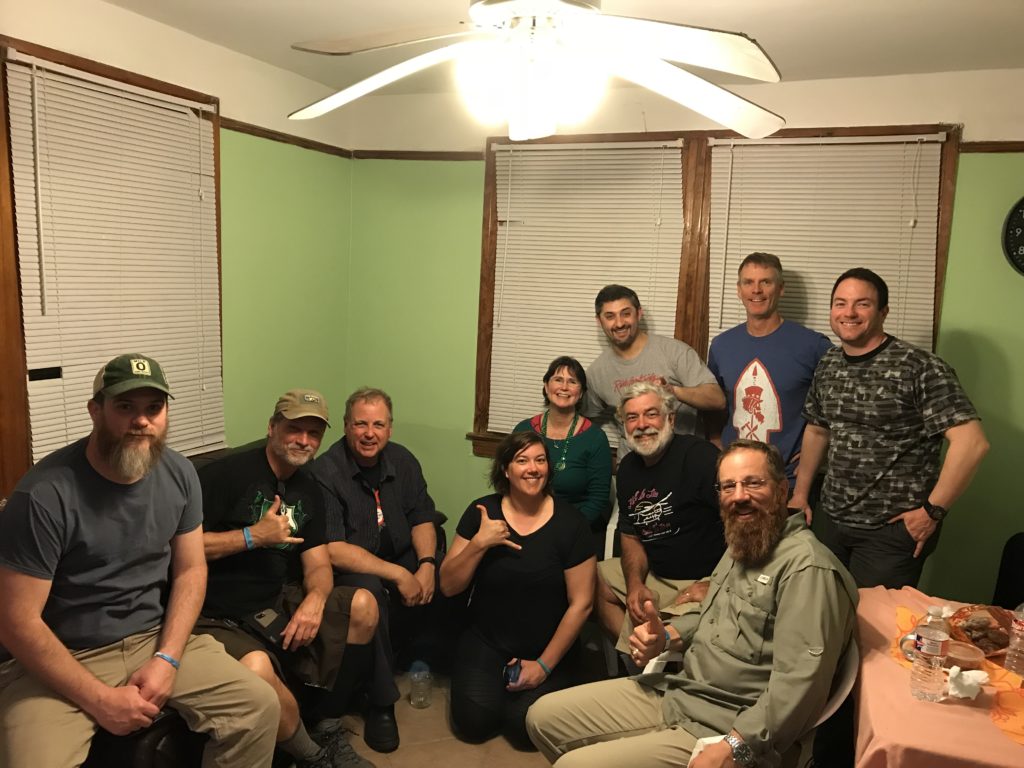
The event ended on St. Patrick’s Day, and I had a great time that evening hanging out with San Antonio-area TacCon folks at their AirBNB house.
The Rangemaster Tactical Conference is an amazing event, offering 3 days of training from dozens of instructors. If you haven’t been, you should make plans to attend in 2020.
The 2019 Rangemaster Tactical Conference was held at the Nolatac Training Facility in New Orleans, March 15-17. I’ve been a part of this conference every year since the early 2000’s, presenting training at 17 of the past 21 events. This is part three of a series of posts summarizing the sessions I attended and observed, and my experiences shooting the match.
The first session I attended was taught by Jon Skubis from Vortex Optics, titled “All About Optics”. It was an excellent technical presentation covering many concepts and definitions related to scopes, rangefinders, red dot sights, binoculars and other optical devices used by shooters.
Second session of the morning was Gary Greco’s “Gunners in Chairs Getting Coffee”. It was a sequence of short (10-15 minute) interviews. Among those interviewed were Claude Werner, Darryl Bolke, John Holschen, Michael Bane, Gabe White, and me. I didn’t take any pictures from this session, because the next thing on my mind was shooting the match.
Each year the TacCon event includes a pistol match. Over the past decade it’s mutated from a multi stage, surprise, 3D target event to a more traditional square range + shootoff format. Cold rainy weather took its toll on the ranges, as you’ll see from the pictures.
I shot the match using my new Glock 48. My match got off to a less than ideal start when my very first shot on the first string landed in the “4” ring of the RM-Q target (one point down), blowing my chances of a perfect score and tying for first overall. I ended up on a relay standing next to Massad Ayoob, and he and I ended up in a 10-way tie for 4th overall, at 195/200 points. That earned us both a slot in the next morning’s shootoff.
After shooting the match and getting lunch, I went to the classroom where I was going to present that afternoon, and caught the end of a session of Dr. Lauren Pugasli’s “Trauma Care for Pets”. I wrote about that course in detail when I attended it at the 2018 TacCon.
My final session of the day was teaching my “Correcting Common Shooting Errors” lecture. It goes through 10 common errors – how to diagnose and observe them, and how to fix them. Many in attendance were trainers looking for tips on how to coach others. Jan Sabo from Coolfire assisted me and had some Coolfire gear for people to try. I was able to demonstrate one technique for using the Coolfire recoil simulator to teach trigger control that Jan caught on video.
Saturday night was the trainer’s dinner. We celebrated Lynn Givens’ birthday with cake and caught up with friends old and new. With many of us in the shootoff at 8 a.m. the next morning, the event broke up fairly early.
The 2019 Rangemaster Tactical Conference was held at the Nolatac Training Facility in New Orleans, March 15-17. I’ve been a part of this conference every year since the early 2000’s, presenting training at 17 of the past 21 events. This is part two of a series of posts summarizing the sessions I attended and observed, and my experiences shooting the match.
The afternoon of day 1, I attended a session taught by Massad Ayoob on Controversial Acquittals. This was new material Mas put together for this year’s conference, including many high profile cases.
The list of cases he discussed included the Michael Brown/Darren Wilson/Ferguson incident, the George Zimmerman/Trayvon Martin case, the Philandro Castile shooting, the Terrance Crusher/Betty Shelby incident, the Diallo/NYPD shooting, the Quan McDonald/VanDyke case, and the Lizzie Borden legend.
The common theme in each of the cases was that even though the person(s) on trial were acquitted, the general public’s opinion and perception of the incident was still that those acquitted were guilty and that the shootings were unjustified. He used the Lizzie Borden case as a historical example. Most in the audience were familiar with the “Lizzie Borden took an axe…” song, but few (including me) were aware that Borden was not only acquitted of the murders of her parents, but those in court cheered when the not guilty verdict was read. The true facts of the case have mostly been lost to history, while the legend, most of which is untrue, survives generations later.
Beyond the One Percent (2 hour version)
The final presentation on day 1 was my own. I gave a 2 hour short version of the Beyond the One Percent talk I had given at a previous Tac Con, and let everyone know that the long version, updated and expanded, was available in the new book. According to Tom, about half of the attendees at this year’s TacCon were first-timers. I was honored to have a big turnout for my talk.
Dinner
After 20 years of attending and presenting at many TacCons, many of the trainers and regulars are good friends. Most of the trainers that I host each year come from the Rangemaster “family”, as are most of the trainers and ranges that host my road courses. This year’s event in New Orleans not only offered great company but many options for great food, from oysters on the half shell at a fancy restaurant to chicken and waffles from a local food truck at the range.
The 2019 Rangemaster Tactical Conference was held at the Nolatac Training Facility in New Orleans, March 15-17. I’ve been a part of this conference every year since the early 2000’s, presenting training at 17 of the past 21 events. This is part one of a series of posts summarizing the sessions I attended and observed, and my experiences shooting the match.
History of the National Tactical Invitational
Each year after the conference is over, the Rangemaster staff survey the attendees to get recommendations for trainers and sessions they would like to see in the next year’s event. “History of the NTI” was one of my recommendations. The National Tactical Invitational (NTI) was not a widely publicized event, but the influence it had on those that attended, and the innovative ideas that were tested and developed there, are an important part of the story of evolution of defensive handgun training. Many elements of the Rangemaster Tactical Conference were inspired by the NTI, and most that were part of the NTI consider the Rangemaster event to be carrying on the NTI’s legacy.
The session was presented by Skip Gochenour, who was the event organizer for most of its 20 year history.
During the late 1980’s and early 1990’s, IPSC/USPSA competition was in peak “equipment race”. The single stack .45 ACP 1911’s and leather holsters used at the start of the 1980s were replaced by higher capacity .38 super pistols, with compensators and red dot sights, drawn from plastic competition holsters unsuitable for practical concealed carry use. Many that had shot IPSC matches for their value as defensive pistol training drifted away from the sport. Also during the 1980s, many defensive pistol schools were established. Some schools had close ties to the Gunsite/Cooper/IPSC community, others did not and taught curriculum that was rooted in pre-Gunsite law enforcement training, or techniques that the instructors had developed themselves.
In 1991, the first NTI was held. One of its goals was to run scenarios to test the training (and trainers) of the defensive pistol academies. The event was truly an “invitational”: those that wanted to attend had to submit a resume listing their credentials and training history. As a result, the event was not widely advertised beyond the alumni contact lists of the schools and trainers that were invited by the event organizers.
The event was not a competition in the traditional sense. It was presented as a training exercise, where each practitioner’s skills were evaluated both with a score and by team members who looked at more difficult to quantify elements such as tactics and awareness and communication. Score cards were detailed, and most scores were not posted. In some years a top 5 list was identified, but the intent was not to create another shooting sport.
The match was a “shoot what you carry” event. Each person was inspected before each stage to ensure that they had the same gear they had declared on their card.
The live fire stages were different from IPSC/USPSA events. 3D reactive targets were used. The event was run as a “hot” range (all guns were always loaded), and some stages required engaging targets that appeared behind the shooter as they moved through a building set into a 360 degree berm. Stage descriptions were not posted in advance, shooters were not allowed to see the stages before shooting them.
The NTI team developed several variations on reactive 3D targets that could be engaged from any angle.
The most unique element of the NTI was called the “Village”. The NTI team were pioneers in incorporating force on force scenarios into the event. This evolved into a 60-90 minute session each practitioner would spend in the Village, interacting with roleplayers performing mundane daily tasks. Many of these assignments resulted in no drama, no drawing of guns, no criminal attacks…just like real life. The way to win in the Village was to use awareness, movement, tactics and communication to avoid any use of force situations…just like real life. If a use of force incident occurred, the Sheriff (Vicki Farnam) was called, and the event treated like a real incident would be.
The key to the success of the NTI was a team of up to 50 people who met multiple days a week, and one Saturday each month, as a study group. This group invested the time and effort to develop innovative targets, build complex stages, become skilled role players and evaluators.
The last NTI was in 2011 – the 20th year. Running a event of that scale for 20 years was a significant accomplishment, particularly given the complexity of the live fire stages and the Village. Skip’s closing slide summarized what 20 years of the NTI taught the team. (VCA = Violent Criminal Actor, MFG = Master Firing Grip)
When the Rangemaster conference began, the live fire stages were modeled on the NTI format: surprise/secret stages using 3D reactive targets that had to fall to score. I enjoyed that format, as it provided a test unavailable at any other event. When the event was run at facilities with indoor ranges, it was possible to restrict access to the range area and prevent attendees from seeing the stages in advance. Over the past decade, the match format has changed to be a more traditional test of marksmanship – still challenging, but in a different way. In the early years of the Rangemaster Conference, I ran force on force scenarios involving multiple participants. In recent years Craig Douglas has carried on that tradition – from the Village to my scenarios to his Experiential Learning Lab sessions. The force on force/live action scenario component is one way the Rangemaster Conference carries on the work began with the NTI.
The Vehicle Environment Skills course illustrates manners and methods by which we can be deselected, deter or, if necessary, prevail in a criminal encounter in and around our cars. Students will engage in both “dry” and “live” fire exercises and engage in scenario based work around their own vehicles. For this session KR Training obtained a junked vehicle that could be shot from, at and through, to be used for the live fire part of the course.
Classroom lecture from the Vehicle classVehicle anatomyRed gun work around vehiclesLive fire warm up on the FPF targetGetting ready to shoot through the car windshield
I was the guest on Civilian Carry Radio last night (March 20, 2019) with guest hosts Lee Weems and Ashton Ray. We discussed the material in the new Strategies and Standards for Defensive Handgun Training book, the red dot study, the recent TacCon 2019 event, and much more. Thanks to CCR for having me on! I’ve been invited to be a guest host for next week’s show.
The 2023 update of the book from KR Training instructors Karl Rehn and John Daub is now available in e-book and print format.
Signed print copies are available through KR Training (select Signed Book Copy) Our signed book copies purchased direct are the same price as print copies purchased from Amazon, except they are signed and more of the money goes to us. But if you absolutely want to give more money to Amazon and get an unsigned copy, use this link below:
“Strategies and Standards for Defensive Handgun Training” contains expanded and updated material from essays, blog posts, and presentations Karl and John have produced over the past 10 years. This publication organizes the older material, combines it with new content, and presents it as a comprehensive guide to developing strategies and standards for instructors and all individuals interested in handgun training.
Section 1, Beyond the One Percent, expands Karl’s analysis and thoughts on the challenge of motivating more than 1% of carry permit holders to train beyond their state’s minimum requirements.
Section 2, Minimum Competency for Defensive Pistol, shares John’s updated analysis and thoughts on what minimum standards should be. What skills are essential? What level of performance is a realistic acceptable minimum? Why testing and measurement of skills matters.
Section 3, Drills, includes guidance in how to calculate the relative difficulty level of any handgun drill, comparisons and analysis of many well known standard courses of fire, discussion of the development of the Three Seconds or Less test and KRT-2 target, and a recommended list of 10 drills as a progression of performance level and skill development any shooter or trainer could use to define standards for every level of handgun proficiency.
About the Authors: Karl Rehn is the lead instructor & owner of KR Training. His credentials include more than 3000 hours of coursework from more than 60 different trainers over the past 30 years. His certifications include USPSA Grand Master, IDPA Master, NRA Training Counselor, Texas LTC and School Safety instructor, Massad Ayoob Group Deadly Force Instructor and Rangemaster Advanced Instructor.
John Daub is senior assistant instructor for KR Training. His credentials include more than 1000 hours of training in firearms, empty hand martial arts and combatives, medical, tactics and other self-defense topics. He is certified as an instructor by NRA, Rangemaster, Massad Ayoob, Cornered Cat, and KR Training.
Some pictures from the February 2019 session of Defensive Pistol Skills 3‘s section on shooting from sitting and crouched positions, and individual pics of the coin earners getting their coins. We have another session of the DPS-3 course scheduled for April 20, 2019.
Showing the signs students see while scanning, to identify another target to shootShooting through mid-height port from a crouchMore work from the mid-height portDrawing and shooting while seated.Seated to standing draw.Drawing from a seated position, shooting through mid-height portShooting from seated through mid port
Welcome to the KR Training February 2019 newsletter!
Many March classes are already sold out. We’ve added more classes to our April schedule. Don’t miss the opportunity to sign up now for any classes on the schedule. Check the schedule page on the KR Training website for the full list of upcoming classes.
February was even busier than January. We had classes every weekend including a visit from John Murphy of FPF Training (Virginia) and an M&P gunsmith class taught by Hank Fleming. I have lots of pics and video from those courses but have been busy working multiple big projects related to events in the next few months. I’m teaching at the Rangemaster Tactical Conference in March, and multiple KR Training team members are teaching at the A Girl and A Gun National Conference in April. We’ll have more about those events and more information about the projects in development in next month’s newsletter.
11 New Coin Holders
During the February 9th Defensive Pistol Skills 3 and Personal Tactics Skills classes, 11 students completed requirements for the Defensive Pistol Skills program challenge coin. Several more students will be earning coins during March classes. Congratulations to everyone!
MARCH CLASSES
Beyond the Basics / Long Gun Skill Builder – March 23
Space is still available in March 23rd Handgunning Beyond the Basics (BTB) and Long Gun Skill Builder classes. BTB is NOT a ‘basics’ class. It is a mandatory course in the Defensive Pistol Skills program, teaching how to increase speed and accuracy. The material in BTB is NOT covered anywhere else in our program. It’s suitable for graduates of Basic Pistol 2 and up, and particularly useful to those trying to push their skills past the DPS-3 level and/or those shooting matches and wanting to improve their scores.
Long Gun Skill Builder is 2 hours of drills with your rifle or pistol caliber carbine. It’s scheduled back to back with BTB so you can get 2 hours of long gun training in along with the 4-hour pistol class. Sign up for both classes March 23rd, pay in full in advance and save $20 ($140 for combo).
Basic Pistol 1 & 2 Ladies – March 30
On March 30 Tracy Thronburgand Becky Dolgener will teach small group ladies-only sessions of Basic Pistol 1 and Basic Pistol 2. This is the same material taught in our regular classes, just taught by ladies to ladies. This is a special event so I encourage everyone to share this opportunity with ladies that would prefer a ladies-only course. We have scheduled both classes back to back on the same day and we encourage students to attend both.
If you’ve taken DPS-2 or higher classes, Tom Givens’ Intensive Pistol Skills will push you to the next level. It’s not a repeat of DPS-level material. It may be several years before we host this particular course in his program again. If you haven’t trained with Tom but you’ve heard us talk about him, this is an excellent opportunity to train with him.
BLOG-O-RAMA
You can also follow KR Training on Facebook or Twitter to see our favorite blog content from other authors as we post it. Due to a very heavy schedule this month, Blog-O-Rama is on hiatus. Want to see articles we’ve shared? Follow KR Training on Facebook where we post the links when they are fresh and current.
We look forward to training you! Karl, Penny and the KR Training team
If you aren’t already a subscriber to receive this newsletter each month, you can subscribe here or follow this blog. You can also , Twitter,Instagram, or subscribe to this blog for more frequent posts and information.
After several weeks of waiting for my preferred distributor to get Glock 48’s in stock, I started calling all the major distributors until I found one that had some G48’s available. Ordered two. One to leave in factory original condition, and one to modify as a possible new carry gun.
Historically I have favored the S&W M&P guns over the Glocks. The standard Glock frame is just a little too big for my hands. I have a gen 3 G19 that a gunsmith did a grip reduction on, and while it’s seen a lot of use as a class loaner, it never was as comfortable to me as the regular M&P frame with small grip insert, or the M&P Shield.
I found myself carrying the M&P Shield a lot more often than the full size M&P over the past several months. I had spent quite a bit of time working with the Shield in the past, adding a Silencerco threaded barrel and a Taylor Freelance Glock sight block w/ Dawson Precision front sight, to extend the sight radius to roughly 4″. I also put a Crimson Trace laser on it.
Shield w/ silencerco barrel and Taylor Freelance sight block
And I experimented with different magazine base pads and insert kits, finding several solutions to make the Shield into a practical 9+1 carry gun, documented in this older blog post. Most recently, I put the flat faced Apex trigger in the Shield, which improved the trigger feel quite a bit.
I started running a wide variety of drills with the modded Shield, not comparing it against “small gun” standards but against what I could do with the full size M&P. One drill I used a lot was the “modified Cooper Cup” as documented by Ed Head in a 2018 Shooting Illustrated article. This drill was also a “historical” drill going back to the Cooper era at Gunsite. It included multiple reloads and 25 yard shooting. Despite putting in a lot of work, I kept coming back to two key limitations:
It’s hard to do reloads quickly when you can’t get all 4 fingers of your shooting hand on the grip frame of the pistol.
The Shield, with its 3″ barrel, just would not group better than 5″ at 25 yards from benchrest with any ammo I put in it. By comparison, the full size 1.0 M&P was consistent 2-3″ groups at 25 yards with the same ammo from the bench.
Enter the Glock 48
I’m a fanatic about gun fit because I’ve seen how much it matters to ease of operation, the way the gun “points”, and shooting with speed and accuracy generally. Rubbing the middle section of the trigger finger against the frame, (a.k.a. frame-dragging), can contribute to shots going left for right handed shooters. This article by Tom Givens explains the issue in detail. The problem, for people with shorter fingers, is that there are very few single stack options that aren’t either $1000+ 1911’s or guns with chopped frames and 3″ barrels. I learned recently that Springfield dropped the 4″ XD-S from their product line. The problem is that untrained/undertrained gun buyers are overly obsessed with finding the smallest carry gun possible, with no regard to how some of those compromises affect performance.
In reality, a gun with a chopped frame, that comes with a magazine with a pinky ledge, ends up being the same length as a gun with a 4-finger frame and a flush mag is. The difference is ease of handling when it’s time to reload the gun under any time pressure. So despite the fact that barrel length, for a gun carried IWB, really doesn’t affect concealability, but does affect shot to shot recovery time, bullet velocity and accuracy, buyers (and the dealers that have to choose which models to carry), don’t seem to want a single stack striker fired carry gun with a frame long enough to grip with all your fingers, with a 4″ barrel. So in a world full of duty sized high capacity guns, and chopped frame 3″ barrel micro guns, the 4″ single stack has not been available — even though many industry types have been saying that “single stack Glock 19 is the most requested variant that Glock hasn’t made yet”.
When the 43X and 48 were announced, many bloggers and commenters revealed their own ignorance of the value of longer frames and longer barrels, as they questioned the reasoning behind the introduction of both models. It’s the perspective you get when you (a) don’t train a lot of people with smaller hands (b) don’t understand gun fit and therefore don’t even notice the number of people that would benefit from a single stack frame, and (c) don’t include timed reloads, or reloads at all, in any shooting done to write a gun review.
The G48 seems to be a great fit for my hand. I can get on the trigger with no frame-dragging. I can run the mag release without shifting the gun in my grip. No extended mag release needed. If I want to, I can close the slide from slide lock by pushing down on the slide lock lever, making my slide lock reloads a little quicker than the power stroke technique. It feels slimmer than the Shield, even flatter feeling than a single stack 1911.
Configuring my Glock 48
It’s a given that the Glock factory sights have to be replaced. I was curious about the new F8 sights introduced by XS. I have not been a fan of their Big Dot product, but the F8s specifically included design features I think are useful: good light on both sides of the front sight, sharp ledge to facilitate one handed gun manipulation, high contrast/color on the front sight, black solid rear…with the added bonus of vertical tritium dots (not horizontal 3-dots). I got a set of the F8s and put them on my new G48.
Rough idea of what the F8 sight picture looks like.
Apex announced that their flat faced gen 3 Glock trigger was compatible with the G48. Liking the Apex trigger on my Shield, I went ahead and put that part in my Glock 48. (Note – to remove the Glock 48 trigger face from the trigger bar requires damaging the factory trigger face itself, since the pin is a one-way pin and the only way to get it out is to punch through the housing.)
Glock 48 w/ Apex trigger
Shooting the Glock 48
I figured out that the Glock 48 would fit in a Comp-Tac CTAC IWB holster made for a G19, if I removed the rubber washers that prevented the holster shell from closing flat. And I found that the G48 mags fit just fine in mag carriers made for full size M&P mags, if the screws holding the shells closed were tightened down a little extra to compress the rubber washers. So by raiding my boxes of class loaner gear, and robbing the other 2 mags from Glock 48 #2’s box, I had a full carry and practice rig: holster, mag pouches, and 4 mags.
I shot a few rounds as a quick check at 15 yards to make sure I had gotten the rear sight left-right position correct, went back into the shop, made a small adjustment, checked it again, said “good enough to try” and started running drills.
The first drill I ran was the 2019 FBI qualification course of fire, as shared recently by Tom Givens to Rangemaster alumni. Tom taught at the FBI academy last year. He’s been using the FBI qual course in his classes for quite some time, and his opinions on what could be changed to improve the qual were shared with FBI staff.
FBI PISTOL QUALIFICATION COURSE, revised Jan
2019
QIT silhouette, scored 2 points per hit
3 yards Draw and fire 3 rds strong hand only, switch hands and fire 3 rds
support hand only, all in 6 seconds
5 yards Draw and fire 3 rds in 3 seconds
From the Ready, fire 3 rds in 2 seconds
From the Ready, fire 6 rds in 4 seconds
7 yards Draw and fire 5 rds in 5 seconds
From the Ready, fire 4 rounds, conduct an empty gun reload, and fire 4 more
rds, all in 8 seconds
From the Ready, fire 5 rounds in 4 seconds
15 yards Draw and fire 3 rds in 6 seconds
From the Ready, fire 3 rds in 5 seconds
25 yards Draw and fire 4 rds from Standing, drop to a Kneeling Position and
fire 4 more rds from Kneeling, all in 20 seconds.
50 rounds total 100 points possible 90 or above for instructors
Awhile back I made myself a stencil that had the QIT bottle as a cutout, so I could convert USPSA/IDPA targets to practice QIT’s easily. The 1980’s version of the target included a lower area of the bottle (marked “OLD” in the pic). The current target does not include that lower section as an acceptable hit area.
Glock 48 on the 2019 FBI qual course
Prior to running the live fire test I had done maybe 20 dry fire shots with the G48. I did not expect to clean the course, with almost all the shots staying the inner small box.
Cooper Cup
Next up, Ed Head’s modified Cooper Cup drill. It included more reloads than the FBI qual did, and the scoring area of the Gunsite target is smaller. I had not been able to shoot a perfect score on the drill with my Shield, even after all the mods and multiple attempts. First run with the G48 was 220/225, with one round dropped low at 25 yards. I made the mistake of checking my target at 15 yards before I moved back to 25 to finish, and what was on my mind was “all you need is 4 good shots and you can clean the course finally!”. Thinking about outcomes instead of the process never helps and the proof is there with that one bad shot. However — I was very pleased with the results.
Zeroing and Group Size
Now with 100 rounds or so through the gun, time to really check out how the F8 sights worked for 25 yard shooting, and what kind of mechanical accuracy I could get out of the gun. My first attempt, using Blazer 124 gr JRN ammo, was decent, but I knew I did not shoot as well as I could. I had some Freedom Munitions 124 gr JRN reman ammo on hand, and shot a test group with it, to get a measure on what I thought would be the “low end” of potential accuracy. I ended up with a 6 shot group that was under 3″ at 25 yards, with the center of the group 1.5″ above the spot on the target where the tip of the front sight had been. While that’s not a statistically valid number of trials, it was a good result that indicates even though the F8 sights were originally made using G43 (shorter barrel) geometry, they are good to go. 1-2″ high at 25 yards usually equates to “right on” at 10 yards, which is certainly what I had observed in the drills. And the 3″ group size surpassed any group I’ve shot with the Shield – not just my gun with the aftermarket barrel, but several other samples of that gun I’ve shot benchrest groups with over the past few years.
More to Come
My plan is to run the G48 as much as I can between now and the Rangemaster Tactical Conference coming up in mid-March, including running the F8 sights in low light during the low light class I’m teaching March 2. Unless I break the gun or encounter some other problem with it, I will likely be using that gun in the match and as my daily carry gun at the Conference.
Welcome to the KR Training January 2019 newsletter!
February classes are filling up quickly, and we’ve just added many classes to our March-June schedule! Don’t miss the opportunity to sign up now for any classes on the schedule. Check the schedule page on the KR Training website for the full list of upcoming classes.
Still to come in January is another session of the state-certified Active Shooter/School Safety class. Students can attend for 1/2 day, 1 day or the full 2 day course to get the state certification. Teachers attend for half price, school administrators, principals and school board members attend FREE.
On Sunday, Immersive Training Solutions will bring their video simulator out and all students in the course will get to run an active shooter scenario.
Hank Fleming, who is an S&W armorer and full time gunsmith, will teach a special class on maintaining and upgrading M&P pistols on Sunday Feb 10 from 10-5. It will cover all the M&P variants (full size, compact, Shield, 1.0, 2.0, etc.). Class will be hands-on, with each student disassembling his/her gun, inspecting each part, learning what each part does, installing any aftermarket parts or new sights (BYO parts!), putting the guns back together and test-firing them on the range.
If there is enough interest we’ll offer this again, and/or do AR-15, 1911 and/or Glock classes later this year.
You don’t need a partner to sign up for the team tactics course. Students will work with many different partners during the course. The vehicle class will include live fire drills in and around a junked vehicle that we’ll be able to shoot into and out of.
On Saturday, February 23 I’ll be offering the one day version of my Historical Handgun class. 1/2 day lecture only and 1/2 day range only slots are also available. That course was featured in the current issue of American Handgunner, and will be featured on the January 30th episode of Shooting Gallery on the Outdoor Channel. Historical Handgun is a fun class where you can shoot up to 4 different handgun types, using vintage techniques on classic courses of fire, and learn all about the important people, incidents, books, and other inflection points in the history of handgunning.
Working on a cool SHOTING GALLERY…Karl Rehn’s ”History of Combat Shooting.”Pretty neat stuff!
Posted by Michael Bane on Sunday, September 9, 2018
March and Beyond
We have so much going on there’s not room to include it all.
And looking ahead to June, something big. We are partnering with Lone Star Medics to do a Medicine-X Alumni Event. 1.5 days of scenarios and training integrating firearms, tactics and medical skills, taught by 4 trainers: Karl Rehn (KR Training), Caleb Causey (Lone Star Medics), Dr. Sherman House and Eli Miller. We are also hosting a free DHS course taught by TEEX on the Thursday and Friday prior to the Medicine X event. The TEEX course teaches search and rescue skills for community volunteers.
The Med-X Alumni event is open to anyone that has any prior medical training, from any school.
Registration in the TEEX course and the Medicine-X Alumni Event are now open.
LTC PROGRAM
We have partnered with Point Blank CHL to offer a “blended” solution to Texas License to Carry training. That means students will take the 4 hour classroom training from Point Blank using their online course. Students registering with KR Training for the online course will get a one-time use discount code for the online class.
Then, the range part of the LTC training can be completed by attending any of the handgun classes we offer, and shooting the LTC qualification test either during or after the class.
Some of our staff trainers will continue to offer the full in-person LTC course, and both the full and range-only LTC training will be available from Karl as private weekday training by appointment
BLOG-O-RAMA
You can also follow KR Training on Facebook or Twitter to see our favorite blog content from other authors as we post it. Here’s a list of what we’ve shared recently:
Registration is open for all classes on the KR Training schedule. Weekday private lessons are still available on a limited basis.
Thank you for sending your friends and family to train with us. Your referrals keep our classes full and help us continue to offer in-demand classes that specifically address the needs of responsible armed citizens. Remember, now you can train with even more purpose through the KR Training Defensive Pistol Skills Program. Start working to earn your coin now.
We look forward to training you! Karl, Penny and the KR Training team
If you aren’t already a subscriber to receive this newsletter each month, you can subscribe here or follow this blog. You can also follow KR Training on Facebook, Twitter,Instagram, or subscribe to this blog for more frequent posts and information.
On January 19 and 20, 2019, KR Training hosted Hock Hockheim, a Texas-based trainer that has taught all over the world over the past several decades.
Hock’s best known within the martial arts training community. He’s written many books and produced many videos, not just instructional materials, but also personal memoirs of his time as a military policeman and time spent as a detective in Texas, and a few books of fiction set at the turn of the 19th century.
He’s also one of the trainers that started offering truly integrated courses back in the 1990’s. He calls his program Hand, Stick, Knife, Gun. What he brought to KR Training was a 14 hour overview of that curriculum in a seminar format.
Day one included his version of the “mindset” lecture common in many defensive and use of force classes. His program uses the phrase “Force Necessary” as the guiding principle. The goal is to make students proficient in all the options so they can apply them appropriately, whether the situation is restraining an angry friend or relative or defending against an armed attacker intent on killing you.
Learning the arm bar
We spent some time learning arm bars in response to a variety of attacks, with discussion about what you can do after you get the arm bar. Day one also included a lot of knife and counter-knife material.
I was too busy training most of day 1 to take many pictures. That’s an indicator the class was fast paced and kept the students involved all the time.
Day two added in the stick and the gun, but mostly focused on adding gun skills, since the majority of students attending were more likely to have a gun or a small knife with them than a stick.
Discussing knife characteristics
Hock uses rubber band guns for a lot of the gun work. That may seem like a silly idea, but the ones he had allowed the user to fire 2-3 shots from a retention or body index (no sights) position. They can be used in any building without concern about damage to walls, furniture or people, and provide a little more realism than a non-firing ‘red gun’ or even a laser gun like the SIRT, since projectiles were actually flying. For the sort of close range work we were doing in class, they worked very well.
Ground skills were also integrated, as just about any drill could go to the ground. We got out my blue mats and put them to good use.
Sprinkled throughout the course were stories and anecdotes that tied back to the material we were learning. Hock’s a very entertaining speaker and writer. At the end of class I purchased several of his books, some to read for fun, one (Fighting Words) to read and review as part of my Historical Handgun program.
Like many courses we offer, there’s a one day and two day option. We had more people attending on Saturday (when I wasn’t taking pictures) than on Sunday.
The content of the course fit very well with the material we teach and what is taught by other trainers that I host and Hock’s material, because it can be done indoors, is “weather proof”. Look for another visit from Hock to KR Training in January 2020.
Here’s a quick summary of 2018, which was an amazing year in many ways.
Great People
Before I get into the numbers I want to say “thank you” to everyone I interacted with: my KR Training assistants, course and conference hosts, students in classes, blog readers, podcasters and broadcasters, bandmates, venue owners that booked me to perform, audiences, and of course, friends, family and (most importantly!) my wife Penny who has been incredibly supportive of all the different projects and activities I dived into in the last 12 months. The people are what made it all so much fun.
KR Training
2018 was a huge year for KR Training. Between group classes and private lessons taught at the A-Zone, classes on the road and running training at national conferences, I taught more than 1000 people, spending more than 140 days on a podium or on a shooting range. I presented at 3 national conferences (Rangemaster conferences in March (Arkansas) and July (Oregon), and the A Girl and a Gun conference in April), and taught road classes as far away as Virginia and as close as San Antonio, Conroe and Beaumont. Subscribers and page views of this blog increased, despite my sporadic pace in writing articles for it. This year’s improvements the A-Zone facility included purchase of many more mobile walls and props for the shoothouse bay and additional carpeting for the main bay firing line area. During the summer, I also ran 8 USPSA matches under the banner of the Chicken Ranch USPSA club, and officially took over full ownership of that club’s identity as the club founders chose to discontinue running matches at the La Grange location. I also hosted a special event sponsored by CoolFire and Walther where participants got to evaluate and handle Walther pistols and CoolFire kits.
Historical Handgun Project
Work continues on the Historical Handgun project, with the highlight being the invitation to be on an episode of the Outdoor Channel’s Shooting Gallery show. I traveled to Colorado in September 2018 for the session, and the episode is scheduled to air January 28th. I read dozens of books, wrote reviews of some of them for this blog, have a dozen reviews in the queue to be written, presented the material at conferences, and taught the range portion of the course a few times. During my Virginia training trip, I spent a day at the NRA Museum doing research on books and guns, and later in 2018 I was able to correspond with several experts on the FBI shooting program, the history of fast draw competitions, and holster evolution. (Some of that content is also in the queue for future blog posts.)
Personal Firearms Training & Matches
I used to track my practice sessions and training goals in more detail than I do now. The main goal I’ve been working on for the past 5 years (or 30, depending on how you count), is to earn Grand Master rankings in USPSA. It took about 25 years to get the first one (in Production division), and since then I’ve chosen one division per spring-summer cycle to dig into, specifically focusing my practice on USPSA classifier stages. This is doing what those that are serious competitors call becoming a “paper” GM, in that I’ve basically retired from shooting major matches and just shoot club matches a few months each year. I do it because it gives me a short term goal and the excuse to get proficient with a variety of handguns. In the past few years I took on Carry Optics (slide mounted red dot), Limited and Limited 10 divisions (iron sights, single action style semiauto). This year’s project was supposed to be Single Stack division, going back to where I started running a steel framed single stack 1911 in .45 ACP. Despite my efforts I was not able to hit the scores I needed using a .45 ACP pistol shooting Major, or a 9mm 1911 shooting minor. But JP-sponsored Pistol Caliber Carbine (PCC) Grand Master Cory K, who won most of the matches we ran at the A-Zone this summer, kept handing me his PCC gun and saying “just the shoot the classifier stage with this….” and I ended up finishing up the summer earning a Grand Master rating in Pistol Caliber Carbine.
The other big accomplishment of my shooting year was a 4th place finish at the Northwest Rangemaster Tactical Conference, keeping my streak of strong finishes in the shooting match part of those events going for another year.
The other half of my bifurcated career is performing music: as a solo act, in duos and trios, and with multiple bands. In 2018 I played 142 gigs, mostly as a solo act on Tuesdays at Luigi’s and Fridays at Paolo’s, with a 4 night-a-week, 7 week run in November and December with Doc Tictok and the Mistletoe Medicine Show at Santa’s Wonderland, where we played multiple 5 hour shows to thousands of people during an amazing Christmas week.
I also performed with Midnight Express, Johnny D and the Genotones, the Brazos Valley All Star Band, Terry and the T-Birds and The Klone of Rock and Roll (Elvis tribute show), and was featured on a segment on local TV news in Bryan. I found time to record tracks for a new demo EP and the Doc Tictok band recorded our final week of shows to multitrack audio with multiple video cameras – so I have lots of material to edit down and release in 2019.
Personal
After Penny’s father passed away, her mother decided to move away from her home located adjacent to the A-Zone. We purchased “the Manheim house” (as we call it) in 2018 – expanding the KR Training footprint a bit in Lee County. I can now add “property manager” to my list of part-time jobs, as I handle maintenance and upkeep on our house in Bryan as well as everything in Manheim.
I got serious about weight loss in August, and stayed on a calorie limited keto diet until the last 2 weeks of December, dropping 30 pounds, getting down to 175 (before gaining a few pounds back with holiday eating). Still, between weight loss efforts in 2017 and 2018 I’m down a total of 50 pounds from where I was in 2016, back down to where I was in my early 30’s.
Penny and I took her mother for a week’s vacation in Washington DC in April, to see the cherry blossoms and museums. Penny and I made a quick vacation trip to central Colorado for our 20th wedding anniversary and my birthday, and I joined her in Vancouver for a few days’ vacation after she attended a scientific conference.
Summary
2018 was a memorable year, full of great experiences. In another post I’ll get into what’s already planned for 2019.
These classes happened back in summer 2018, but with another session of the Active Shooter course scheduled for January 26-27, now is a good time to remind everyone of this course and what it covers.
Those wanting the full state certification can attend the full 2 day course. Limited on time, funds or interest in the material? You can attend 1/2 or 1 day of the 2 day course at a reduced cost.
——————————————————————–
Back in 2013, the Texas House of Representatives passed a bill that would authorize teachers at K-12 schools to carry on campuses, if they passed a special training course and met higher standards for proficiency. Under the Act, teachers would receive training on best practices for the protection of students, how to interact with first responders, tactics to deny an intruder entry into a classroom, and accuracy with a handgun under duress. This enhanced training is voluntary and only available to teachers who already have a license to carry.
In 2017, the Texas Department of Public Safety began offering a 2 day course to certify License to Carry instructors in the new course. Three KR Training instructors attended sessions of the certification class, and we held our first session of the new course on Dec 27-28, 2017. The course was developed by the Texas Department of Public Safety with input from the ALERRT program, to align it with material being taught to law enforcement officers nationwide. Both of the DPS trainers that taught the instructor course I attended were also ALERRT instructors.
This course content is general enough that it has value to anyone interested in active shooter response, and as a state-certified, state-developed course, the training it provides will be more legally defensible in court than other un-certified courses offered by private sector schools.
DPS guidelines require the course to be 15-20 hours long. It includes classroom lecture, video from actual incidents, roleplaying scenarios and range work. In order to pass the course, students in it must pass the Texas License To Carry shooting test with score of 90% (225 points) or higher, the morning of the first day class.
We were told at the instructor course that we could add material to the course, as long as we did not extend the total class hours beyond the 20 hour maximum. Prior to delivering the first KR Training version of this class, Paul, Tina and I prepared some supplemental material, to be used if time was available. Some of that additional content included discussion of medical preparedness, hands-on training in tourniquet use, and audio from actual 911 calls.
I added two additional live fire qualification courses: the shooting test from the NRA Defensive Pistol class, and the annual qualification course of fire used by a major Texas city’s police department. My decision to add these optional qualifications was to provide graduates of the course additional documentation that they meet a national standard higher than the Texas License to Carry class (the NRA test), and a standard equivalent to what a typical responding police officer in our state has met.
The June course was taught at the A-Zone, with Paul Martin and Tina Maldonado assisting. We began (as the state curriculum requires), with everyone shooting the Texas LTC qualification course of fire. Students must shoot 90% on this drill to pass the course.
Students also shot the “Shooting Under Duress” live fire block that’s part of the official curriculum. It’s shot at 3, 7 and 15 yards using photographic school shooter scenario targets.
Part of the state’s live fire drills include a few rounds fired at 50 yards. In the instructor course we were advised simply to let people attempt the shots so they could assess their current skill level. We chose to modify that curriculum to spend time teaching people how to actually get hits at those distances, from standing and prone positions.
We also included a “walkback” drill using an 18×24″ steel rectangle. The drill puts all the students in a line. The student at the front of the line engages the target, holsters and moves to the back of the line. Next student then draws and engages the target, holsters, and moves to the back. This causes the firing line to move back about 1 yard per student attempt. With 10 students in the relay, each cycle moves the firing line back 10 yards. We started at 15 yards and worked our way back to 85 yards on this drill, with many students still hitting the steel at that distance, including several using subcompact guns like the M&P Shield.
We also shot the NRA’s Defensive Pistol test, using the NRA D-1 target.
The course also included 10 hours of lectures and ‘red gun’ training teaching armed movement in structures. We added some additional red gun drills specifically addressing armed movement and decision making in a 3D environment with multiple people in motion around you. One student would be the armed defender, one was the active shooter. All students in the group would move within the training zone. When the whistle was blown, the armed defender would have to assess the situation in that instant. Could I shoot? Are there others at risk of being hit if my bullet goes through? If it misses? Where’s my nearest cover?
Pictures of the class shooting the “Shooting Under Duress” module (above) and the metro PD qualification course of fire (below). Bottom picture shows part of the lecture portion of that course.
The next session of the course will be held at the A-Zone January 26-27, 2018. I don’t plan to offer it again until June or July 2018, so anyone interested should consider attending this winter session.
Welcome to the KR Training December 2018 newsletter!
Class dates for February are set and March classes are in development. Don’t miss the opportunity to sign up now for any classes on the schedule. As the days get longer and the weather warms up, classes will fill quickly. Check the schedule page on the KR Training website for the full list of upcoming classes.
If you aren’t already a subscriber to receive this newsletter each month, you can subscribe here or follow this blog. You can also follow KR Training on Facebook, Twitter,Instagram, or subscribe to this blog for more frequent posts and information.
Start your new year off right by attending one or both days of preparedness training with Paul Martin, the KR Training staff, and some special guests!
Saturday January 5 is the “everything except guns” day (Preparedness Seminar 1)- medical from Dr. Ben Weger, kubaton w/ Tracy Thronburg, fitness with John Daub, chainsaws with John Kochan, and multiple sessions from Paul on a variety of preparedness topics. $160
Sunday January 6 is the “nothing but guns” day (Preparedness Seminar 2) – a mix of lecture, live fire and scenario training covering topics specific to preparedness, focusing on how the prepper can better assist the untrained/undertrained in their lives with gun selection, firearms skills and team tactics in an emergency. Immersive Training Solutions will be bringing their full screen video simulator and everyone will get to run at least one scenario on that. Paul and Karl will also run a “Get Home Bag” live fire/medical scenario that incorporates multiple skills and gear. $160
Sign up for both days, pay in full in advance and get the discounted price of $250.
HOCK HOCKHEIM JAN 19-20
We are hosting internationally known Texas-based trainer Hock Hockheim January 19-20. The class will be a mix of training across multiple disciplines: unarmed, knife, stick, gun. No prior martial arts training experience is necessary to attend. The Hand, Hock, knife gun course is a bargain for 2 days at $199.
Jan 13th is “my new year’s resolution was to get my carry permit” day, with Handgun Coaching in the morning and Texas License To Carry in the afternoon. Take both for the discount price of $100.We do not plan to offer the LTC course very often in 2019 so those wanting to take the course from Karl should take advantage of this opportunity.
Another option for completing the carry permit training is to take the classroom portion online. We recommend the Point Blank CHL online course. Those completing the online portion can attend the Handgun Coaching course on Jan 13, which ends with the LTC qualification course of fire. That course meets state requirements for the 2 hours of in-person range time training required for the “blended” LTC course. We are also working to develop our own online LTC course.
ACTIVE SHOOTER
Another session of the state-certified Active Shooter/School Safety class is scheduled for Jan 26-27. This course is suitable for anyone interested in armed active shooter response. For this session we intend to bring Immersive Training Solutions out on day 2 so students can run the active shooter program on their full screen (indoor) video simulator. $400 for the 2 day course. Teachers attend for half price ($200). School administrators attend for free.
UPCOMING EVENTS AND CLASSES
All events at the A-Zone Range unless noted otherwise
Preparedness Seminar 1 – Jan 5, 9a-5p, Paul Martin, John Daub, John Kochan, Ben Weger, Tracy Thronburg, $160
You can also follow KR Training on Facebook or Twitter to see our favorite blog content from other authors as we post it. Here’s a list of what we’ve shared since the November newsletter:
Registration is open for all classes on the KR Training schedule. Weekday private lessons are still available on a limited basis.
Thank you for sending your friends and family to train with us. Your referrals keep our classes full and help us continue to offer in-demand classes that specifically address the needs of responsible armed citizens. Remember, now you can train with even more purpose through the KR Training Defensive Pistol Skills Program. Start working to earn your coin now.
We look forward to training you! Karl, Penny and the KR Training team
It lists 25 things an armed person needs to be good at to be well prepared for armed self-defense.
You have to be focused enough to avoid potentially bad places, events, etc.
You have to have a gun with you.
You have to be aware enough of your surroundings to notice that something isn’t right.
You have to assess what’s not right to determine if it’s a threat.
You have to – in real time – decide if it’s a deadly force threat.
You have to act on the threat. Most people freeze or don’t believe what’s actually happening. You have to employ appropriate tactics such as moving, sheltering a loved one, etc. Of course you have to be aware of your environment to make the best choice here (see 1. above).
You have to give appropriate instructions to anyone with you.
You have to access your weapon in time.
You have to employ effective challenging techniques, if appropriate.
You have to track the BG’s movements in real time – we’re talking fractions of a second here – to understand what he’s really doing at that exact fraction of a second.
You have to track what’s behind the BG so you don’t potentially hit an innocent.
You have to be aware of anyone else in the area with a gun who might mistake you for a BG with a gun.
If you have to shoot, you have to hit the BG, preferably COM.
You have to track the just-shot BG to make sure his weapon is out of reach and prevent same weapon from falling into the hands of his buddies or a bystander.
You have to communicate effectively with the now-shocked/hysterical bystanders to keep them safe, let them know what just happened, and make it clear that you – the guy that just shot someone – is in fact a good guy.
You have to get yourself and loved ones to safety.
You have to get your gun out of sight.
You have to call 911 while making it clear that you are the good guy. Included in that call, among other things, has to be a description of you so that responding cops know who you are. You want to do this yourself for what I hope are obvious reasons. Also of course, you have to know everything else to say and what to include in this critical call.
You have to initiate first aid to any innocent injured.
You have to make sure you’re not shot by responding police.
You have to know how to interact with responding police: how to act, what to say, what not to say, etc.
You have to call your lawyer. Do you know who’ll you’ll call? Bail will come later.
You have to call your spouse, partner, parents, whomever, if they aren’t with you to let them know you’re OK and won’t be home for dinner. Or maybe for a few days. And to let them know that the press will soon be pounding on their door. And how to handle that, if you haven’t already discussed it.
You have to call some trusted, competent third party to go and be with your spouse, partner, whomever to help them through this stressful time and to deal with the jackals in the press.
You have to be able to articulate a clear self-defense case to your attorney. This assumes that you know what those elements are, and what things (witnesses, etc.) need to be tracked down pronto because they will disappear in short order.
The author then points out that very few firearms courses address any of those items except #13.
In the 1990s the National Tactical Invitational event included a full simulation “village” with multiple interactive roleplayers that covered the entire spectrum of those 25 elements in a way that no other training class or event open to the private sector ever had. The logistics of running that type of event are significant and since NTI stopped doing it, no one else has attempted anything similar.
The reality of the firearms training “industry” is that the popularity of scenario based classes, particularly FOF, is tiny compared to the demand and appeal of high round count live fire classes. There’s a significant Dunning-Kruger element involved. (I discuss Dunning-Kruger and related topics in this section of my Beyond the One Percent series). It’s easier to believe that you’ll always make the right decision under stress, and avoid opportunities to validate that hypothesis, than it is to risk having that confidence crushed by making a mistake in a scenario in a class. It’s no different than the D-K element that keeps 99% of gun owners/permit holders from going to any kind of training beyond state minimum. Going to a class with higher standards makes it impossible to insist that they “shoot good enough”. At least on the live fire side, poor shooting is something people know can be fixed with practice — and the infrastructure and tools to do that practice are well understood and available. Becoming better at all the non-shooting aspects of scenarios is harder to measure and harder to train for on your own. But it’s important, and you should seek that training out. Reality is that the majority of negative outcomes that occur to gun owners are failures of actions prior to the shooting part of the incident, and/or mistakes made after the incident is over. Even though proficiency is a frequently cited issue (or problem) in law enforcement shootings, draw speed or even precision of hits are almost never cited as the primary cause of a bad outcome in an armed citizen incident. This recent Growing Up Guns post is a great summary of information about training needs.
Some of those elements, particularly 2, 4, 5, 6, 8, 9, 10, 11 and 15 can be incorporated into live fire training in mobile classes, and many trainers that offer traveling courses do include those elements. They aren’t present in the standard type of practice most people do, which is standing in one spot shooting one target in a cramped lane at an indoor range, though.
Those looking for training that incorporates more of those 25 elements should look at the trainers and courses I’ve listed above, or just compare the curriculum of any course they plan to take against it, as a good way to assess the value of the training. Those topics are woven throughout many of the courses in our 40 hour Defensive Pistol Skills program (made of multiple short courses offered throughout the year) and the state-certified/state developed Active Shooter/School Safety program (particularly our version of it which expands the curriculum to include additional exercises beyond the state minimum).
I have a lot of my pistols in canvas & fabric gun cases, particularly the LA Police Gear cases. I use those cases to keep all the mags and misc. parts, and manuals together with the guns. A lot of those guns are used as loaners when students need them for classes, and I’ve gone through several different attempts to find an easy way to label the cases so I can quickly find the gun I’m looking for in the safe.
Simple options like using painters tape, masking tape, duct tape or target tape didn’t work well. The tape didn’t stick and would come off when the cases rubbed against each other. Using clear shipping tape to hold paper labels on had the same problem.
A complicated solution that worked was having paper labels laminated and then using velcro to stick them on. The advantage to that approach is the labels are easy to take off and can be changed or updated. The UPS store where I get my mail can laminate documents for a small fee.
Velcro and laminated paper label
Even the velcro & laminate solution was not really what I was looking for. I had tried some iron on labels before, but decided to try again with a different product. This time I found something that works.
Ironing these on the cases using medium heat worked well. (Take the gun and mags and etc out of the cases before ironing, of course.) I used the iron on labels on all the soft pistol cases in the safe, and I’m sure they’ll get a workout over the next few months as those cases get used in upcoming classes.
Stage I – 3 yards: From holster, draw and fire five rounds strong hand only in 10 seconds; transfer weapon to support hand and remain at low ready. When targets turn fire five rounds in 10 seconds, support hand only. (10 total rounds this stage)
Stage II – 7 yards: From holster, fire five rounds in 10 seconds; targets turn away; remain at low ready. When targets turn, fire five rounds in 10 seconds and return to low ready. Targets turn again and again, fire five rounds in 10 seconds. (15 total rounds this stage)
Stage IIa – 7 yards: Set up pistol with five total rounds on board and two five round magazines in pouch. When targets face, draw and fire five rounds; slide lock reload; fire five more rounds, execute a second slide locked reload and then fire five more rounds in 30 seconds total. (15 total rounds in this stage)
Stage III – 15 yards: Draw and fire five rounds in 15 seconds. (5 total rounds this stage)
Stage IV – 25 yards: Shooter starts one step right and one step behind barricade. When targets face, move to cover, draw and fire five rounds in 30 seconds. (5 total rounds this stage)
How hard is the course of fire?
I had some TQ-15 targets and put one up to run the course of fire. When I started looking at the times, I compared them to par times for the Texas License To Carry test. Similar to Texas LTC, it has 5 shots in 10 seconds at 3 and 7 yards, and 5 shots in 15 seconds from the 15 yard line, with the only difference being that many strings start from the holster rather than a ready position.
As I discussed recently in a post suggesting a modified version of the LTC course of fire, the time limits and standards for the Texas LTC test are so easy that the test is nearly impossible to fail, even for someone with absolutely no prior firearms experience. The LTC test standards are NOT the answer to the question “what level of proficiency is desired to have acceptable performance in a gunfight?“. They are the answer to the question “what are the lowest possible standards that can be used to assess whether someone is a danger to themselves or others if armed in public?”
I didn’t bother to shoot the test using the original par times. Instead, I borrowed a idea from Massad Ayoob, who scales the difficulty of his MAG-20 shooting test in higher level classes by dividing the par times by 2, 3 and 4 to increase the drill difficulty.
Shooting the Double Speed Dallas PD Qual
The double speed Dallas PD qual is this:
Phase 1 – 3 yards (5 seconds) – Draw and fire 5 shots strong hand only, transfer to support hand and stay at ready (5 seconds) – Fire 5 shots support hand only, reload and holster
Phase 2 – 7 yards (5 seconds) – Draw and fire 5 shots, go to low ready (5 seconds) – Fire 5 shots, go to low ready (5 seconds) – Fire 5 shots, go to low ready
Phase 2a – 7 yards Load with 4+1 in gun, two additional 5 round mags on belt (15 seconds) – Draw, 5, reload, 5, reload, 5
Phase 3 – 15 yards (7.5 seconds) – Draw and fire 5 rounds
Phase 4 – 25 yards (15 seconds) – Draw, move one step to cover, fire 5 rounds
Here’s my target. 250/250.
Shooting the Quadruple Speed Dallas PD test
Just to see how hard the test was at quadruple speed, I ran it again using the same target. I didn’t tape up the previous run, because I was lazy and it was cold. My assumption was that I could easily see any hits outside the center zone, and that I was unlikely to miss the target completely.
Phase 1 – 3 yards (2.5 seconds) – Draw and fire 5 shots strong hand only, transfer to support hand and stay at ready. This requires a 1.5 second draw and 0.3 splits. (2.5 seconds) – Fire 5 shots support hand only, reload and holster. This requires about 1 sec to first shot from ready and 0.4 splits.
Phase 2 – 7 yards (2.5 seconds) – Draw and fire 5 shots, go to low ready. (2.5 seconds) – Fire 5 shots, go to low ready (2.5 seconds) – Fire 5 shots, go to low ready For all strings about a 1.5 sec draw and 0.3 splits.
Phase 2a – 7 yards Load with 4+1 in gun, two additional 5 round mags on belt (7.5 seconds) – Draw, 5, reload, 5, reload, 5 Assumes 1.5 sec draw, 1.5 sec reload and 0.3 splits.
Phase 3 – 15 yards (3.75 seconds) – Draw and fire 5 rounds 1.75 second draw, 0.5 splits.
Phase 4 – 25 yards (7.5 seconds) – Draw, move one step to cover, fire 5 rounds
2.5 sec draw and move, 1 sec splits. I shot too fast on this string and finished it in under 5 seconds.
Here’s my target. 248/250 with some points dropped at 25 yards.
Analysis
Even at quadruple speed, shooting 80% (200 points) on the course of fire should be do-able by anyone capable of passing the FBI agent qualification test, or any B class USPSA shooter or IDPA Expert level shooter. Anyone choosing to use this drill in practice should start with the “double speed” version of this test as a minimum proficiency goal, in my opinion. Using an IDPA/USPSA target instead of a TQ-15 will increase the difficulty, as would trimming the par times to triple or quadruple speed.
Welcome to the KR Training November 2018 newsletter! Class dates for January and February are set, along with guest instructor visits and Karl’s road classes.
If you aren’t already a subscriber to receive this newsletter each month, you can subscribe here or follow this blog. You can also follow KR Training on Facebook, Twitter,Instagram, or subscribe to this blog for more frequent posts and information.
Jan 26-27 Active Shooter/School Safety – teachers attend for half price ($200), school administrators attend for FREE
Must pay in full in advance to get the discounts.
PREPAREDNESS TRAINING JANUARY 5 & 6
Start your new year off right by attending one or both days of preparedness training with Paul Martin, the KR Training staff, and some special guests!
Saturday January 5 is the “everything except guns” day (Preparedness Seminar 1)- medical from Dr. Ben Weger, kubaton w/ Tracy Thronburg, fitness with John Daub, chainsaws with John Kochan, and multiple sessions from Paul on a variety of preparedness topics. $160
Sunday January 6 is the “nothing but guns” day (Preparedness Seminar 2) – a mix of lecture, live fire and scenario training covering topics specific to preparedness, focusing on how the prepper can better assist the untrained/undertrained in their lives with gun selection, firearms skills and team tactics in an emergency. Immersive Training Solutions will be bringing their full screen video simulator and everyone will get to run at least one scenario on that. Paul and Karl will also run a “Get Home Bag” live fire/medical scenario that incorporates multiple skills and gear. $160
Sign up for both days, pay in full in advance and get the discounted price of $250.
HOCK HOCKHEIM JAN 19-20
We are hosting internationally known Texas-based trainer Hock Hockheim January 19-20. The class will be a mix of training across multiple disciplines: unarmed, knife, stick, gun. No prior martial arts training experience is necessary to attend. The Hand, Hock, knife gun course is a bargain for 2 days at $199.
Jan 13th is “my new year’s resolution was to get my carry permit” day, with Handgun Coaching in the morning and Texas License To Carry in the afternoon. Take both for the discount price of $100.We do not plan to offer the LTC course very often in 2019 so those wanting to take the course from Karl should take advantage of this opportunity.
Another option for completing the carry permit training is to take the classroom portion online. We recommend the Point Blank CHL online course. Those completing the online portion can attend the Handgun Coaching course on Jan 13, which ends with the LTC qualification course of fire. That course meets state requirements for the 2 hours of in-person range time training required for the “blended” LTC course. We are also working to develop our own online LTC course.
ACTIVE SHOOTER
Another session of the state-certified Active Shooter/School Safety class is scheduled for Jan 26-27. This course is suitable for anyone interested in armed active shooter response. For this session we intend to bring Immersive Training Solutions out on day 2 so students can run the active shooter program on their full screen (indoor) video simulator. $400 for the 2 day course. Teachers attend for half price ($200). School administrators attend for free.
UPCOMING EVENTS AND CLASSES
All events at the A-Zone Range unless noted otherwise
Preparedness Seminar 1 – Jan 5, 9a-5p, Paul Martin, John Daub, John Kochan, Ben Weger, Tracy Thronburg, $160
You can also follow KR Training on Facebook or Twitter to see our favorite blog content from other authors as we post it. Here’s a list of what we’ve shared since the October newsletter:
Registration is open for all classes on the KR Training schedule. Weekday private lessons are still available on a limited basis.
Thank you for sending your friends and family to train with us. Your referrals keep our classes full and help us continue to offer in-demand classes that specifically address the needs of responsible armed citizens. Remember, now you can train with even more purpose through the KR Training Defensive Pistol Skills Program. Start working to earn your coin now.
We look forward to training you!
Karl, Penny and the KR Training team