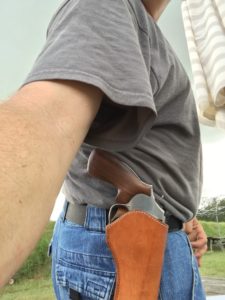
Someone recently gave me a “one size fits all” nylon holster with integral mag pouch.
I’ve always told students this type of holster was a “don’t buy”, and thought they were a bad idea because of the difficulty in doing a decent reload with the mag pouch being on the wrong side of the body for traditional reload techniques. I took the holster to the range and ran some drills with it.
The problems I found with the holster were:
Not stable on the belt. Loose and floppy in all axes of movement. Moved up and down as I tried to draw from it. Actually came off the belt when I tried to draw at normal speed.
“One size fits all” fits none. The holster is big enough to fit a Desert Eagle. My standard size M&P went so far down into the holster that I could not get a proper firing grip on the pistol before drawing. I could only get the bottom two fingers on the pistol with it holstered.
Loose and floppy holster also meant loose and floppy mag pouch. The holster moved around as I got the magazine out of the integrated pouch.
Completely useless for concealed carry, even in winter with a large cover garment.
Completely inappropriate for open carry due to total lack of retention and poor fit to all but the largest, widest belts.
Metal belt clips, in addition to not providing much tension to the belt, will also scratch anything you rub against, like other people’s cars in parking lots, or the upholstery of anything you sit in.
I did several different reload techniques: I swapped the gun to my left hand, grabbed the magazine with my right hand, reloaded the gun the way a left handed shooter would, and transferred it back to my right hand to shoot. This was complicated and slow compared to a standard reload. After a few tries, and moving the holster to a position in front of my hipbone so i could reach the magazine with my left hand, I was able to do some acceptable reloads with it, if I was able to get the magazine out without the holster flopping around too much. But that required moving the holster to a position I wouldn’t wear it for concealed or open carry.
The intended market for this holster was probably someone that has a bunch of different guns that are worn when out shooting on private property or during hunting season. Even for that low intensity use, it’s not a good product. Since there’s no retention for the gun, it’s likely to come off the belt if it snags against anything. Certainly not safe for wearing while climbing into a tree stand, into a deer blind or moving through thick brush. It’s not a holster any reputable instructor would allow to be used in classes, nor would I expect it would be allowed at any IDPA or USPSA match.
If you are considering purchasing this product or something like it, don’t.
Spend a few extra dollars on a holster that rides closer to the body, is made specifically to fit your gun, offers some retention (even if it’s just the friction of fitted leather or kydex with screws you can tighten to snug the holster to the pistol), and has belt loops intended for use with the width belt you plan to attach the holster to. (Better, get a holster that has belt loops that go all the way around the belt. They are less convenient for taking the holster on and off, but they will keep the holster on your belt much more securely.)
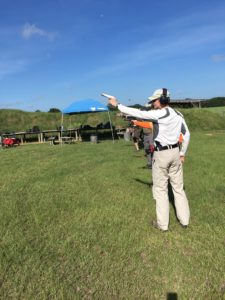
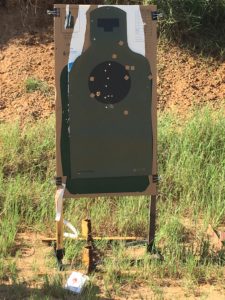
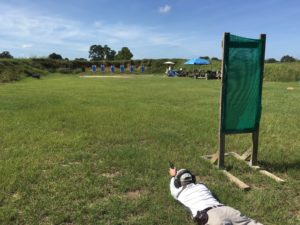
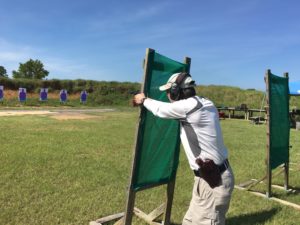
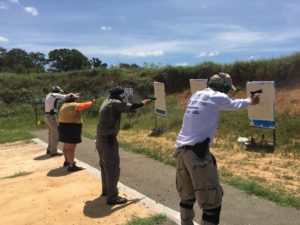
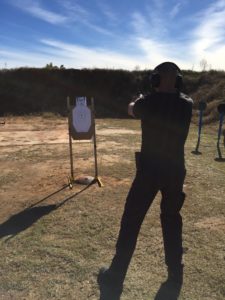
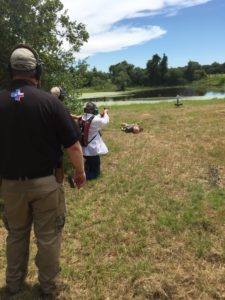
Over the past year I’ve been developing a new course for KR Training, Historical Handgun, that teaches the history & evolution of defensive handgun skills. On August 12, 2017, I taught the 1/2 day version of the course for the first time. 6 shooters braved the August heat to shoot 8 different qualification courses of fire, from 1940 to the present day, and listen to two short lecture blocks that included vintage film (video) clips and discussion of the evolution of shooting techniques and training standards.
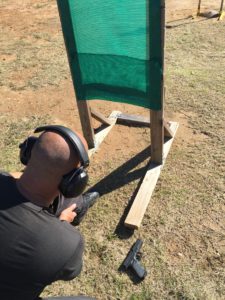
The course was designed to be shot with one handgun, or up to 4 different gun types (1911, double action revolver, DA/SA style semiauto, and a striker fired semiauto). Three students brought all 4 gun types, 3 chose to shoot all the drills with a single handgun.
Drill #1 – US Army handgun qualification (1940)
The first course of fire was the U.S. Army military qualification, which was one handed group shooting at 25 and 50 yards on the military L bullseye target, and 15 repetitions of ‘one shot from ready’ at 25 yards on the military “E” target.
Student scores ranged from 42% to 86%, with 5 of the 6 meeting the 60% qualification standard, and one exceeding the 85% threshold for Expert.
Drill #2 – FBI qualification course of fire, 1945
In earlier blog posts (and this update), I discussed this course of fire. It’s the most physical of the 8 that we shot, requiring prone, kneeling, sitting, quick movement between shooting positions, and hip shooting (at 7 yards).
It also covered the longest distance, with 5 rounds fired from 60 yards.Student scores ranged from 46% to 88%, with 4 of the 6 failing to meet a 70% passing standard, for a class average of 59%.
Drill #3 – Practical Pistol Course B
The NRA PPC course has been around since the 1950s, and is still shot today. According to the historians at the Texas Ranger Museum in Waco, the Texas Rangers used the PPC course as part of their qualification standards in the early 1970’s.
The PPC course starts at 7 yards and works back to 15, 25 and 50 yards, with prone, standing and barricade work similar to the FBI 1945 course but with faster time limits.
Scores ranged from 31% to 73%, with 4 shooters falling below the 70% passing threshold, for a class average of 56%.
Drills #4 and 5 – Gunsite 250 and 350 tests
Details of the Gunsite 250 and 350 tests can be found in these excellent articles from Gunsite instructor Ed Head. They are both 10 round drills with 1 and 2 shot strings, from 3 to 25 and 35 yards.
The biggest challenge on the previous 3 drills was getting hits beyond 25 yards. The challenge in the Gunsite drills was draw speed – a skill not really tested in any of the older tests at all. Late shots, not misses, affected student scores the most.
Of the 6 students, only one shot passing scores on both the 250 and 350 tests, with class averages of 60% (250 test) and 54% (350 test). Most of the points were dropped on the close range strings, where a minimum draw time of 1.5 seconds was required.
Drill #6 – 1980s FBI
There are many videos showing people shooting this course of fire. It includes elements of the 1945 FBI course, such as moving quickly from position to position, but uses two handed aimed fire (originally taught using the Weaver stance), and more shooting from closer distances (5, 7 and 15 yards). The video shows students running the final string, which requires moving from the 7 to the 5 yard line, firing 5 rounds strong hand only, reloading, and shooting 5 rounds support hand only, in 15 seconds.
Student scores were higher on this course of fire, ranging from 64%-82%, but none met the standard of 43 hits inside the larger bottle of the QIT-99 target. 3 of the students shot the course using DA/SA style semiautos and the Weaver stance; the other 3 shot striker fired guns using a modern isoceles stance.
Drill #7 – Local Police Department qualification course, 1990s
For the last two drills, all but one student switched to striker fired pistols (one shot a 1911 for the entire course). We ran a version of a nearby major city’s police department qualification course of fire. It was a mix of 3, 7 and 15 yard shooting, including strong hand only and support hand only strings, with 6 rounds fired at 25 yards, and one reload.
The combination of familiar guns, and drills testing more frequently practiced skills resulted in higher student scores: all 6 easily met the 70% threshold for qualification, with scores ranging from 88%-99%, and a class average of 93%.
Drill #8 – Current FBI qualification course of fire
The final course of fire was the current FBI shooting test, which several students had shot before in my own and other classes.
Scores on this test were also good, ranging from 87-95%, with a class average of 91%.
Analysis
The scores show what people practice and what they don’t. Courses of fire with lots of reasonably fast shots fired on midrange targets (7-15 yards) produced good scores; courses requiring fast presentation of the pistol from a holster, and slower speed accurate shooting at 25 yards and beyond were more challenging.
None of the students in the course had much (any) experience hipshooting targets at 7 yards, but most did reasonably well with that skill, after we ran a dozen 1 and 2 round draw and hip-shoot drills.
Because the goal of those drills was to replicate the shooting test of the 1940’s and 1950’s, students were not allowed to use speedloaders for revolver reloads, and there were a lot reloads required during strings of 15, 18, 20 and 24 rounds. The 3 students running double action revolvers did not have period-appropriate belt pouches, and were loading from loose rounds carried in pockets. This caused them to fire more quickly than perhaps they would have, if each part of each string was a separately timed event.
Based on lessons learned from this session, I’ll be adding some additional practice time on 25 and 50 yard shooting and 7 yard draw prior to running the tests in which those skills are essential. For revolver shooters, I’ll be recommending students serious about doing it period-accurate invest in belt pouches. I’ll also allow those that would otherwise have to load loose rounds out of pockets to use speedloaders. Students using semiautos for the older revolver-centric courses of fire will run them using faster par times, adjusted to provide them reasonable reloading time, but less than the 15-20 seconds budgeted for loose round revolver reloading.
The next session of Historical Handgun will be Sept 16, 2017 at my A-Zone Range. It will be a 1 day version of the course, including all 8 drills listed here, plus practice drills, historical film/video and additional lecture material on key historical figures and books.
Those that attend the 1 day session will be eligible for discounted slots in 2018 sessions of the full 2 day version of the course, which will include additional courses of fire, video, and lecture material.
Over the past year I’ve been developing a new course for KR Training, Historical Handgun, that teaches the history & evolution of defensive handgun skills. Part of that effort has been searching for old handgun qualification courses of fire, and shooting them using the techniques and equipment used in that era. In a previous article, I discussed the 1945 FBI qualification course of fire.
Trainer Tom Givens , who shares my interest in handgunning history, provided me with this additional information:
The original course was shot on a range that had individual shooting lanes that fanned out from the 60 yd line. When Hoover said 5 minutes and 45 seconds to run the course, that is how they did it. Once the start signal was given, each agent ran the course, with some ahead of and some behind others. Some time later, the individual stages were broken out and given a time limit because so few police ranges had the fanned out lanes that the original FBI ranges had.
The second stage to the Practical Pistol Course (PPC) consumed 40 shots and, thus, comprised the bulk of the PPC’s various elements. These 40 continuous shots (80% of the entire course) were fired within five minutes and 45 seconds over multiple firing strings at the 60, 50, and 25 yard lines.
Beginning in a standing position at the 60 yard line, at the signal, special agents drew their revolvers as they dropped into a prone position and used a two-handed grip to fire five shots using the thumb-cocking mode.
They then immediately reloaded, re-holstered, and ran or jogged forward to the 50 yard line. There they fired a total of 20 shots, using two hands to fire five shots each from four positions—sitting, prone, and right- and left-hand barricades—that simulated use of cover (e.g., the corner of a building or around a car’s fender). Reloading between these four strings was under time pressure.
After again reloading and holstering, special agents immediately ran or jogged forward to the 25 yard line where they fired a total of 15 rounds—five each from the kneeling, and then right- and left-hand barricade positions, to include reloading between strings.
According to Roberts and Bristow (1969, pp. 77-81), these 15 shots were to be fired trigger-cocked. Considered in its totality, this 40-shot stage brought a sequential closing by a special agent upon his target, something Weston (1973) characterized in the following manner: “The shooter assumes he is under fire from an armed opponent at all times . . . [and] . . . Each of the combat-shooting positions emphasizes target reduction, and the use of barricades suggests seeking available protection in real life combat” (p. 77). There was also somewhat of a military “assault” flavor to this stage since special agents were in a fashion “firing and advancing” on the target. While this is fairly easy to explain given the FBI’s training relationship with the U.S. military, it still seems a curious one for police work. Perhaps experiences such Law Enforcement Executive Forum • 2008 • 8(1) 51 as the prolonged encounters at Little Bohemia and elsewhere where special agents engaged in extended surveillance or conducted raids to apprehend dangerous suspects inclined the FBI toward this feature to the course.
The PPC was a far more complex course-of-fire than conventional bull’s-eye target courses. One of the major differences was in using prone, sitting, and kneeling firing positions akin to those used for rifle shooting positions in order to provide greater shooting stability. For example, in the prone position, one rested the forearms and/or heels of the hands on the ground to fire at the target 60 yards away and, thus, need not attempt to hold the handgun steady at arm’s length in a standing position. The kneeling and sitting positions also were intended to offer support to the shooting arm and hand.
Given the linear arrangement of general purpose ranges, shooters stand in a line perpendicular to the direction of firing. This is a safe arrangement since all shooters are at precisely the same distance from the target line (i.e., not staggered). Recall, however, that stage two of the PPC course had special agents run from the 60 to the 50 yard line, and then from the 50 to the 25 yard line under time pressure. On the conventional target range with its parallel, compact firing lanes, this would be extremely unsafe and pose unacceptable risks for trainees. The alternative of having one officer fire the PPC while others waited for their turns would have been administratively cumbersome.
The FBI overcame this problem to its satisfaction by arranging one area of its range complex in a radial or fan-shaped fashion with firing lanes emanating from a central hub. Several FBI agents would start close together and at angles to one another at the hub, and as they moved down range to the various specified distances, they also moved increasingly further apart on their respective lanes. Critical analysis of the PPC, including discussion of its positive aspects, shortcomings, and alteration by local and state departments is presented further below. Because it was an important development in police firearms training, first we examine how the FBI was able to so effectively promote the PPC’s use by U.S. police departments. Exporting the PPC to Local and State Police No other single police handgun training or qualification course-of-fire has a provenance so generally well-known and its elements so easily recognized as the PPC-based course-of-fire.
Q: Why was the course of fire based on 5 shot strings, when the revolvers of that time held 6?
A: It was a hold-over from bullseye days. All bullseye strings are 5 rounds, or multiples of 5, like 10 rounds. When the PPC was designed, everyone was shooting the NRA bullsye course. The 5 shot Chief wasn’t invented until the early 1950’s.
I believe the bullseye tradition came from carrying cap and ball revolvers and 1873 Colts with 5 beans in the wheel and an empty chamber under the hammer.
If you aren’t already a subscriber to receive this newsletter each month, you can subscribe here or follow this blog. You can also follow KR Training on Facebook or Twitter for more frequent posts and information.
CLASS DISCOUNTS AND DEALS
50% price refresher slots available in all courses. If you haven’t practiced the skills you learned in class in awhile, fall refresher slots are a great option.
I have developed a new program called Historical Handgun, teaching the history of handgun training and skills, 1935-present. The full course is a 2 day program that I’ll start offering in 2018, at the A-Zone and on the road. I’ll offer a 1/2 day preview of the shooting part of the class on August 12th, and a 1 day preview on Saturday Sept 16. Students that attend either of the preview courses will also get credit that can be used toward slots in the 2 day version I’ll offer spring 2018.
PERSONAL TACTICS SKILLS CLASS August 26th
Personal Tactics Skills is a 3 hour course that teaches the non-shooting skills essential to avoiding common mistakes in common armed citizen situations. Being good at shooting is not enough to avoid making errors in tactics, decision making and communication. There is much more to “self defense” training than marksmanship and gunhandling. Here’s an AAR from a 2011 session of this course. If you haven’t taken Advanced Training 2 because you don’t feel ‘ready’ for Simunition or Airsoft force on force training, this class is for you. It’s also perfect for couples or friends to learn the basics of team tactics. We are offering a Bring a Friend option – 2 slots for $80, which is a $40 savings.
In July, John Daub attended a 2 day Dark Angel Medical course. In August, all the KR Training instructors certified to teach the License to Carry course will attend refresher training at the DPS academy. In September, Karl will attend the School Safety Instructor certification course at the DPS academy, joining Paul Martin and Tina Maldonado as KR Training staff certified to teach this new state course. In October, Karl will take a 2 day Vehicle Defense course taught by John Farnam in Victoria, Texas. It’s important for trainers to continue to learn and improve by taking courses from others.
Over the past year I’ve been developing a new course for KR Training, Historical Handgun, that teaches the history & evolution of defensive handgun skills. Part of that effort has been searching for old handgun qualification courses of fire, and shooting them using the techniques and equipment used in that era.
I’ve ordered some B-21X targets, but had some B-21M’s on hand, so I used the B-21M for a test run on the 1945 FBI course.
My approximation of vintage gear was a S&W 686 revolver (in .357 magnum, but loaded with .38 special), and a fairly basic leather holster. My interest in historical handgun is as a trainer studying the evolution of technique, not so much as a reenactor. A more appropriate gun for this drill would be a Colt Official Police .38 special revolver, which would have had a 4″ barrel, a trough rear sight and narrow blade front sight. My 686 had modern target grade sights and a heavier 6″ barrel.
This particular 686 is a 7 shot model, which added some complexity to the reload, as I was loading with 5 and having to get the cylinder aligned properly so that the first 5 to fire were loaded chambers. A true 5 shot revolver would have been easier to work with.
In the 40’s and 50’s, speedloaders were not in common use (or available), so reloading was done from pouches or pockets. Modern shooters running semi-auto pistols can learn to change magazines in under 2 seconds (or even under 1 second). Modern double action revolver shooters can reload in 3 seconds or less, as demonstrated by Massad Ayoob. World record holder Jerry Miculek can reload a double action revolver at a one second pace, as shown in this video.
Loading loose rounds into a revolver cylinder is much slower. A “fast” loose round reload for me was 15 seconds, compared to a 1.5 second semiauto reload, or 3 second speedloader revolver reload.
Course Breakdown
String 1: 7 yards. Draw, shoot 5 from the hip, double action, reload, shoot 5 more double action. 25 seconds.
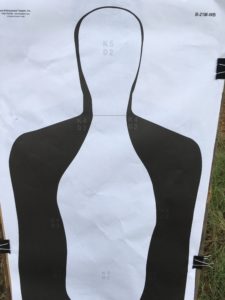
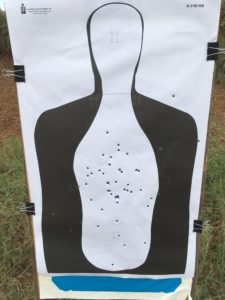
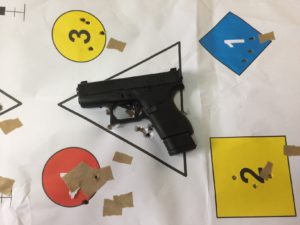
What this really means is “draw and shoot 5 in 3 seconds or less, reload in 18 seconds or less, shoot 5 more shots in 3 seconds or less.” The hip shooting part was fun. The target below was a 2.5 second run for “draw and hipshoot five shots at 7 yards”. What I learned from running that drill was that you have to pay attention to where the first shot lands, so you can correct your “pointing” if needed before firing shots 2-5.
In the American Rifleman article, Hoover says the rest of the course takes “5 and 3/4 minutes to complete”. Not finding a better breakdown of the time, I’ve tried to figure out what the likely string times were, by running the test multiple times. All string times below are my estimates and may not match exactly how the test was run in 1945. Assume that all shots fired for the remainder of the test are shot single action, thumb cocking the revolver for each shot.
String 2: 60 yards. Draw, drop to prone (2 handed), and shoot 5. 45 seconds. Off the clock, reload and holster.
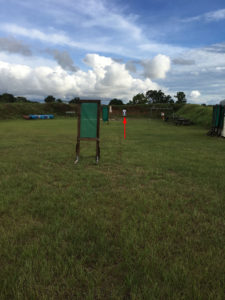
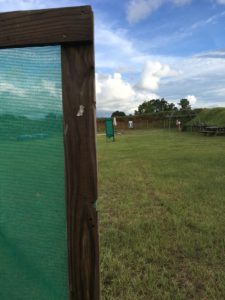
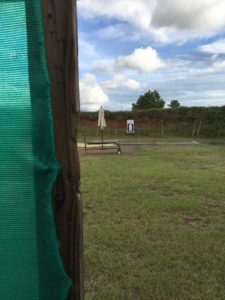
The picture shows the view from the 60 yard line. The red arrow points to the target.
String 3: 50 yards. Draw, drop to prone (2 handed), fire 5. Reload, shoot 5 from sitting (2 handed), reload, shoot 5 right hand only (right hand side of barricade), reload, shoot 5 left hand only (left hand side of barricade). 180 seconds. (3 minutes) Off the clock, reload and holster. Move “quickly” to the 25 yard line, per Hoover’s article (probably intended to raise shooter heart rate and induce some additional stress.)
The string breakdown is about 30 seconds for each set of 5 rounds, with 20 seconds budgeted for each reload.
String 4: 25 yards. Draw, drop to sitting, fire 5 rounds (2 handed), reload, shoot 5 right hand only from right side of barricade, reload, shoot 5 left hand only from left side of barricade. 120 seconds (2 minutes).
This breaks down to 25 seconds for the 5 seated shots, 25 for the dominant hand only shots and 30 seconds for the non-dominant hand only shots, with 20 seconds for each reload.
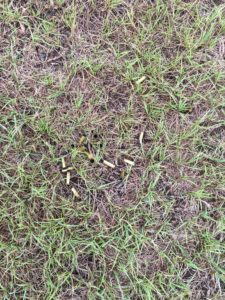
Being faster at reloading with loose rounds buys you a lot of time to make your shots. I dumped my brass on the ground during reloads. I can’t find any records indicating the Bureau required agents to pocket their spent brass.
Scoring
The B21 has “K” values on it: K5 is 5 points, K4 is 4 points and so on. 50 rounds, 250 points possible. Multiply your “K” score by 0.4 to get your score. (Or just divide by 250 to get a percentage).
Hoover’s article did not specify a passing score, but typically 70% is passing on all other law enforcement tests, with a few requiring 80%.
My target from run #2 on the test:
I got 48 hits on paper, 41 in the K5 zone (205 points), 6 in the K4 zone (24 points), and one visible miss from the first shot after the reload on the hip shooting string. The 2 hits off paper happened somewhere at 50 yards with the one handed shooting. 229 * 0.4 = 91.6%. Reloads were my biggest challenge, as they seemed to take forever, leaving me feeling like I had to rush the shots. At 25 yards I blew through that string in 79 seconds, leaving a lot of unused time.
When my shipment of proper B-21’s comes in I’ll run the test again and update this post with the results. A little work on my hipshooting, reloads, and shot timing should get me to the 100% level.
Analysis
This is the oldest documented course of fire I can find that requires drawing from the holster and shooting from multiple positions (prone, sitting, from cover, crouched), reloading on the clock, movement, rapid firing at close range. The design of the course appears to be heavily influenced by the methods and concepts in Lt. Col. Rex Applegate’s “Kill or Get Killed” book. Famous FBI agent/gunfight Jelly Bryce was also a likely influence on this, at least the 7 yard hip shooting part.
Semi-Auto Update
Because modern semiauto pistols can be reloaded much faster, those that want to run the test can try these updated time limits, still using historical shooting techniques:
String 1: 7 yards. Draw, shoot 5 (one handed from hip), reload, shoot 5 (one handed from hip). 9 seconds
String 2: 60 yards. Draw, drop to prone, shoot 5. 45 seconds (no change).
String 3: 50 yards. Draw, drop to prone, shoot 5, reload, shoot 5 from sitting, reload, shoot 5 right hand only from right side of barricade, reload, shoot 5 left hand only from left side of barricade. 120 seconds (reduced from 180).
String 4: 25 yards. Draw, shoot 5 from sitting, reload, shoot 5 right hand only from right side of barricade, reload, shoot 5 left hand only from left side of barricade. 90 seconds (reduced from 120).
Allowing two handed sighted fire, and eliminating some of the reloads, due to the higher capacity of modern semiauto handguns could allow the par times to be reduced even further.
Students attending the 1/2 day and 1 day Historical Handgun classes coming up in August and September 2017 will get to shoot this course of fire, as will the students in the sessions I’ll be teaching at the 2018 Rangemaster Tactical Conference.
On July 29, 2017, KR Training ran another session of the Defensive Pistol Small Gun class. This class focuses on skills specific to subcompact semiauto pistols (Glock 42/43 sized), and snubnose revolvers. It’s more than a repeat of the material in Defensive Pistol Skills 1, shot with smaller guns, although there is some overlap in course content.
It includes work drawing from a seated position and shooting from a vehicle, as shown in this video of student runs. More about the class can be found in my USCCA article “Is A Small Gun Enough?”
As part of the course, students shoot the Three Seconds or Less test (3SL) with both their small gun and larger (belt holster carried) primary gun. I collect this data to track the typical performance loss/gain students see when switching from larger to smaller guns.
Data from this year’s two sessions:
16 shooters
Small Guns: one SA (Sig 938), 5 DAO (Kahr, R9, snub revolvers), 10 striker fired (Shield, Glock)
Large Guns: all 16 were striker fired guns (Glock, M&P, Walther)
Average small gun score: 75/100
Average large gun score: 83/100
Performance gain from shooting the larger gun: 8%
Students passing the 3SL test with 70% or higher score using their small gun: 10 of 16.
Students passing the 3SL test with 70% or higher score using their primary gun: 13 of 16.
Students passing the 3SL test at the 90% level (desired) using their small gun: 1 of 16.
Students passing the 3SL test at the 90% level using their primary gun: 7 of 16.
The biggest problem for most students was draw time, particularly those using pocket holsters. Many in the July session chose to run the class using an IWB belt holster for their small gun, as that was their method of summer carry.
Historical average of the entire data set of 48 shooters:
Small Gun score: 78/100
Larger gun score: 86/100
So this year’s class numbers were right in line with historical average of 8% gain.
Observations: Despite my efforts to promote it to that target market, very few low skilled shooters choose to take this course. A goal for next year is to change the marketing of the course to try to attract more students from the “I passed the carry permit course, but never practice with the little gun I stick in my pocket or carry in my car.” That will likely include allowing people to run all drills from a ready position as an alternative to pocket or holster work.
Those that attend are typically those that carry daily and have taken 16 or more hours of training with their larger gun. What the data shows is that for shooters that have reached a reasonable level of skill: 80 points or better on the Three Seconds or Less test, transitioning to the smaller gun, for shots 7 yards and closer, is not a major problem, but most are still not at the level we’d like to see (90% or better on the 3SL test).
Trainer Paul Gomez passed away in 2012, at the young age of 40. Paul was a colleague, a friend, a teacher and a student. He took classes from me, I took classes from him, I hosted classes he taught, including some of the first ECQC classes he and Craig Douglas offered, and we had many long discussions on the phone and email about training and technique. I use some of his youTube videos as supplemental material in classes. The idea for the Historical Handgun course I’m developing came from our discussions about the evolution and history of shooting skills.
Paul was well respected within the national private sector training community. Every two years they hold a training conference, with the proceeds benefiting Paul’s children.
My schedule this year prevents me from attending, but to support the event, KR Training has purchased a student slot that I am going to give to a KR Training student as a scholarship to go learn from some of the best trainers in the country.
There are three requirements to claim the scholarship slot:
You need to be a graduate of at least one KR Training course.
You have to attend the event. KR Training will cover your event fee; you have to cover your own travel and ammo costs.
You have to send us photos, videos, and some event AARs so we can share them here on the blog and on all the KR Training connected social media sites.
The offer is open from now until someone claims it. Please don’t claim the slot until you are 100% sure you can go. I will keep a wait list just in case whoever claims it has to cancel.
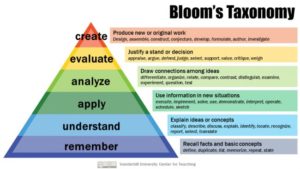
The typical firearms course is heavy on Bloom’s level 3 objectives: execute and implement, for example, because the class teaches hands on skills that are evaluated with targets and timers. Even gun safety is typically assessed at the level 3 (execution) level.
In order to evaluate whether a student has achieved the learning objective or not, standards are needed. The derivation of those standards comes from the primary learning objective for the course, and the amount of time available to teach the topic.
Here are some plain language primary learning objectives for our lower level classes:
Basic Pistol 1 – Graduates are competent enough to target shoot without supervision. (They are measured against the performance checklist from the NRA Basic Pistol course.)
Gun Selection Clinic – Graduates understand enough about gun selection to select a handgun appropriate for their needs and physical characteristics.
Basic Pistol 2 – Graduates are capable of passing the Texas License To Carry shooting test with 90% or greater score.
Nothing in our curriculum or standards development process addresses the question of “what minimum skills should be a legal requirement to own or carry a firearm.”
A few recent readers of our blog postings (or of articles referencing our work) have misinterpreted our writing to claim that we advocate these standards as any type of legal standard related to a fundamental Constitutional right.
That assumption is completely incorrect.
Legal standards
No license is required to use the right of free speech, at home or in public. Similarly, no license should be required for the right to keep and bear arms. When public speech is abused, and harm is caused, the speaker may be found guilty of libel, slander or defamation. There are legal consequences for harmful speech. There are many legal consequences for harmful misuse of firearms.
According to polls, public speaking is the most common fear. A person seeking to reduce their fear of public speaking might seek out instruction in public speaking, and that instructor might offer different levels of training on any of these topics:
give the prayer at a family dinner or at church
speak at a city council meeting
giving a sales presentation
small group instructing
instructor training
leadership level public speaking
radio/TV presentation skills
Being afraid to carry, or afraid to act in a self-defense situation, out of lack of understanding of how the gun operates, proper carry methods, technique for drawing, or fear of making an incorrect use of deadly force decision that could have life-changing consequences are all very reasonable fears — and training, supplemented by practice, is the best way to address those fears.
The Dunning-Kruger effect causes each of us to believe that we are better than we are at many tasks and skills. Being evaluated against formal metrics by a qualified assessor is the best way to get an honest appraisal of your actual abilities. Particularly when the alternative – not discovering that you aren’t good enough in your gun-handling, shooting or use of deadly force decision making – could be a fatal error.
The reason to attend training should never be “because the state is making me”. The standards to which someone trains should be based on functional requirements, because the student expects to benefit from the training, whether it is in reduction of negative outcomes or improved odds of survival.
Those that choose not to seek out training, or work to attain functional standards, are free to make their own choices, and equally free to face the consequences of their errors.
If you aren’t already a subscriber to receive this newsletter each month, you can subscribe here or follow this blog. You can also follow KR Training on Facebook or Twitter for more frequent posts and information.
On July 29th I’ll offer another session of Defensive Pistol Small Gun. I know many of you have pocket sized guns: Glock 42’s, Ruger LCP’s, .38 snubs, M&P Shields, and others. Maybe that gun is your primary carry gun, maybe it’s not. Maybe you know somebody that never trains and never practices but carries one of those little guns in their pocket or their purse.Those people would really benefit from taking this course. The class is appropriate for anyone with an LTC whether they have taken our other Defensive Pistol courses or not.
Maybe you don’t have a little gun and would like to have some fun running one of our loaner guns in drills, to learn the pros and cons of the little gun vs. the larger gun carried in a belt holster.
The Small Gun class is more than the DPS-1 drills shot with a different gun. If you’ve taken DPS-1, you’ll still learn something new from DPS Small Gun. And if you’ve haven’t practiced the drills we run in DPS-1 (or -2 or -3) since you took the course, DPS Small Gun is a great way to refresh those skills.
If 3 hours of shooting isn’t enough for you, stick around for the 2 hour Skill Builder Long Gun that afternoon. That class can be taken with any rifle or pistol caliber carbine, including a .22, making it suitable for all levels from the “I bought an AR and haven’t shot it yet” student to the experienced long gun “operator”.
HISTORICAL HANDGUN PREVIEW
I have developed a new program called Historical Handgun, teaching the history of handgun training and skills, 1935-present. The full course is a 2 day program that I’ll start offering in 2018, at the A-Zone and on the road. I’ll offer a 1/2 day preview of the shooting part of the class on August 12th, and a 1 day preview, co-taught with Tom Givens, on Monday Sept 18 after the Rangemaster Shotgun Instructor course.
AUGUST 19th – MANY OPTIONS
I’ll be on the road August 19th, but assistant instructors Tom Hogel and Greg Howard will offer several classes. From 9-11, Tom will run the 2 hour Skill Builder session on the main range for intermediate and advanced students and Greg will offer a 2 hour Handgun Coaching session in the classroom and the small range for basic and intermediate students wanting to tune up their fundamentals. Then from 11-1, they will co-teach a Gun Cleaning and Maintenance class indoors.
This combo is perfect for couples or families – the more experienced shooter could attend Skill Builder, the less experienced shooter takes Handgun Coaching, and with the Bring a Friend discount, sticking around for the Gun Cleaning and Maintenance class is an affordable option.
SUMMER USPSA MATCHES
You don’t have to be a USPSA member to attend. You don’t have be an experienced competitor to attend.
The summer matches are an excellent, new shooter friendly way to try pistol competition.
Summer USPSA matches will continue in July and August. These are Wednesday evening matches. We will start shooting at 6 pm but you can arrive as late as 7 pm and still shoot the stages. After everyone has shot for score, additional runs are allowed for fun and practice. Follow this link for more information about the summer matches. Matches are limited to 18 shooters so they run quickly.
Safe reholstering (A Girl and a Gun) – At a recent local IDPA match, a competitor’s firearm discharged when his vest’s zipper got caught in the trigger as he holstered after “load and make ready”. The article is a good reminder of best practices for holster work.
Over the past year I’ve been developing a new course for KR Training, Historical Handgun, that teaches the history & evolution of defensive handgun skills. Part of that effort has been seeking out and reading old books on shooting, purchasing copies signed by the authors when possible.
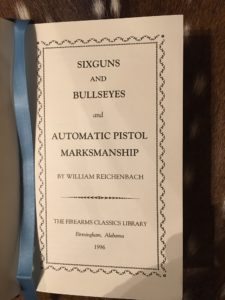
In 1935, WW1 veteran William Reichenbach published a book on bullseye shooting called “The Elusive Ten”. In 1936, he updated the book, re-titled “Sixguns and Bullseyes”, following up with “Automatic Pistol Marksmanship” in 1937. The Sixguns book was reprinted in 1943, but the other book was lost to history until it was reprinted, along with Sixguns and Bullseyes, as part of the NRA Firearms Classics Library, in 1996. (Another list of books published in this series is here.)
In the first chapter, the author explains that the book is for new and aspiring bullseye shooters seeking to improve. He focuses on .22 rimfire and .38 special centerfire revolvers, primarily the Colt and S&W models.
He extols the virtues of the 0.100″ wide, red front sight — essentially the same kind of narrow, bright front sight used by modern competition shooters. The value of the narrow front sight has been known since the 1930’s — yet the factory front sights on almost all pistols are 0.125″, wide enough to fill the rear notch.
As common in many books from this era, he recommends a light grip on the pistol, because it “tires you less”. Modern courses of fire are timed in seconds and hundredths of seconds; bullseye occurs at much slower pace.
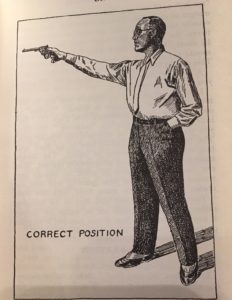
Similarly, his advice on stance is very relaxed, with non-firing hand resting comfortably in his dress pants pocket, and advocates shooting with both eyes open.
He provides the advice shooting instructors have been giving students since the dawn of gunpowder:
Practice as often as you can! Maybe, you do not have the facilities for shooting on a range each day — Not at all necessary! You don’t need a range for your short daily work-out! Any room will do. You practice “dry” with dummy shells! Stick a black paster up on the wall, at the height of your eyes, stand back and go through the motions. When the hammer clicks keep your bead and *call* your imaginary shots just as honestly as the real target would.
The concept of a small amount of daily dry practice producing great results is not new, although we seem to have re-discover it, or have someone of our generation be its champion for the idea to be widely accepted.
He plants the seed of an idea that grew up to be Comstock scoring used in USPSA competition:
My suggestion for competition would be: gun in holster. Upon command the gun should be drawn and fired once, the shot to hit a rather small target. The gun should then be re-cocked quickly and held up again at “ready” position, aimed at the same target. The whole action should be timed and the results judged by “time elapsed” and “value of hit”, the weight of scoring to lie with “time elapsed”.
His concept of a “full live fire practice day” is 3 strings of 20 shots each.
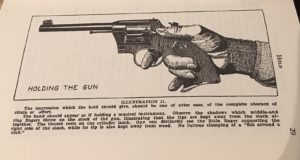
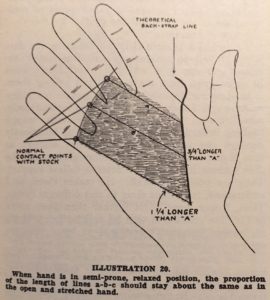
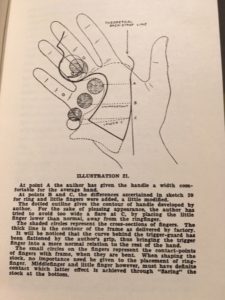
Some interesting drawings discussing gun fit for revolver stocks.
Automatic Pistol Marksmanship Highlights
The second book is all about semi-automatic pistols, which he refers to as “automatics”.
The book opens with his definition of two safety rules:
An Automatic is Always Loaded!
Never point the damn thing at anything you don’t want to hit!
These two rules may have been an influence on Col. Jeff Cooper’s development of his “4 rules“.
Even in 1937, the 9mm vs. .45 debate was common:
Just because a few Moros had been tickled with some .38 Revolver shells and had the audacity to survive, the .45 caliber craze became the credo. And “Shocking power” assumed such importance that it makes one sick. Less extremely large calibers do more effective work than the .45 calibre. It all boils down to the question of how good the shooter behind the gun is, and I claim that a calibre unnecessarily larger is not conducive to good handling.
Reichenbach was a big fan of the .38 super cartridge and preferred it to .45 ACP.
The combination of no hearing protection and one handed shooting made training with the 1911 .45 more difficult, as he notes:
There will never be an opportunity for fast firing in any situation, unless it be for the sake of noise or deception. Ordinarily, after the shooter has fired a .45 Automatic, say 10 times, he is all rattled..shaken up. Co-ordination is destroyed and he goes to pieces. To fire 50 shots with the .45 Auto, under target conditions, is an ordeal.
Despite this, Reichenbach preferred the Automatic as his daily carry gun:
I have developed an arrangement of gun and holster that suits me perfectly. My chest is thrown bravely forward. My eyes are serene and my mind is at ease. I know that I have a little steel-thing with me that carries death if need be, death to the enemy. I feel the instrument of utter security along with my waistband, and..alack, sometimes also a wee bit of weariness. The damn thing doesn’t weigh much, but it keeps it up–all day long. My tailor also objects to it because, he claims, he can’t get the perfect which which he so desires.
He describes the perfect automatic as one that
weighs 30 ounces, with distinct muzzle heaviness and a scientifically shaped grip, with the center of mass well forward and not near the handle. The insertion of the magazine should not materially shift the weight so far back that the gun becomes butt heavy.
Interestingly enough, the Glock 19 weighs 30 ounces, loaded, and has many of these characteristics, as do most of the modern 9mm polymer, striker fired pistols.
His preferred holster is an appendix/cross draw rig with the gun angled, and trigger guard exposed.
From later discussion, it appears that he carries hammer down on a loaded chamber, and intends to thumb cock the gun as part of the draw. (Those that followed him down the trail of defensive shooting eventually figured out that exposed trigger guard and thumb cocking during the draw were bad and dangerous ideas.)
The last part of his book on Automatics is all about what he calls “Practical Shooting“, which he defines as “the ability to draw our gun quickly, align it with speed and discharge it without pulling (flinching), at the target.” His description of how to learn a proper drawstroke should sound familiar to anyone that’s taken a defensive pistol course:
Stand before a full size mirror. The hand goes down to the gun, takes it out of the holster, cocks and carries it to arms length. The bead is at the nose of our adversary. We squeeze the trigger! The whole action may take us fully 3 seconds. That’s fast enough for beginning. The thing is to see that the action is carried smoothly. There should be one deliberate, clean motion. Start right by starting with the slow draw. Work from the “Three Second Draw” to the “Two Second Draw” to the “One Second Draw”. I consider a draw executed with 1/2 second a damn fast draw. Whatever you do, make it your business never to miss your target! Never fire more than 50 shots a day. How about using a 5″ bullseye? If you get to the point you can hit a 5″ bullseye at 25 feet (8.3 yards) with a one second draw, you are a deadly shot and no fooling!
(By modern standards, hitting a 5″ target at 25 feet with a 1.0 second draw is USPSA Master/Grand Master level shooting.)
As with other books on pistol shooting from the 1930’s, the book is full of information that really hasn’t changed, and standards for “what is good shooting” that remain challenging today with modern equipment.
If this sort of thing interests you, I’ll be offering 1/2 and 1 day sessions of my Historical Handgun course August and September 2017, with additional sessions to be presented at the 2018 Rangemaster Tactical Conference and other locations to be announced soon. The course is mobile and can be presented in 1 or 2 day format at your location, if you have a classroom and a 50 yard range.
Because I have my phone number listed online as my primary business number, I get a lot of unwanted phone calls: offers for credit card processing services, offers for business loans, website builders, office supply companies, promotional product sales, as well as all the common scam calls from “Google” and “Microsoft” and “Windows Support” and the “IRS“. The national Do Not Call list appears to be completely worthless.
The spam callers change phone numbers frequently, and unfortunately, I can’t screen out incoming calls based on area codes. It’s very common for people to keep their cell phone numbers when they move.
A few months ago I started looking at different phone apps that can assist with this problem.
The one I’m using now is called Mr. Number. I’m using the IOS version.
When calls come in, they are checked against Mr. Number’s (large) list of known numbers. They tag calls as “scam and fraud” (red alert) or “suspected spam” (yellow alert). You have the option, for each type of call, to allow it to ring, with the alert showing below the number, or send it to voicemail.
It’s super easy to report a new number as spam.
Pull up the number under “recents”, copy it, and open Mr. Number. It automatically sees the phone number on your clipboard and asks you if you want to do a reverse lookup on it. If you do that, it gives you the option to block or report as spam, with categories of what kind of spam it was.
After several weeks, lots of unwanted calls have been blocked and flagged, I’ve reported a handful of numbers as unwanted, with no false positives (legit calls incorrectly blocked or rejected), with no problems or glitches with normal phone use.
Last Saturday, the KR Training family lost another close friend and team member: Tom Robertson.
Tom was a former Texas A&M police officer, NRA high power competitor, USPSA competition shooter, and NRA instructor, as well as a former homebuilder and skilled craftsman/salesman in the construction industry. He was a pretty good singer too!
Tom was Penny’s next door neighbor during her PhD years at Texas A&M university, coaching her in NRA high power rifle competition and inviting her to join his friends hunting deer, hogs and birds. He
encouraged Penny to seek out NRA instructor certification, around the time the Texas Concealed Handgun License bill passed, so that she could start offering CHL classes in the Bryan. That’s how Penny and I met, which led a beautiful partnership both at the personal and professional level.
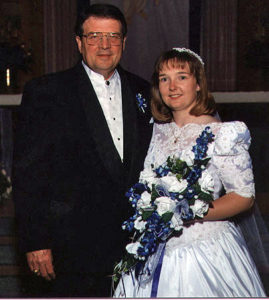
During our dating and engagement period, Tom and his shooter buddies in Aggieland served as Penny’s surrogate big brothers. I eventually passed their evaluation, despite being a t.u. graduate, and Tom was one of my groomsmen at our wedding.
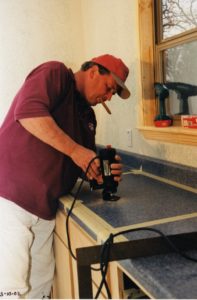
After we purchased the A-Zone property (16 years ago from the date of this post), Tom convinced several of his friends & customers into helping make the classroom building a reality, and he spent many weekends with us, assisting with construction of the building, fences, and every other project that needed doing, including teaching me a lot about home building and construction.
Tom’s day job was selling door and window units for Weatherford Door Company, and he would frequently talk about KR Training with his customers, promoting our classes. Ronald Weatherford, Tom’s boss, was an avid hunter and gun rights advocate who also passed away this month.
Even after Tom’s health declined, he would talk about our classes to the doctors, nurses, physical therapists and anyone else he encountered.
Most KR Training students never met “the T”, but his influence and impact on Penny, me, and KR Training was significant. He will be missed, but never forgotten.
Over the past year I’ve been developing a new course for KR Training, Historical Handgun, that teaches the history & evolution of defensive handgun skills. Part of that effort has been seeking out and reading old books on shooting, purchasing copies signed by the authors when possible.
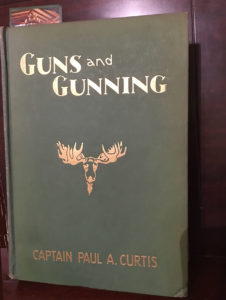
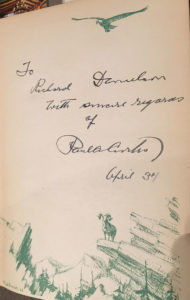
In 2016, Penny had a chance to visit the Armstrong Ranch to conduct interviews as part of the Legacy of Ranching exhibit at the George Bush Presidential Library and Museum. While there, she noticed a copy of Guns and Gunning by Paul Curtis, on a shelf in the library of what had been Tom Armstrong’s (son of Texas Ranger John B. Armstrong) home. She read a few pages and was impressed – the section on trigger press was terrific. Capt. Curtis was a WWI veteran and longtime editor of Field and Stream magazine.
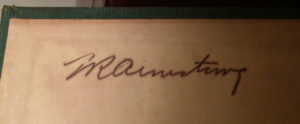
I was able to find a 1st edition signed copy of the book to add to our library.
Much of Curtis’ book contains advice and observations that remain true 80+ years later. The book covers all types of shooting (rifle, shotgun and pistol), with particular focus on hunting. My comments focus on the pistol shooting part of the book.
Gun buying trends haven’t changed
The pistol buyer who is interested in target shooting is very much in the minority.
The average pistol is bought solely with the idea of having it on hand for self-defense, and the skill of the owner is in most instances highly superficial.
It is sufficient to observe here that it is ignorance and lack of familiarity with the pistol that is responsible for the wrong type of weapon being bought by the vast majority of people.
The Narrative: crime always going up, gun ownership always increasing
Not only are the members of our military and civil establishments devoting more time to practice with the handgun, but bank clerks, messengers and others in responsible positions are recognizing the need of such practice to combat the crime wave which has engulfed the country.
Gun selection advice hasn’t changed either
As a matter of fact, very few of the great number of revolvers and pistols on the market are worthy of serious consideration…
If one requires a pistol for the pocket to be concealed upon the person, the Colt .380 automatic is, in my opinion, quite in a class by itself. There are those who will prefer a revolver… any revolver is more apt than an automatic to catch in the clothing if one attempts to shoot it from a pocket in an emergency.
Obviously the gun for the civilian who must carry one upon his person at all times must be light. A certain amount of power must be sacrificed.
The average man, however, in buying a revolver is not going to carry it around with him day and night. He wants one to have in the house, where it will probably remain in a bureau drawer from one year to the next, or be occasionally slipped into the side pocket of his car or overcoat when he believes he might need it. For such a man the best is emphatically a .38 special…
The householder will probably say, “Why should I bother with such a powerful weapon? I will probably never use it.” One might just as well ask “why buy fire insurance? My house will probably never burn down”. The fact of the matter is if the house does burn down, you could not have too much insurance, and if you ever have an emergency in which you need a revolver, there is none made so powerful that you would not be thankful for its additional punch.
I feel that the .38 special is amply powerful for the average man. Due to its rather mild recoil, he can shoot more accurately with it than with a larger cartridge having a heavier recoil, and for the same reason his wife or any other feminine member of his family can more capably defend herself with it in an emergency. He is more apt to practice with it occasionally because it less expensive to operate and less objectionable to his nerves and ears.
Neverending debates: revolver v. semiauto, 1911 reliability
While in the service, as an Instructor with the automatic and Captain of the Ordnance Officer’s Pistol Team in 1918, I fired some 4000 rounds from a Colt automatic in practice with but two malfunctions, both caused by faulty ammunition. Despite the prejudice which many men still feel against the automatic, this gun has passed beyond the experimental stage and is today as reliable in an emergency as any hand-operated revolver.
Training goals, 1934
It will be long before the novice with the pistol will be able to keep his shots in an 8” group at 50 yards.
A row of bottles full of water set up at 20 yards are splendid targets. When you can hit 4 out of 5 at 20 paces in 10 seconds, you may consider yourself a good practical pistol shot.
Training tips
(Dry firing) He should begin by learning the proper stance from one capable of coaching , and then devote considerable time to…dry practice…being careful to squeeze off the trigger steadily while holding the sights as near the black as possible.
(Calling shots) The shooter should try also to keep the sight aligned as closely as he with the bull after the hammer has fallen. That is, he should try to name the spot on the target where the sights were aligned at the click of the action.
(Stance) The position should therefore be upright. The feet should be set fairly well apart. I prefer the full extended arm.
(Square to the target) Some face squarely toward the target, while others prefer to stand sideways. If one was hit, a shot transfixing the body was more deadly than one passing through from front to back. Not only did the latter make a smaller wound, but these was less chance of its lodging in a vital organ.
(Don’t move your head / eye-target line) The pistol hand should be raised to a line with the eye, rather than the head lowered to catch the sights.
(Grip) The grip of the gun is most important and must be uniform. If one holds the grip low down for one shot, and with the trigger finger wrapped around the trigger one time and just pressing it with the finger tip the next, he might as well give up practice. The (dominant hand) thumb should be carried in a line parallel to the trigger finger and the barrel.
Flinching & double action shooting
One cause of flinching which can be well avoided is an excessive trigger pull, which in the pistol should not exceed 3 pounds. While all but one of our revolvers are double action, this is of no use where a fair degree of accuracy is demanded, and, in consequence, should only be resorted to for the fastest of shooting at a man size mark at close quarters.
Two handed shooting
…though the conventional use of the pistol is with one hand and no rest, it is really capable of very excellent accuracy when shot with two hands. …hold the pistol in the right hand as usual and then grasp the right wrist with the left hand, while the left arm is pressed tightly against the side for support. The shooter much then face somewhat to the right of his target, with the right forearm across the chest.
(If you do this, what you end up with looks a lot like a Weaver stance.)
Shooting for Women
Women have so firmly established their position…that no book upon shooting that did not consider them would not be complete. I have made the statement many times that in a rifle or pistol match between teams of boys and girls of the same age and experience the girls will almost invariably beat the boys. In selecting the gun for a woman, the points to be considered are the same as those confronting a man.
Trigger Press
He preferred the term “press” to “squeeze”, and advocated “riding the slack” in the trigger, similar to what many pistol and rifle instructors teach today.
I use the term “let-off” because trigger “pull”, as it is commonly called, is a misnomer. “Press the trigger” is better. Pressure should be lightly applied the trigger with the index finger as the aim is started, and completed when the sights are in line with the mark.
What changed?
The biggest differences I found between his book and modern technique were all related to grip. Modern shooters use a two handed grip whenever possible, and grip the gun harder. That’s a result of the change in shooting drills and standards migrating from 25 and 50 yard bullseye to closer, faster drills more closely simulating actual defensive handgun uses.
Summary
This book is relatively hard to find but one of the better old books in my collection, since many of Curtis’ ideas and observations continue to be correct and relevant.
Welcome to the KR Training June newsletter! July and August are hot so we are offering shorter and indoor afternoon classes, along with some shorter morning classes. We’ve added a LOT of classes to our July-September schedule. Check the schedule page on the KR Training website for the full list.
If you aren’t already a subscriber to receive this newsletter each month, you can subscribe here or follow this blog.
I have developed a new program called Historical Handgun, teaching the history of handgun training and skills, 1935-present. The full course is a 2 day program that I’ll start offering in 2018, at the A-Zone and on the road. I’ll offer a 1/2 day preview of the shooting part of the class on August 12th, and a 1 day preview, co-taught with Tom Givens, on Monday Sept 18 after the Rangemaster Shotgun Instructor course.
SUMMER USPSA MATCHES
You don’t have to be a USPSA member to attend. You don’t have be an experienced competitor to attend.
The summer matches are an excellent, new shooter friendly way to try pistol competition.
Summer USPSA matches will continue in July and August. These are Wednesday evening matches. We will start shooting at 6 pm but you can arrive as late as 7 pm and still shoot the stages. After everyone has shot for score, additional runs are allowed for fun and practice. Follow this link for more information about the summer matches. Matches are limited to 18 shooters so they run quickly.
INTERESTED IN INSTRUCTOR TRAINING?
I will be offering a weekday session of the NRA Pistol Instructor class July 19-20. We are hosting the Rangemaster (Tom Givens) Shotgun Instructor class Sept 15-17, and I will be offering my Force on Force instructor course Friday, Oct 6. Attendees of the FOF instructor course will need to attend the AT-2, Low light Shooting, and AT-5 classes scheduled for Saturday Oct 7 and Oct 8 as part of the full FoF instructor course. In January 2018 I’m hosting Massad Ayoob and Marty Hayes (Armed Citizen’s Legal Defense Network) teaching their Deadly Force Instructor certification course.
Aside: The original KRTraining youTube channel is still live with content from 2008-2010, but due to no longer having access to the email account used to create it, and youTube’s nonexistent customer support, that channel cannot be updated.
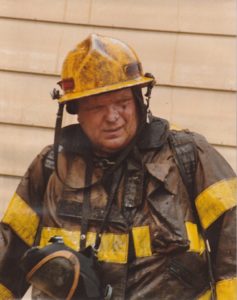
Earlier this week we returned from Anderson, Indiana, where my father in law Mike Riggs was laid to rest.
His obituary is here. Those who worked with him said he was always “first in, last out” on every call: a role model and a mentor that took great pride in his work, and considered heroic acts just “doing my job”.
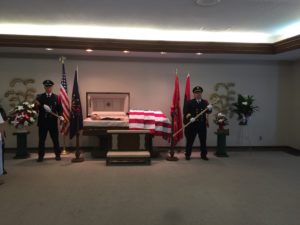
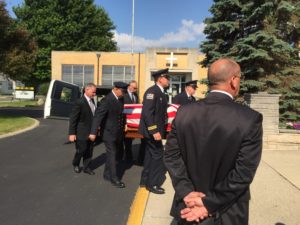
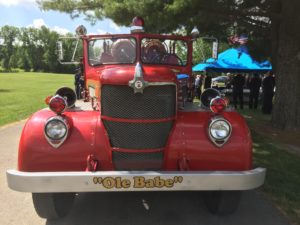
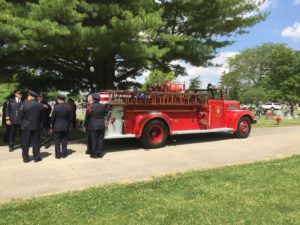
Mike spent 34 years working as a firefighter for the city of Anderson before moving to Texas to retire. The firefighters stood watch over him during the visitation, flew flags at all the fire stations at half mast, and those working at the station where he spent most of his career had other tributes to him as well. His casket was carried from the funeral home to the cemetery in “Ole Babe”, a 1953 fire engine. Mike is one of five members of Penny’s extended family have worked for the Anderson Fire Dept over several generations, including one who was on the job when Ole Babe was a working unit.
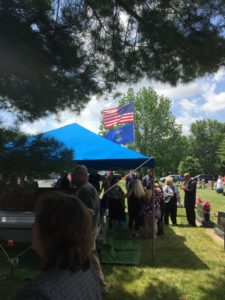
In addition to Fire Department honors, Mike was honored for his Vietnam-era military service. The Air Force sent an honor guard who conducted a flag ceremony and presented the family with the American flag. American Legion volunteers fired a rifle salute and played Taps.
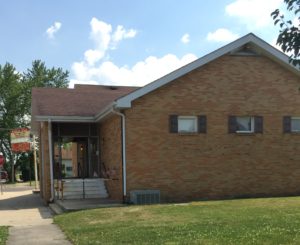
. After the funeral we had the opportunity to visit a historic neighborhood bar, The Polish Club, which was the place Penny’s grandparents were married, and a place frequented by Mike, other firefighters, and others in the community.
Funerals are never fun or happy, but it was good to see their family and friends, meet and talk about Mike with his brother firefighters, and honor his memory in all the ways we could.
Mike’s favorite charity was the Fire Rescue House, a home for fire victims (the first one was built in Anderson).
In addition to teaching group classes, I offer private lessons. Here are some of the observations and lessons learned from those classes, which I taught at KR Training’s A-Zone Range facility. Private lessons are available, by appointment, on most weekdays and weekday evenings. Often these take the form of private versions of our regular group classes, refresher lessons on group course material, or coaching to get graduates of those courses tuned up and ready for the next course in the series.
Recently on the KR Training Facebook page, I was asked about reasons why people would prefer private training to group classes. Here are a few common reasons:
Weekend workers. Many businesses, particularly retail businesses, have their busiest days on weekends, making it hard to get away to attend group classes. Customers in that category range from musicians (including members of touring bands), gun shop owners, police/fire/EMS personnel, and many different retail salespeople.
Refresher/booster training. Some students want a 1-2 hour session where they can review and refresh skills learned in classes, or get follow up training shortly after taking a group class, to correct a problem identified during the group course, without the time investment of re-taking the entire course.
Special challenges. Students with poor vision, limited dexterity, limited grip strength, small hands, limited mobility or other physical issues often find private training a better choice. A private session provides more flexibility to spend as much time as needed, try as many guns, stances, sights, lasers, or whatever is required to find the best solutions for that student. Often the amount of time and attention required is beyond what is available in a group class.
Privacy. Some of my private lesson students are individuals that do not want others to know that they are training or carrying. That category, in the past, has included public officials (judges, public and private lawyers, officials with state agencies and universities), professional entertainers and athletes, reporters, teachers, nurses, doctors, and others in the public eye.
Travelers & tourists. I’ve done private classes for individuals and groups that were passing through the Central Texas area for business or pleasure, who wanted some training or a fun shooting session using our gear, with coaching.
Nervous novices. Many that are new to firearms want private training because they think that their level of inexperience will put them too far behind students in our most basic classes. They don’t want to come to a group class and be ‘that student’ that can’t keep up, or makes a mistake in front of others. Guns are scary and dangerous, and some students need a pre-class confidence building session to feel ready to attend a group course.
The serious student. I have several regular private lesson students who are very motivated, training hard on their own. They contact me when they have specific questions or need coaching on specific skills, often connected with one of the many challenging standardized shooting tests used by many different schools. Even my most advanced group classes may not cover the exact training they need.
I’m currently booking private lessons for the period July 10-August 31. Weekdays (mornings, afternoon and evenings running as late as 9 pm) are available. One popular option is to do a private lesson the afternoon of a scheduled Wednesday night USPSA match at the A-Zone. Get 2 hours of coaching in, cool off in the AC and then shoot the match.
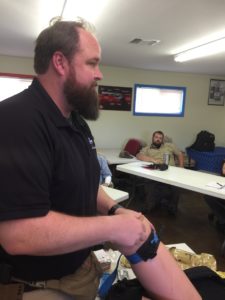
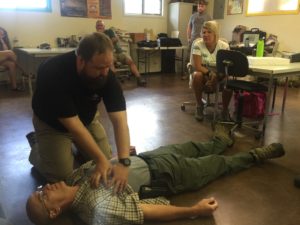
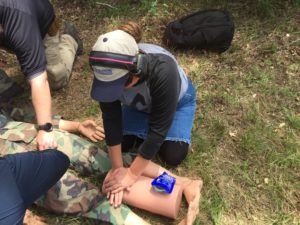
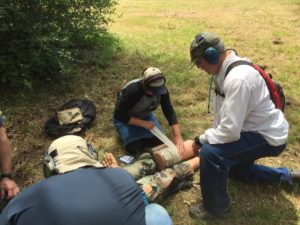
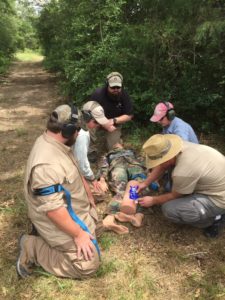
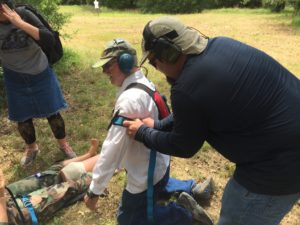
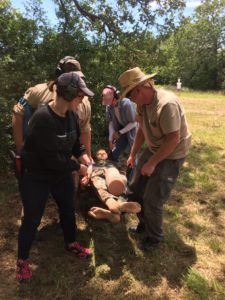
KR Training recently hosted and co-taught the Medicine X Every Day Carry course, taught by Caleb Causey of Lone Star Medics, at the A-Zone Range. The two day course teaches hands on medic and scene security skills useful in that time between the injury and the arrival of first responders that can provide a higher level of security and care. The second day provides opportunities for students to apply medic skills in multiple scenarios where shooting, tactics, and communication are also integrated.
Day one was mostly spent in the classroom, learning patient assessment skills, tourniquet application, wound packing, and other fundamentals.
The topic of what to carry every day, and how to carry it, was covered in depth. One takeaway for me from this course was Caleb’s observation that clotting gauze can be used more places on the body that a tourniquet can, so it may be more important to carry than a TQ, particularly for use on children. I explained to the class that based purely on likelihood of need and risk analysis that I had changed my own daily carry to prioritize a tourniquet/med gear over a spare magazine, in situations where carrying both on my person was difficult, because the odds of needing the medical gear was likely much higher than the need for the spare magazine. Obviously having both items available is best, but in non-permissive environments, compromises may be necessary.
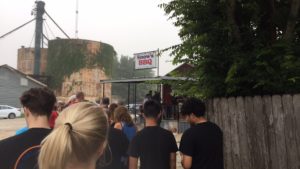
Lunch on day one was Texas’ best brisket, from Snow’s BBQ in Lexington, about 15 minutes from the A-Zone. Snow’s had just been crowned #1 in the state (again) by Texas Monthly. After a 90 minute wait in line, with 200 people behind me, I headed back to the A-Zone with multiple briskets and some pork shoulder.
Part of the afternoon of day 1 was spent working on integrating tourniquet use into a live fire drill where the shooter engaged a target…
retreated to cover (gun placed on ground to simulate the effects of an injury and as a safer substitute for reholstering)…
applied a tourniquet to the designated limb…
picked up the pistol and re-engaged the target.
The goal for this drill was under 30 seconds, with at least 5 hits on the target (3 at start, 2 from cover) and a properly applied TQ. We ran some additional drills working on team tactics, communication and movement, and one drill integrating that material with the application of a TQ and target re-engagement by one team member.
DAY TWO
After some additional classroom material
and instruction on drags and carries,
we split the class into teams and ran them through a scenario in the wooded part of the A-Zone property, searching for their missing friend (“Rescue” Randy), who was discovered down by the pond, injured, with multiple threats (falling steel targets) nearby.
Randy had to be assessed…
moved to cover…
his injuries treated…
and injuries to other team members that occurred during the rescue had to be treated.
Then Randy was evacuated out of the area back to a vehicle.
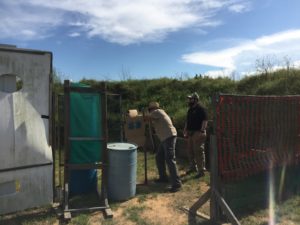
Additional scenarios were run in the shoot house berm, using a variety of paper and 3D targets.
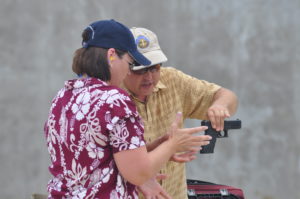
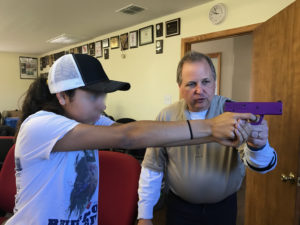
I taught a lot of private handgun lessons over the past two weeks, and I wanted to share some of the observations and lessons learned from those classes, which I taught at KR Training’s A-Zone Range facility. Private lessons are available, by appointment, on most weekdays and weekday evenings. Often these take the form of private versions of our regular group classes, refresher lessons on group course material, or coaching to get graduates of those courses tuned up and ready for the next course in the series.
Multiple students had challenges with lack of hand strength and small hands. Most of the time, I strongly recommend against pistols in 380 caliber, and against the idea of planning on thumb-cocking a double action revolver in a defensive shooting situation. However: I had situations occur during lessons where both of those things turned out to be what produced the best results with students.
I had a student with short fingers: not unusual. She was able to shoot both the 9mm Shield and Glock 42, but gun fit on the 42 allowed better trigger finger placement because of the 42’s shorter trigger reach. We ran multiple drills using both guns, and her scores with the G42 were better. It wasn’t hand strength, nor any aversion to recoil. In the end, ability to get hits has to come first before caliber or capacity, so I ended up recommending the G42.
Grip strength was an issue for one student that could not work the slide on his Walther PPK, and could not handle the double action first shot trigger. As is very common with untrained shooters that buy DA/SA style guns, he had not practiced with the DA trigger prior to the lesson, only the single action trigger, and had not been told by the gun salesman that the gun was not safe to carry with the hammer back (had to be decocked to carry.) We tried a variety of 9mm pistols but based on hand strength issues, the little G42 was once again the gun that worked best.
The final case study was an older student with limited hand strength and a mild tremor in the dominant hand. That student tried a variety of guns but ended up shooting best with their own steel framed double action revolver that was thumb-cocked for each shot (S&W model 36). The student’s hand strength was low enough that even the G42’s slide was a challenge. At the end of the lesson I suggested the student try switching hands, shooting the gun two handed but using the left (tremor-less) as the dominant hand. I am hoping for a report back from the student on whether that worked better or worse.
A side note: New York’s recently proposed “Child Operated Firearm” bill, mandating a 10 pound double action only trigger pull on all firearms, would effectively disarm several of my recent students, as they would be physically unable to fire a pistol with a trigger pull that heavy.
Many of these cases served as reminders to me that the end goal has to be improving the student’s ability to get timely, effective hits, regardless of the equipment used. For younger, stronger shooters with medium or larger sized hands and good vision, many equipment options are available. Those with less ideal physical characteristics have to work harder, and often have fewer viable choices for gear.
My father-in-law, Michael Riggs, passed away early Monday morning after a very long fight with cancer. His official Texas obituary is here.
Mike spent his life helping others, as a firefighter/EMT for 34 years, in the Air Force during the Vietnam War, through his church, as a Knight of Columbus, in his kitchen equipment repair business, and in his personal life. He welcomed me into the Riggs family when Penny and I got married, and after moving to Texas, became a part of the KR Training family, as a range safety officer with me when we worked Lee County Wildlife Association youth shooting events, and assisting me with many behind-the-scenes projects fixing, maintaining and building equipment used at the A-Zone range. He was the one that drove me to the La Grange hospital ER when I had a bad case of norovirus and called him at 4 am from the A-Zone needing help.
He was a great father-in-law to me, a great father to his children, and a devoted grandfather to his grandson Dusty Tilbury. I am glad I had many years to enjoy his frequent company after he and Karen moved to Texas and built their home next door to the A-Zone.
Kalen Perez
On Thursday, June 1 2017, Kalen Perez, the fiance’ of my nephew Alan Rogers, passed away suddenly and unexpectedly from complications due to a seizure.
Kalen and Alan had been together for many years. Every time I saw them it was easy to see how close they were and how much they cared for each other. They made each other happy.
In lieu of flowers, her family is accepting donation via their church, The Well to help pay for her services or donations to TGPR-Texas Great Pyrenees Rescue, an organization Kalen spent the last few months of her life dedicated to.