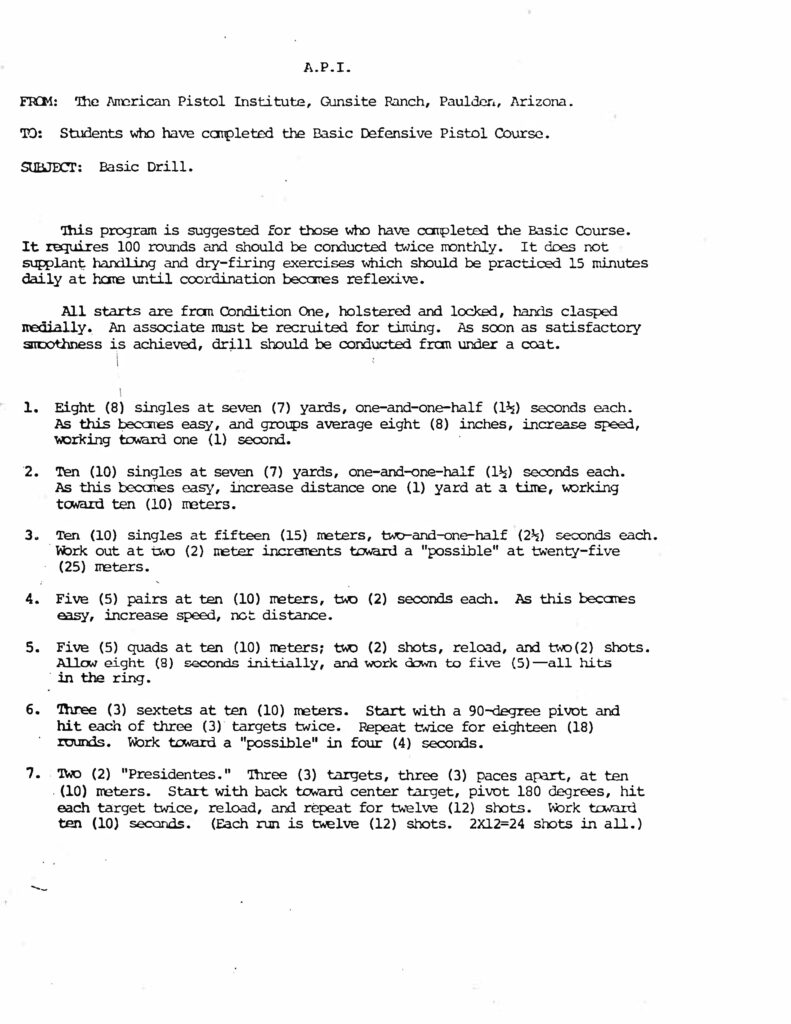
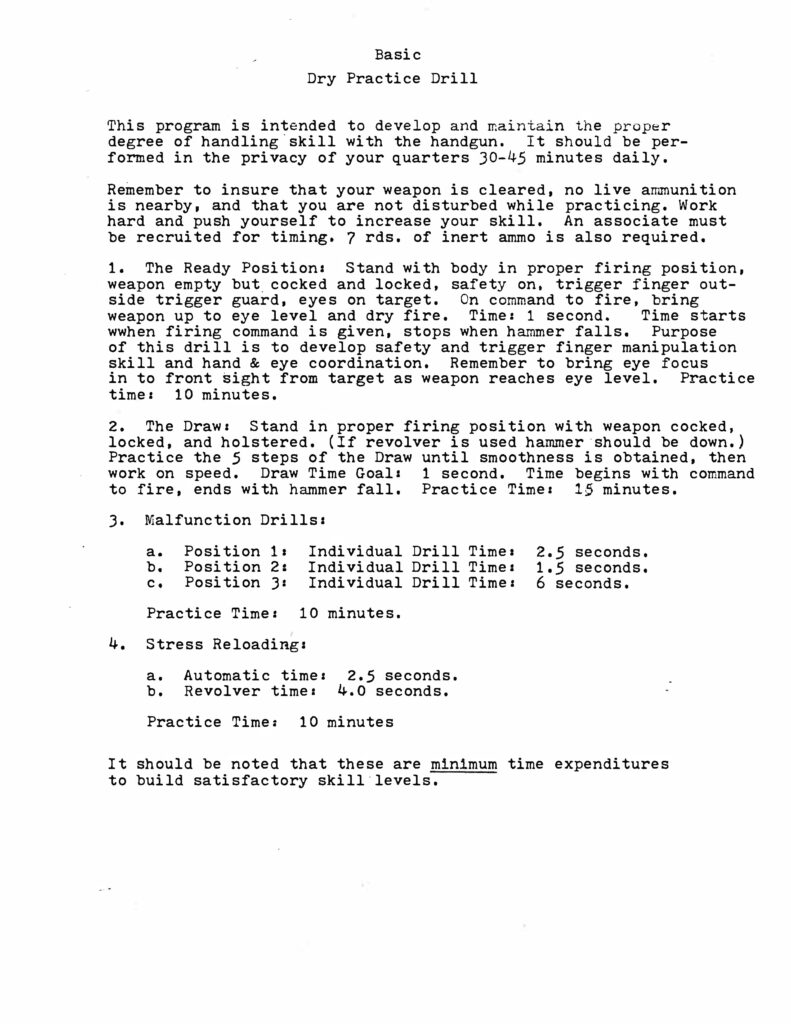
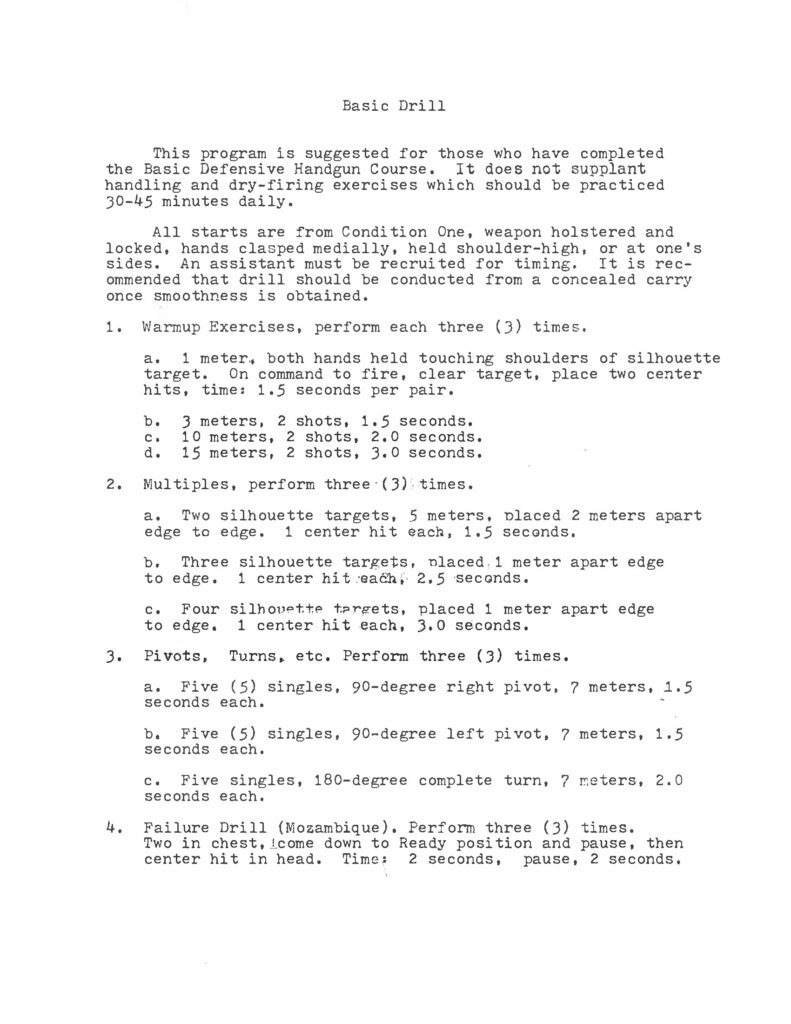
The Modern Technique of the Pistol was written by Gregory Morrison, as part of his PhD work. It compiles many of the techniques and concepts taught at Gunsite in the 1980’s. The book is available direct from the Gunsite Pro Shop.
The contents of the book are listed below. It covers the standard topics found in virtually any handgun training manual, separated into mindset, gunhandling and marksmanship categories, with some additional material included in the final section.
From the foreword of the book:
It must be emphasized that the Modern Technique of the Pistol is a completely civilian development and not a product of either the police or military establishment. It is practically impossible for anything radical or innovative to be introduced by people on the public payroll, bureaucracy being what it is. Several of the people involved in the movement were indeed in the public service at one time or another, but their pioneering work in shooting was done on their own time, at their own expense, and in some cases contrary to the policies of their superiors.
The Modern Technique of the Pistol, Jeff Cooper foreward, 1991
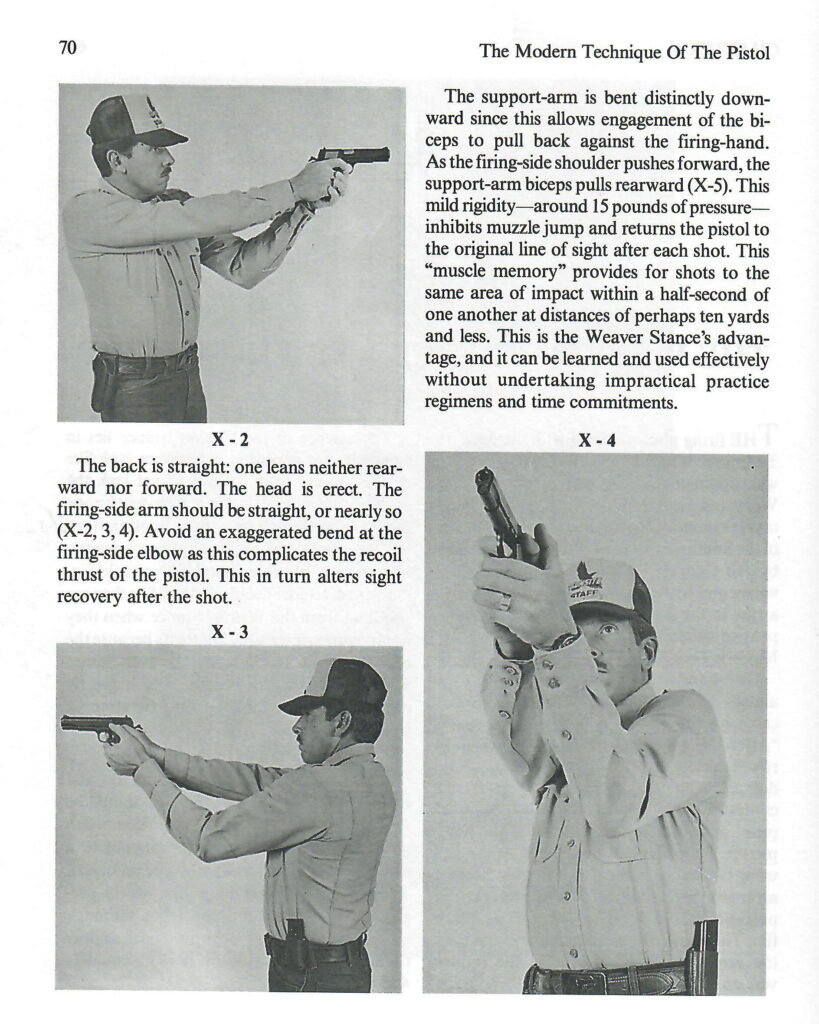
In the 1980’s and early 1990’s, the Weaver stance was widely taught and used. The book provides explanation and pictures documenting what a proper Weaver stance is.
In this video, Jack Weaver discusses the history of the stance that bears his name.
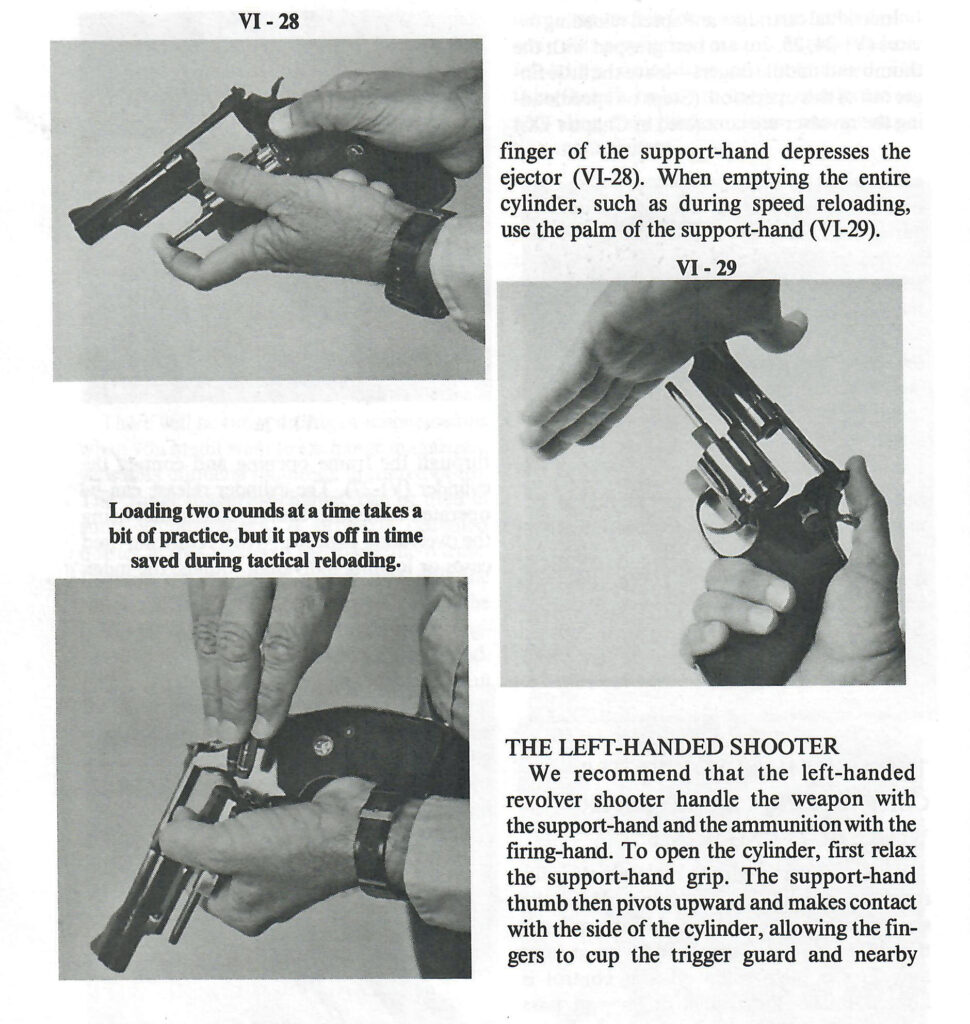
During the 1980’s, semiauto pistols began to displace revolvers as the standard duty handgun for law enforcement, and interest in semiauto pistols for personal defense grew, as traveling trainers teaching Modern Technique and practical shooting matches became more popular. Discussion of revolver reloads, in particular, began to be phased out of training programs and books on handgunning. Morrison’s book covers revolver techniques for right- and left-handed shooters. In the current era very few instructor programs spend any time at all on these techniques. Tom Givens included a block of instruction on that material in his Master Instructor course.
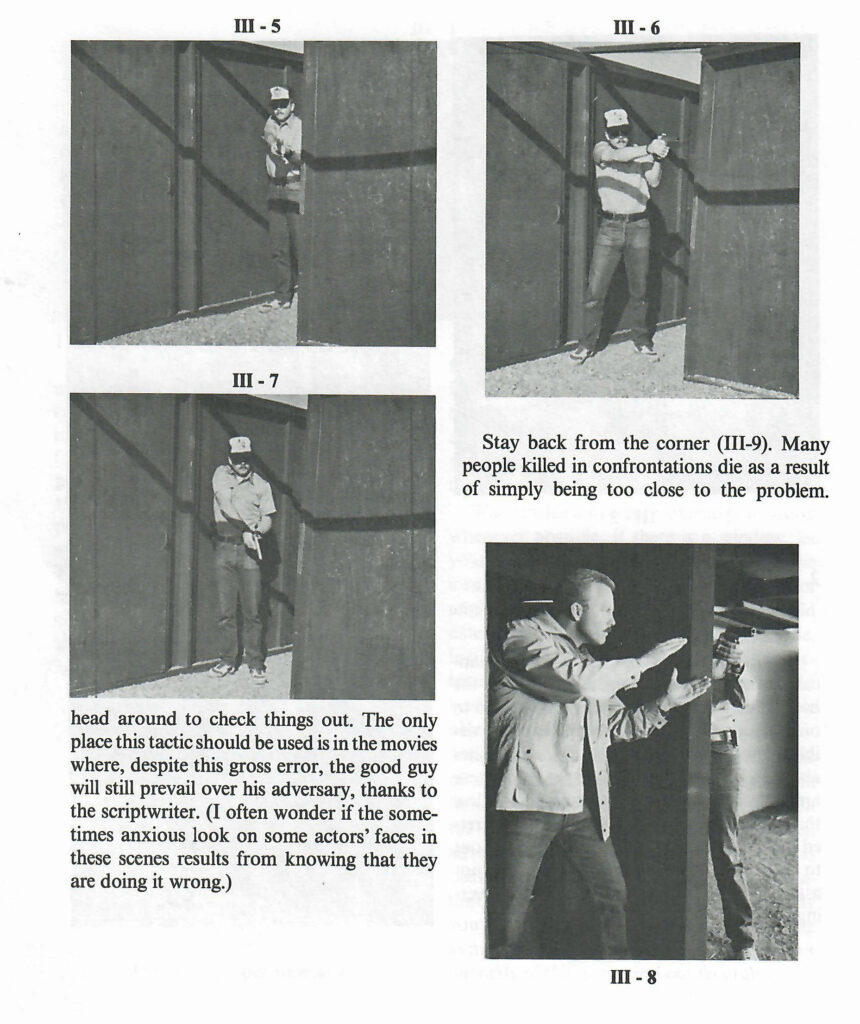
Gunsite has multiple shoot houses, and has always taught “house clearing” (armed movement in structures) skills. Prior to the Gunsite era, armed citizens typically had no access to this type of training.
In the early days of practical shooting, kneeling and prone positions were far more commonly taught and practiced.
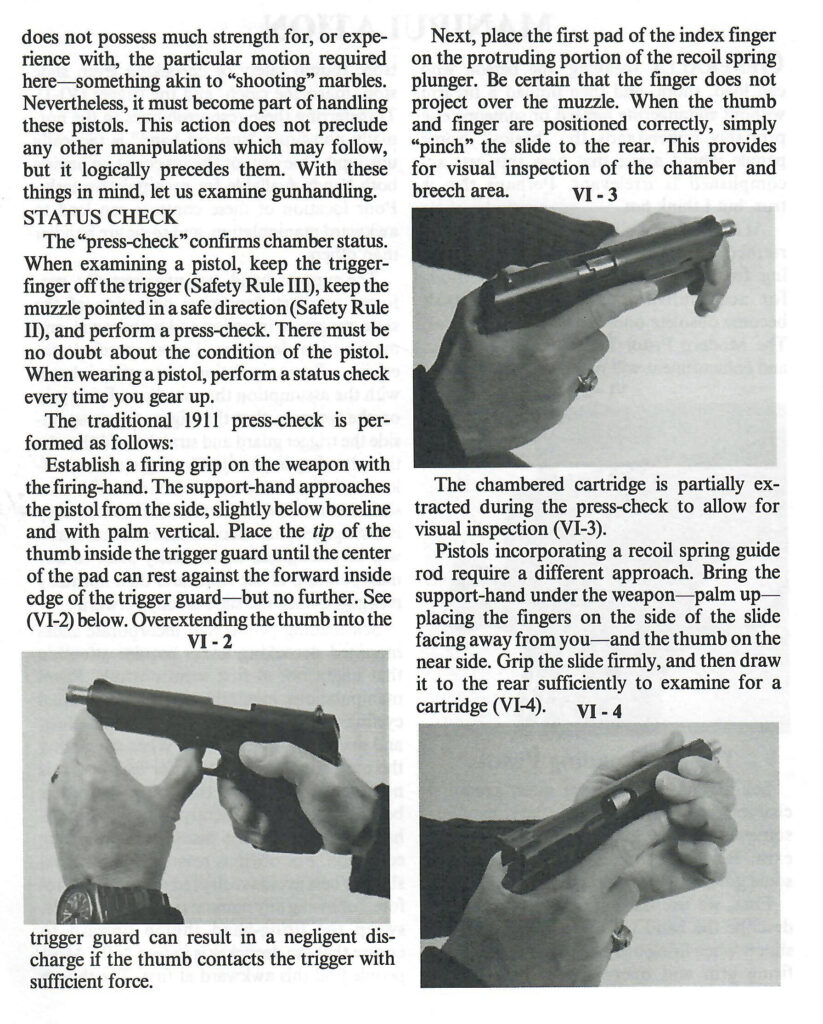
The majority of students training at Gunsite were using 1911 pistols, and many of the techniques taught for gun manipulation were specific to that model (and in some cases, such as the press check method shown below), only possible for certain configurations of 1911. The pinch technique does not work for a gun with full length guide rod. (That’s one of many reasons why that technique is no longer commonly taught.)
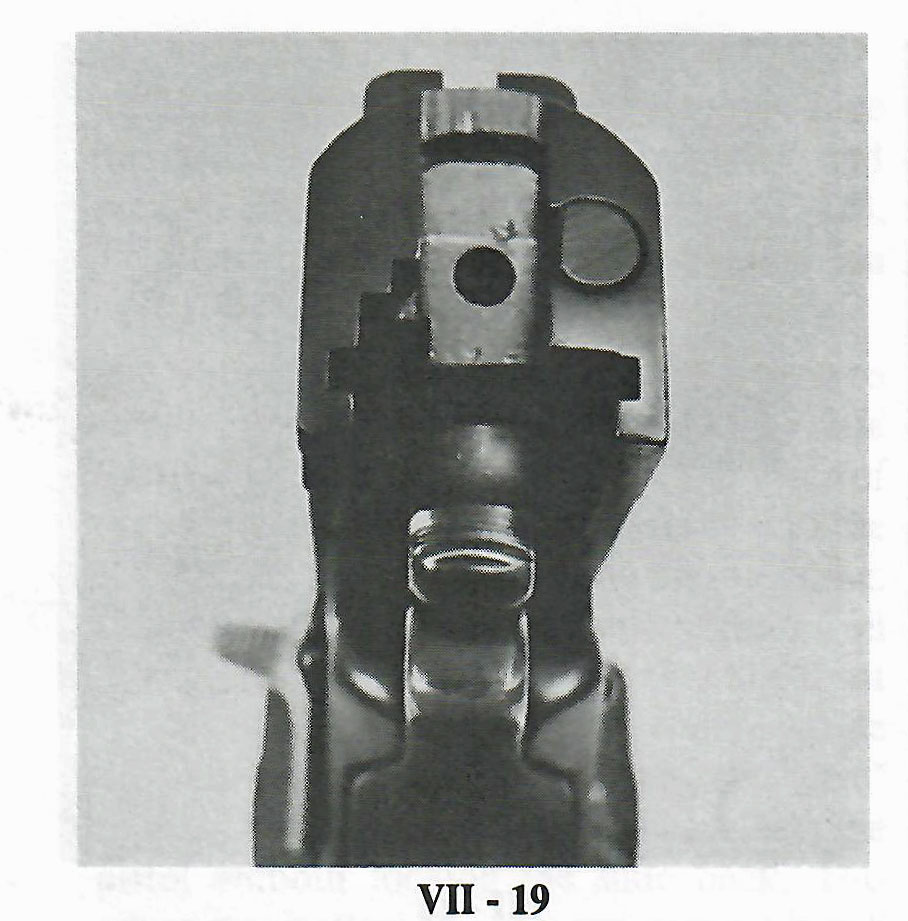
In the section on malfunctions, a 1911-specific malfunction is explained. It occurs when the firing pin stop drops down, preventing the firing pin from returning to its correct position after a round is fired. In the days of custom 1911s this may have been a more common problem. I shot 1911 pistols in the late 80s and all throughout the 1990s and never saw this particular malfunction occur in my own guns or anyone else’s — but apparently it occurred enough times to make the malfunction list in the book.
Perhaps the most misunderstood term that’s part of the Modern Technique is “double tap”. Both USPSA and IDPA competitions require “best 2 hits” on paper targets, and many competitors (particularly those that begin competing without getting any training beyond the carry permit level) hear fast shooters rattling off quick pairs and assume that what is occurring is “aim once, work the trigger twice” shooting. (There is a USPSA club in San Antonio Texas named the Alpha-Mike shooters. Their name comes from the score that often occurs when the “aim once, shoot twice” technique is used: one A-zone (Alpha) hit, and one miss (Mike).
The book explains the more precise terms of ‘hammer pair’, ‘dedicated pair’, and ‘controlled pair’. Just as the Eskimos have many words for snow, shooters have many words to describe the nuances of sights and trigger manipulation. According to the book, the hammer pair involves pressing the trigger for shot #2 as quickly as possible and is “usually reserved for distances of a few paces”). For a dedicated pair, the shooter uses their experience and familiarity with the recoil cycle of the gun to sync the timing of the second shot to point at which the gun is roughly indexed on the target. Each shot of a controlled pair has its own sight picture, and is controlled individually. The subtleties of these concepts only make sense to those that put in a lot of time working on fast pairs (or longer sequences such as 6 shot Bill Drills), and in practice become a balancing act between timing and visual information and recoil.
Unlike many older books on shooting, the Modern Technique book is not easily located in the used market and new copies are not listed on amazon. There is no e-book version. The best way to get a copy is to order direct from the Gunsite Pro Shop.
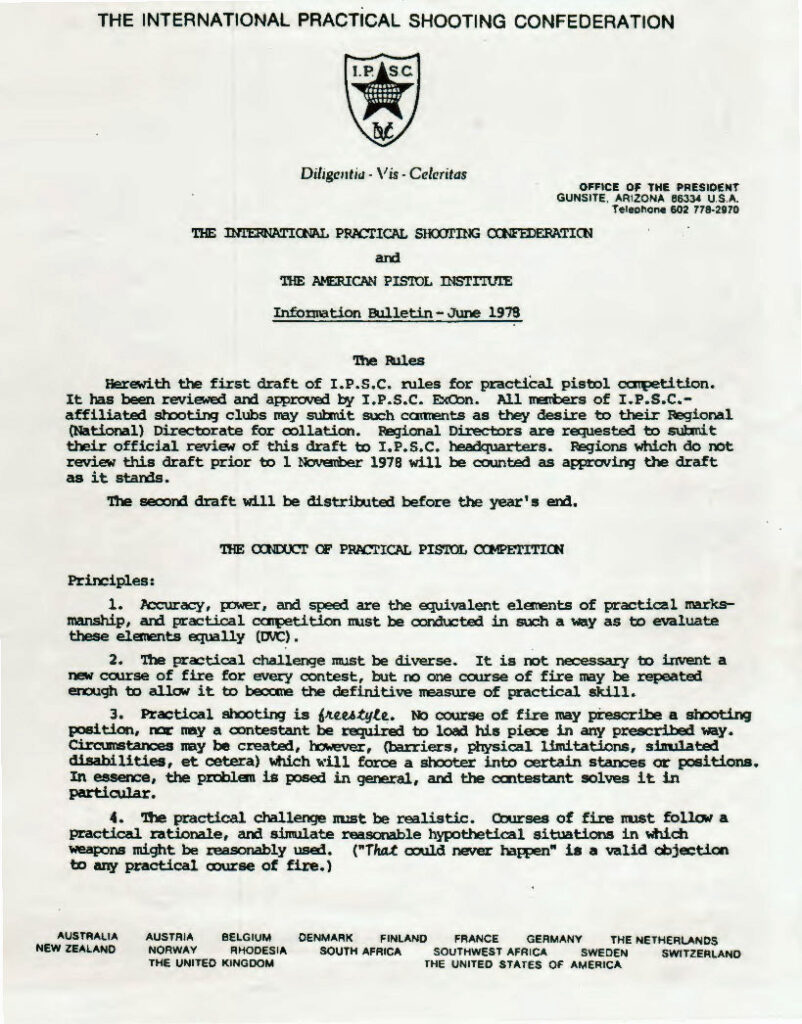
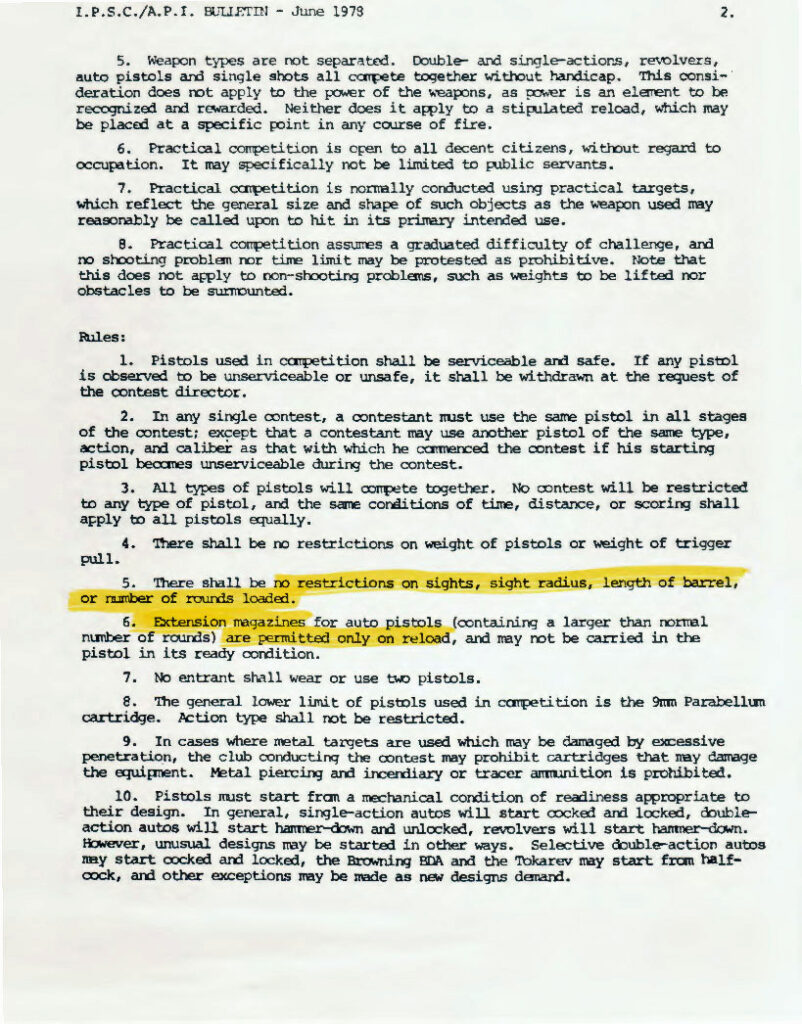
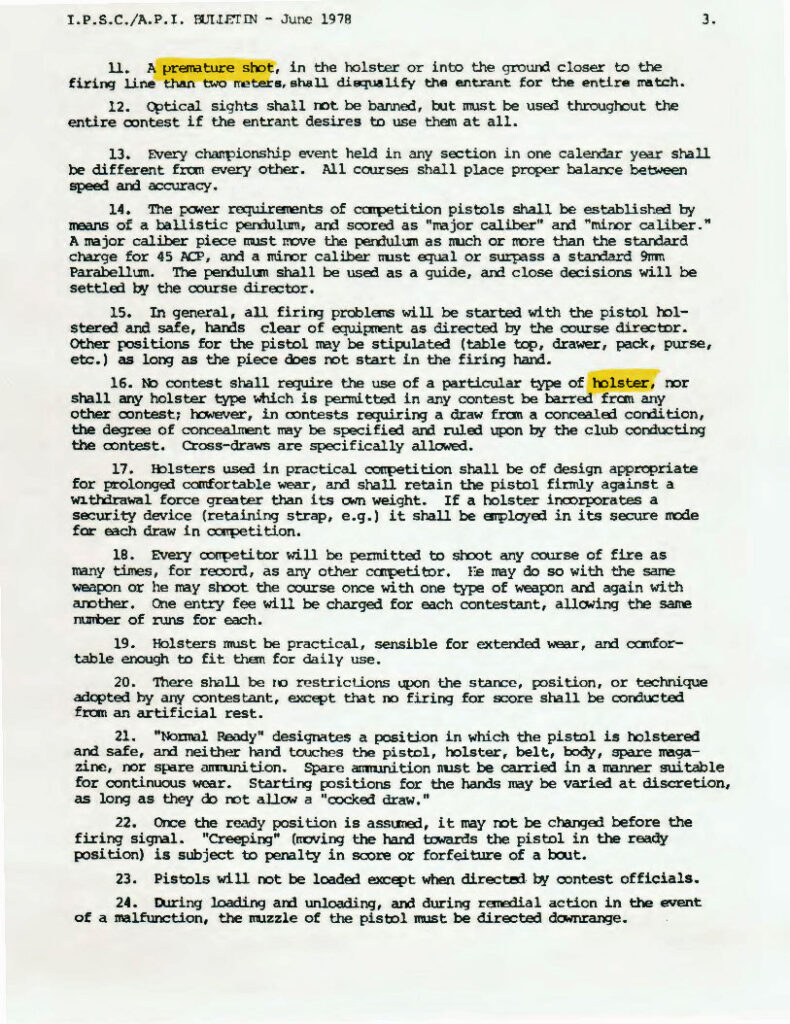
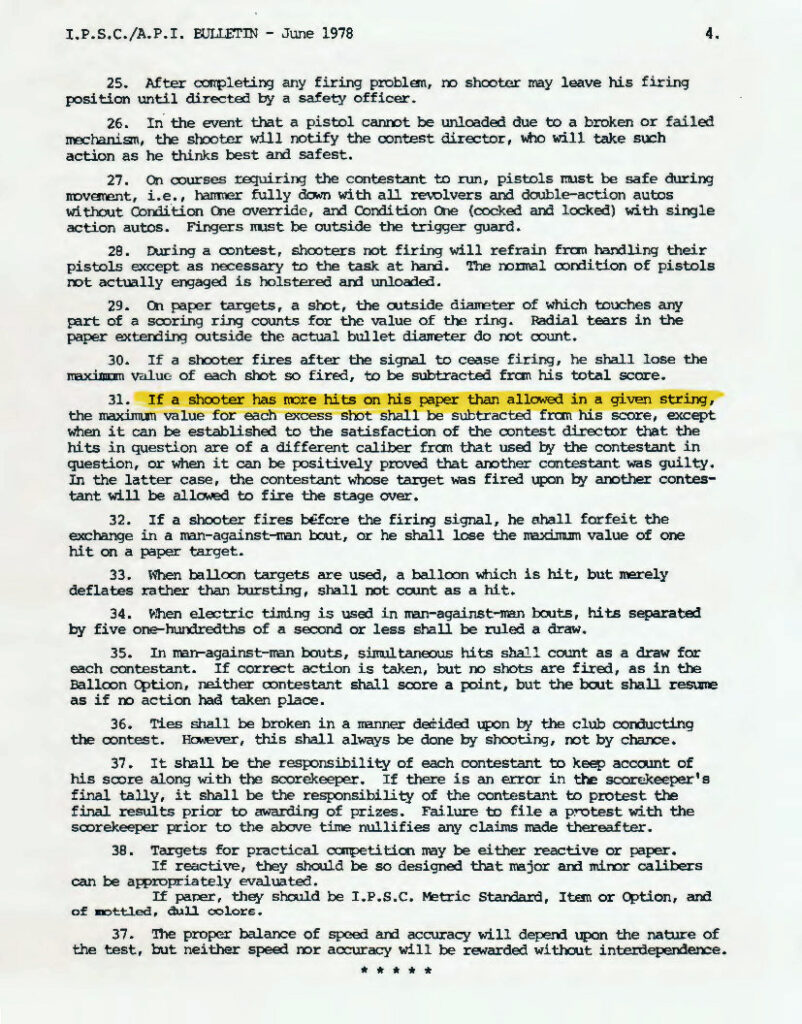
More from Bob Hanna: a copy of the first draft of the IPSC rules for practical pistol competition, sent to Bob by Jeff Cooper, when Bob was competition director for the Brazos Practical Shooters, a sub group of the Sugarland (Texas) Sportsman’s Club.
The rules are interesting, in historical context, as so many of them have eroded over time from the original intent. Principle #4 was perhaps the first to go, as truly ‘realistic’ stages simply don’t have enough targets or shots fired to be as exciting or interesting as longer courses of fire. Principle #5 (weapon types are not separated) proved to be unworkable in a sporting context, as every practical pistol sport is now subdivided into divisions based on action type and other characteristics.
In 1978, the idea of a magazine capacity ban was not a concern. It was only after the 1994 national magazine capacity law (and state laws that persisted after the national law expired and was not renewed) that capacity limits became an issue in the pistol sports. The lack of limits on magazine capacity, along with courses of fire requiring more and more rounds, drove interest in higher capacity pistols and magazine upgrade kits allowing a few more rounds to be fit into existing magazines – from 8 round 1911 .45 magazines in the 1980’s to today’s aftermarket spring, follower and base pad vendors offering ways to increase magazine capacity by 1-3 rounds without extending mag length, and magazine extension kits for the competition approved 170mm magazines, and super extended magazines used in Pistol Caliber Carbine divisions.
The ballistic pendulum, and major/minor scoring, was later replaced with pulling and weighing bullets and measuring velocity with chronographs. The intent of this process was to prevent the use of downloaded ammunition, as was common in PPC and bullseye matches.
Principle #19: “holsters must be practical” became a controversial topic in the 1980’s, as open carry, high speed competition holsters were developed and used by match winners. Holsters evolved from steel lined leather holsters suitable for concealed carry, to very open designs using plastic locks grabbing the trigger guard. The limits imposed on holsters by IDPA are an attempt to get back to the original principles of the sport.
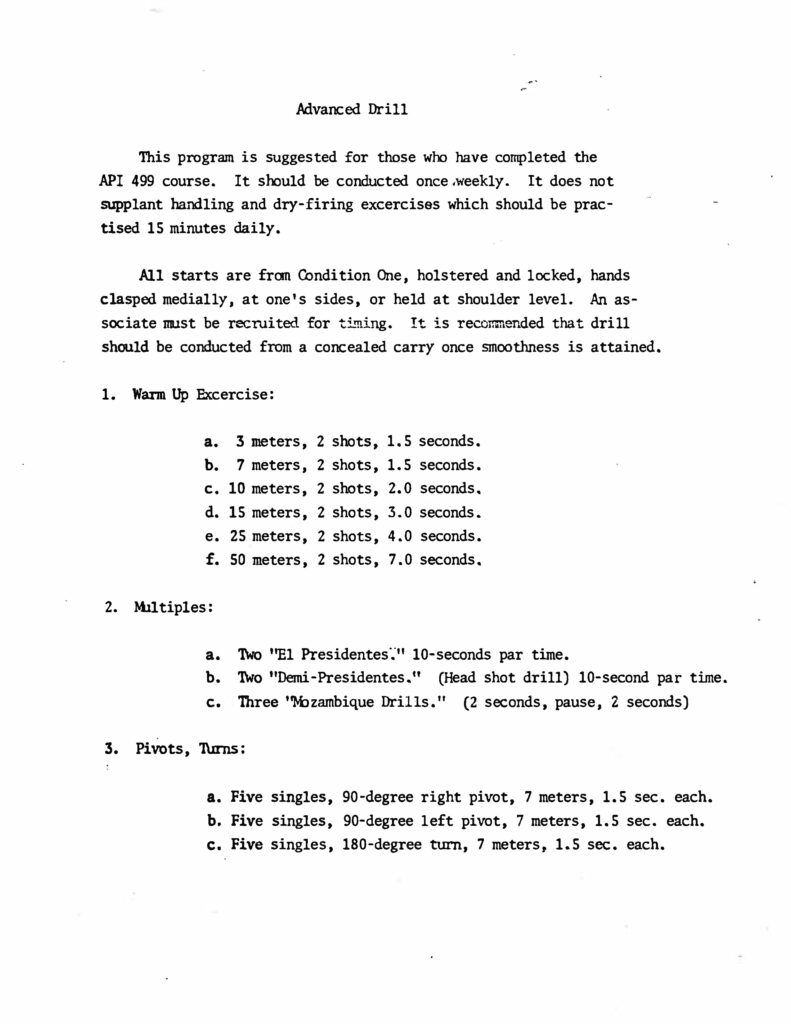
The advanced practice drill. Turning draws were emphasized a lot more in courses (and matches) in the 1980’s than they are today. Other than concerns about students muzzling others during turning draws, I have no good explanation for why that particular skill has faded away. We included a turning draw in our Three Seconds or Less test, but none of the other popular standards courses, including most law enforcement qualification courses, incorporate that skill.
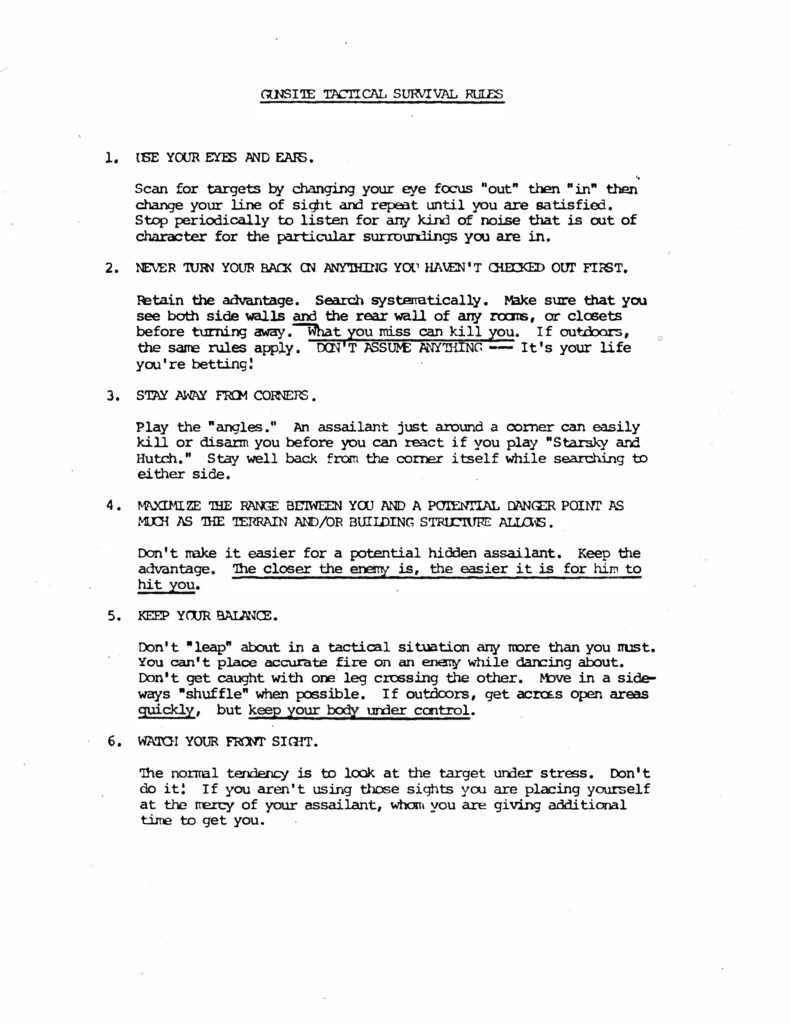
Mindset and tactics guidance.
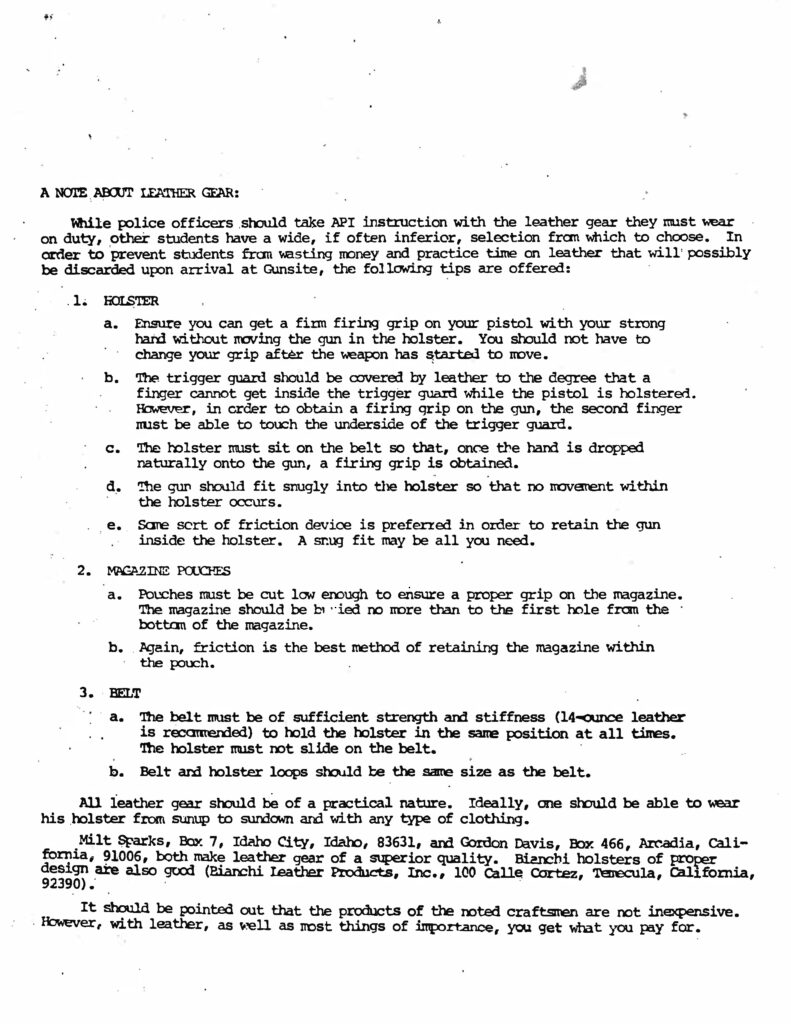
Holster advice. The issue with being able to get a full firing grip on the pistol when its holster remains valid. One common problem I deal with in almost every class or private lesson is holsters set up to ride too low to the belt, or having giant sweat guards that prevent a full firing grip on the holstered gun.
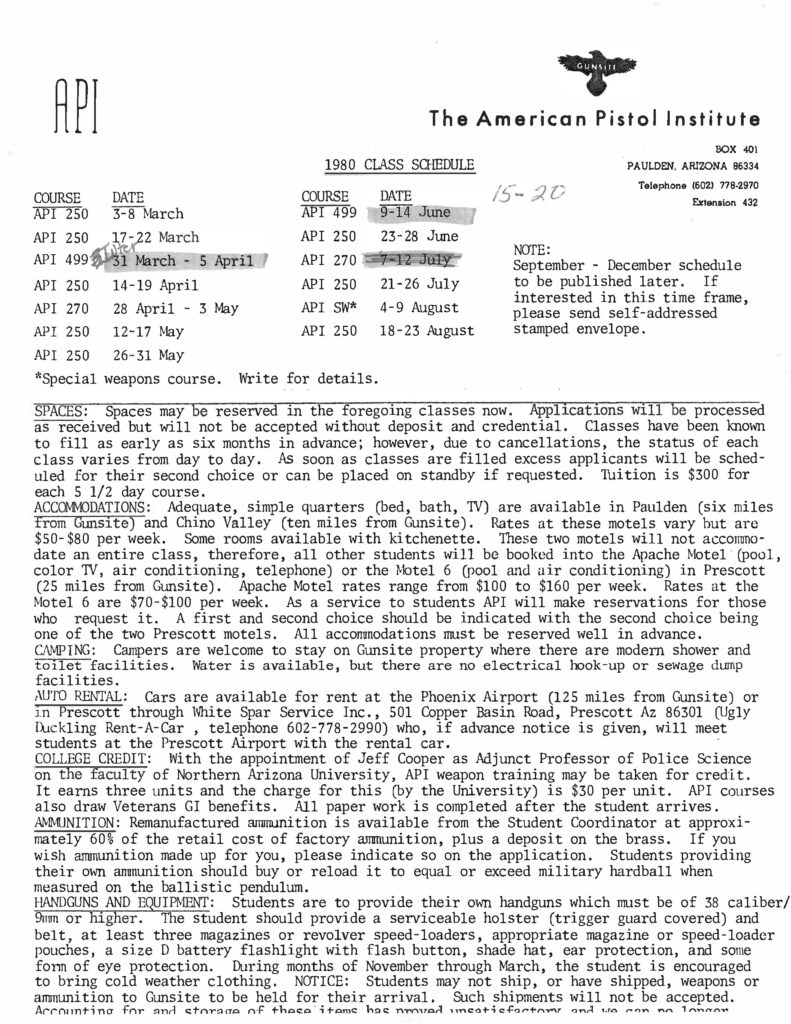
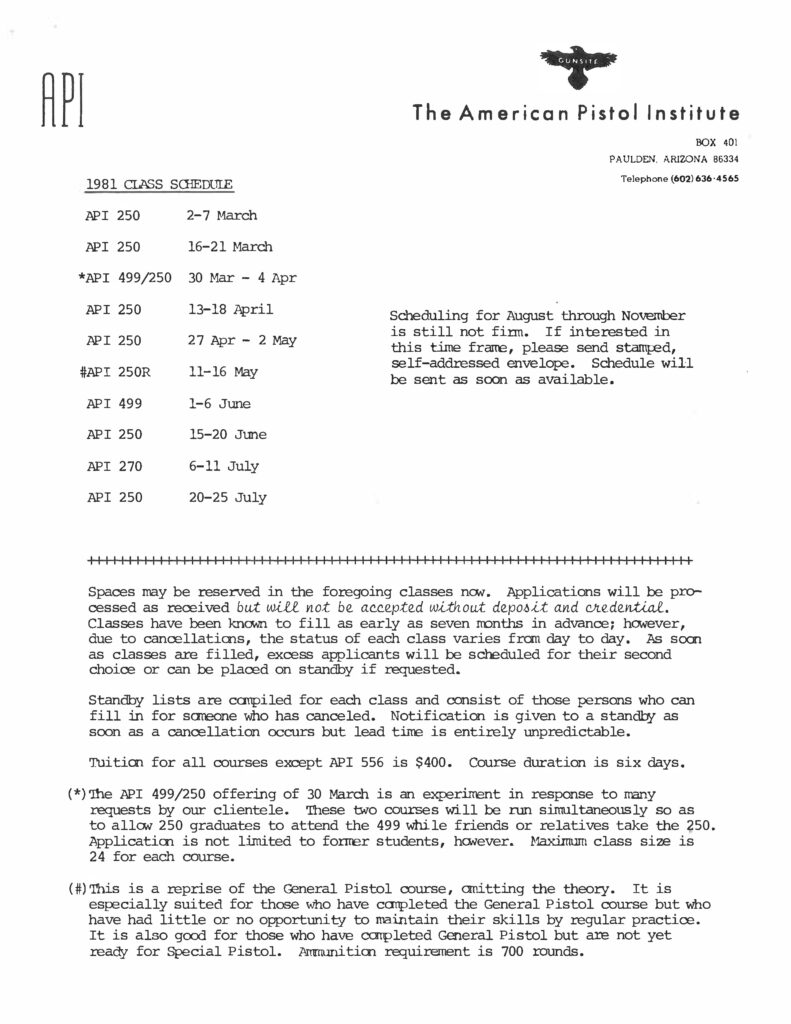
Schedules for 1980 and 1981.
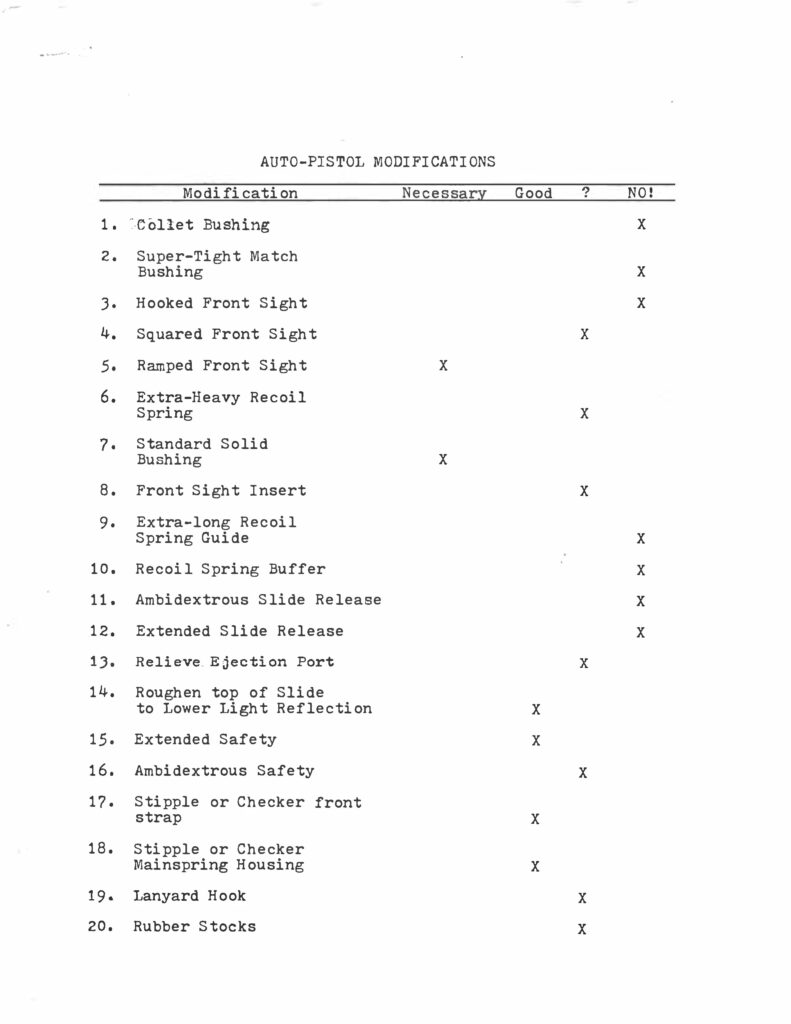
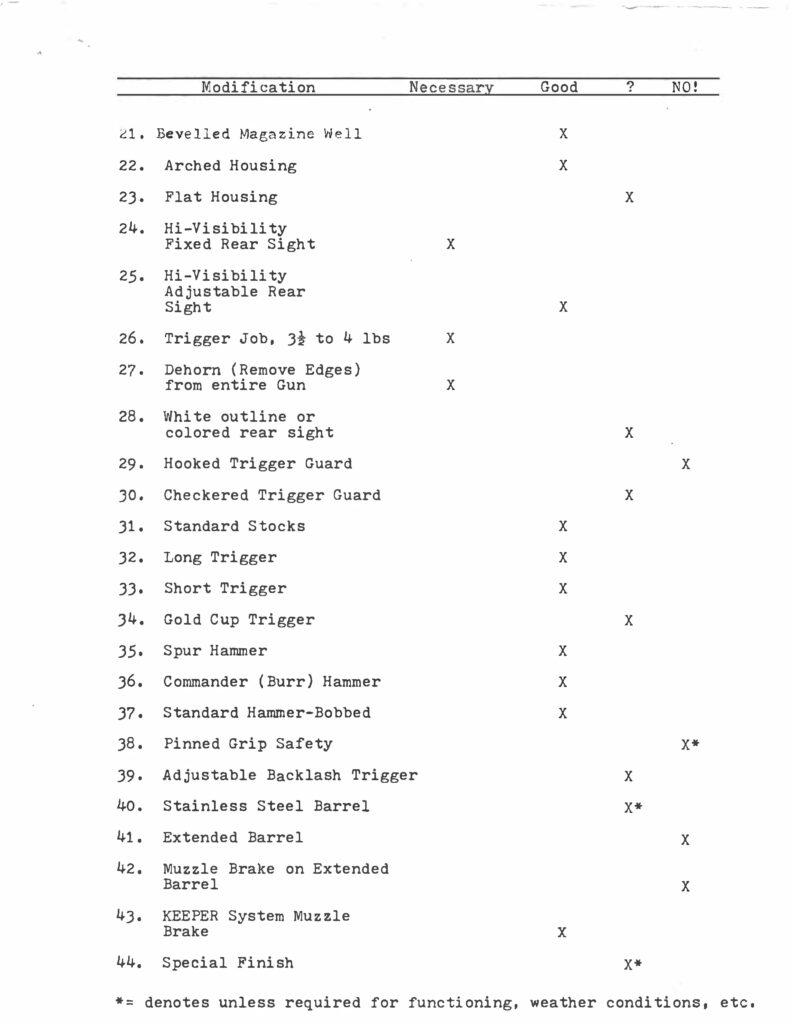
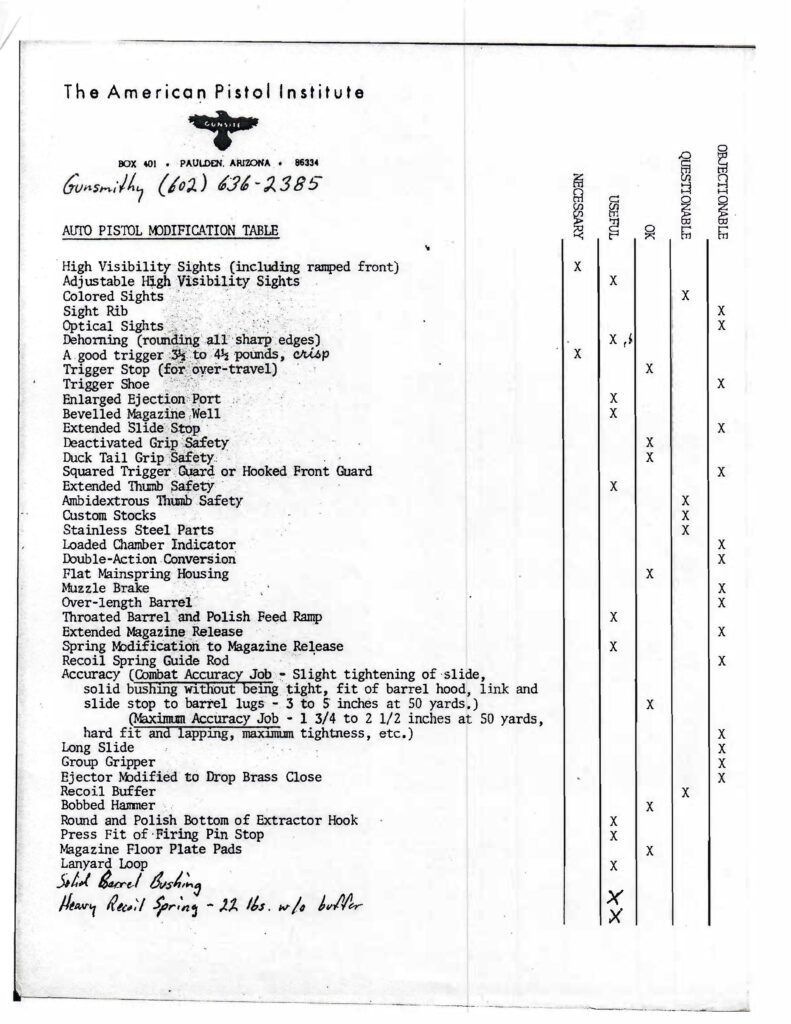
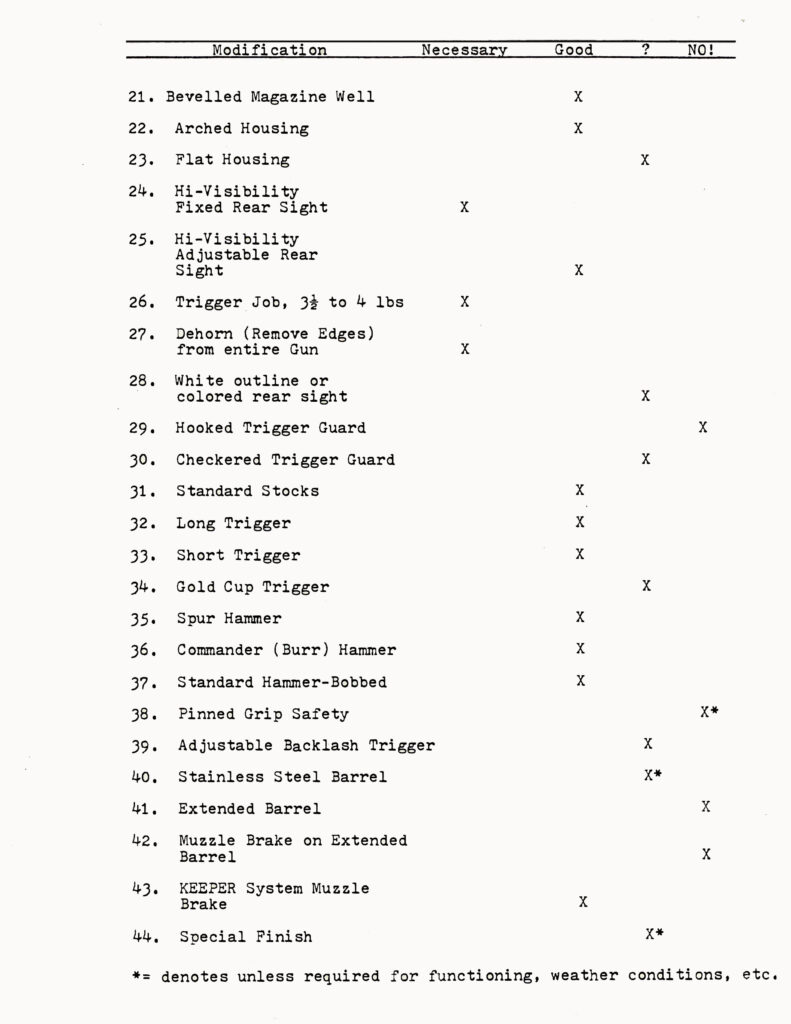
The list of pistol modifications recommended (and not recommended). Most of these are 1911-centric as that pistol was by far the most popular one with API students.
Claude Werner, a.k.a. the Tactical Professor, has a distinguished background as an analyst in the military (Special Operations), as a market research director for real estate and major accounting firms, and as a firearms trainer at the elite Rogers Shooting School.
Several years ago he began to study what he called “negative outcomes” involving armed citizens. What mistakes do they make? What are the contributing factors? It’s a topic that really hasn’t been written about or discussed within the gun culture or training community to the depth that Claude explored it.
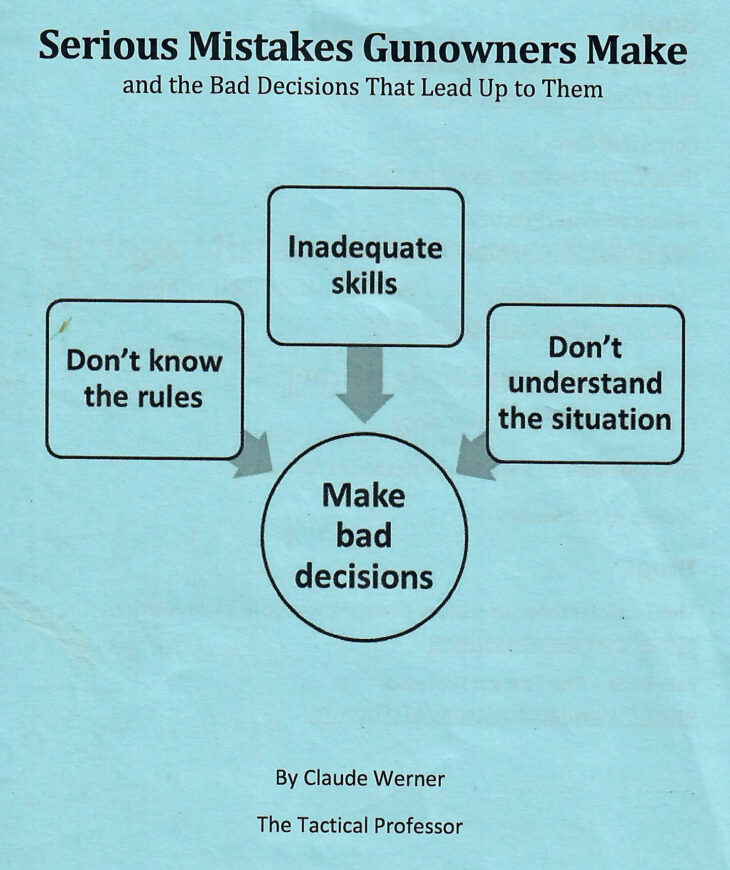
He defines three factors that lead to bad decisions and negative outcomes:
Don’t Know the Rules
Inadequate Skills
Don’t understand the situation
There’s really no excuse for not knowing the rules, in a time where information is immediately accessible online. Perhaps a better description for this factor is “didn’t think it important enough to learn the rules”. Rules could be gun safety rules, applicable laws, or the basic rules of self-defense tactics and interaction with law enforcement when armed.
The importance of dry fire practice in building skill, particularly related to safe gun handling and rapid, effective presentation of the gun from concealment, has been understood for decades, and is widely emphasized in modern training programs. Live fire time, or access to a range, isn’t required to develop most of the skills associated with pistol shooting and gunhandling. So perhaps another description for this factor is “didn’t think it was important enough to learn how to develop skills and develop them”.
“Not understanding the situation” is the most difficult factor. Unlike the other two, learning how to assess situations often requires life experience, and most armed citizens living normal lives don’t get a lot of life experience in high stress deadly force situations. Watching videos and online analyses of incidents can help, as can participating in force on force scenarios, but it’s fair to say that this particular factor requires more effort to improve than the other two.
Claude breaks down the types of mistakes into three categories:
Legal mistakes
Imprudent mistakes
Mechanical mistakes
Claude’s list of legal mistakes include unjustifiable shootings, warning shots, unnecessary intervention, and more. His definition of imprudent mistakes mainly focuses on gun access problems (lost, stolen, child access). Mechanical mistakes are related to gun handling and marksmanship.
From that he defines a list of Negative Outcomes, that include being injured or killed, arrested, tried, imprisoned, and several others.
The book itself goes into detail about each type of mistake and negative outcome.
I strongly recommend this book to all firearms trainers, particularly those teaching state carry permit classes. Carry permit students, most of whom are unmotivated to train beyond mandatory state minimums, are the ones that need to understand the information Claude presents, to understand why training and regular practice is important.
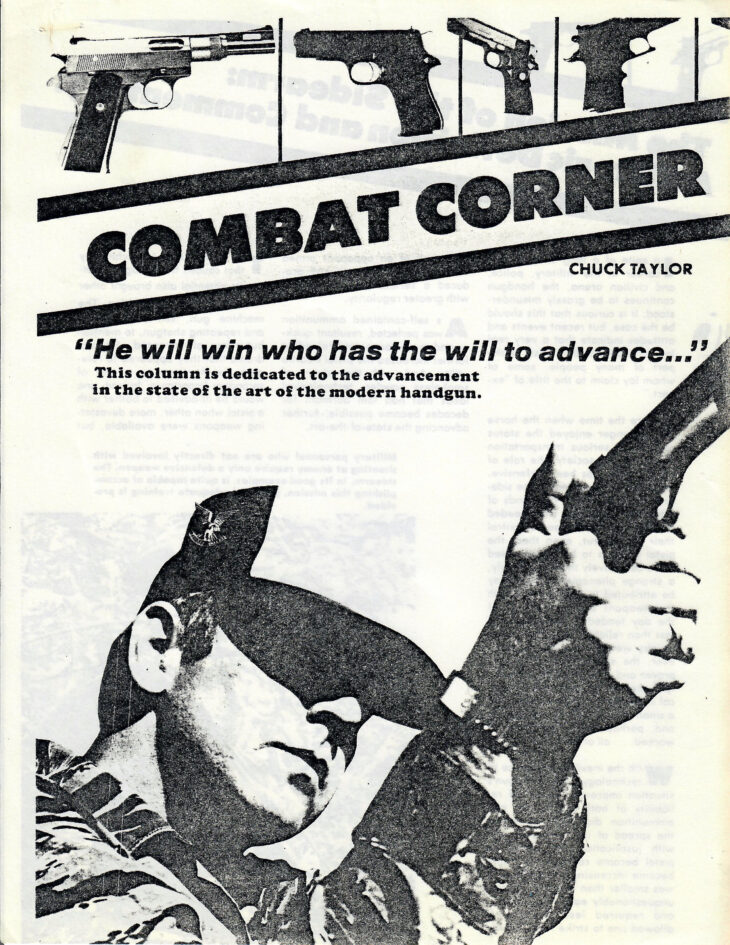
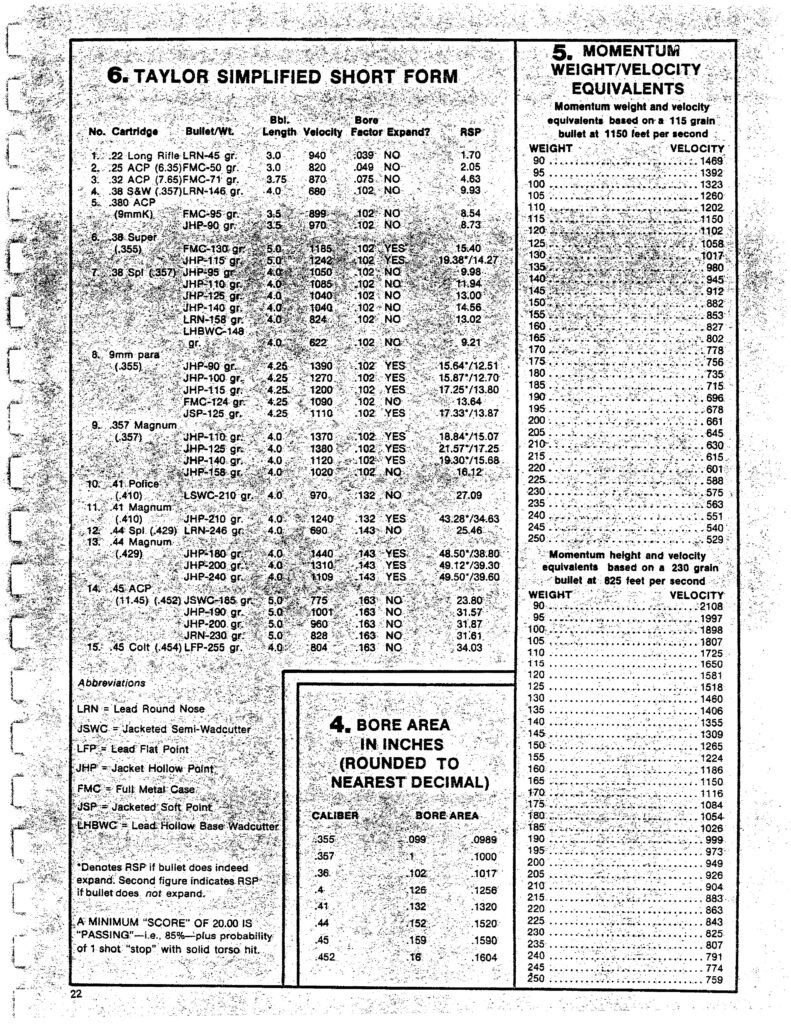
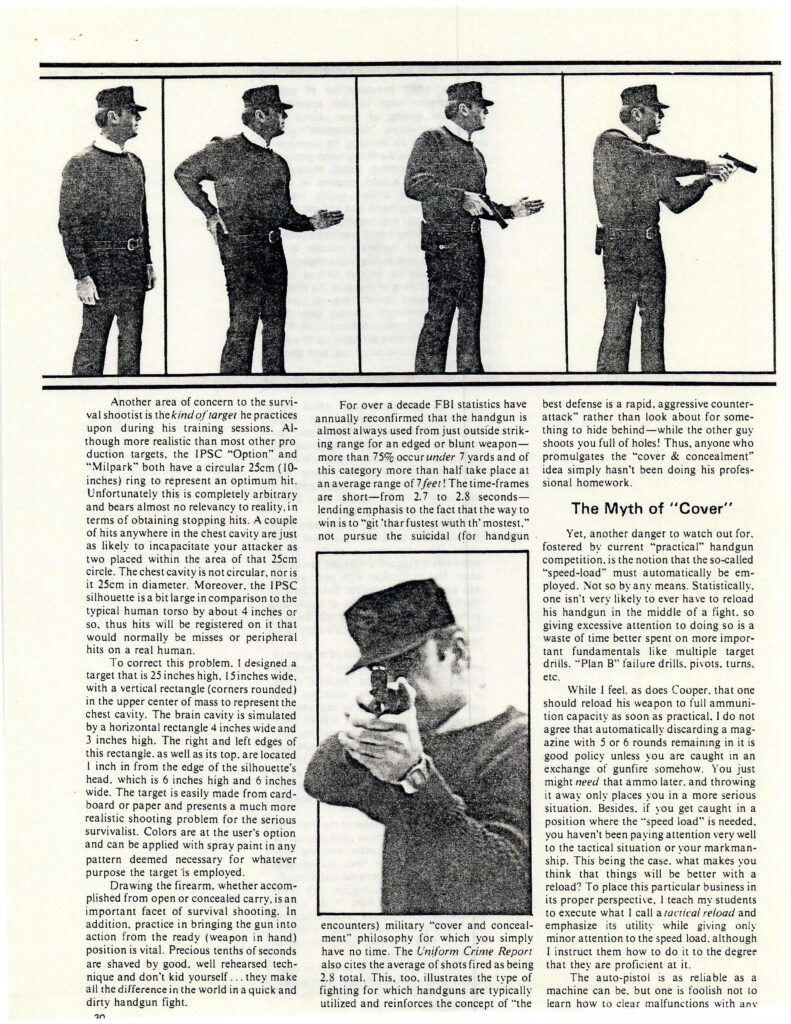
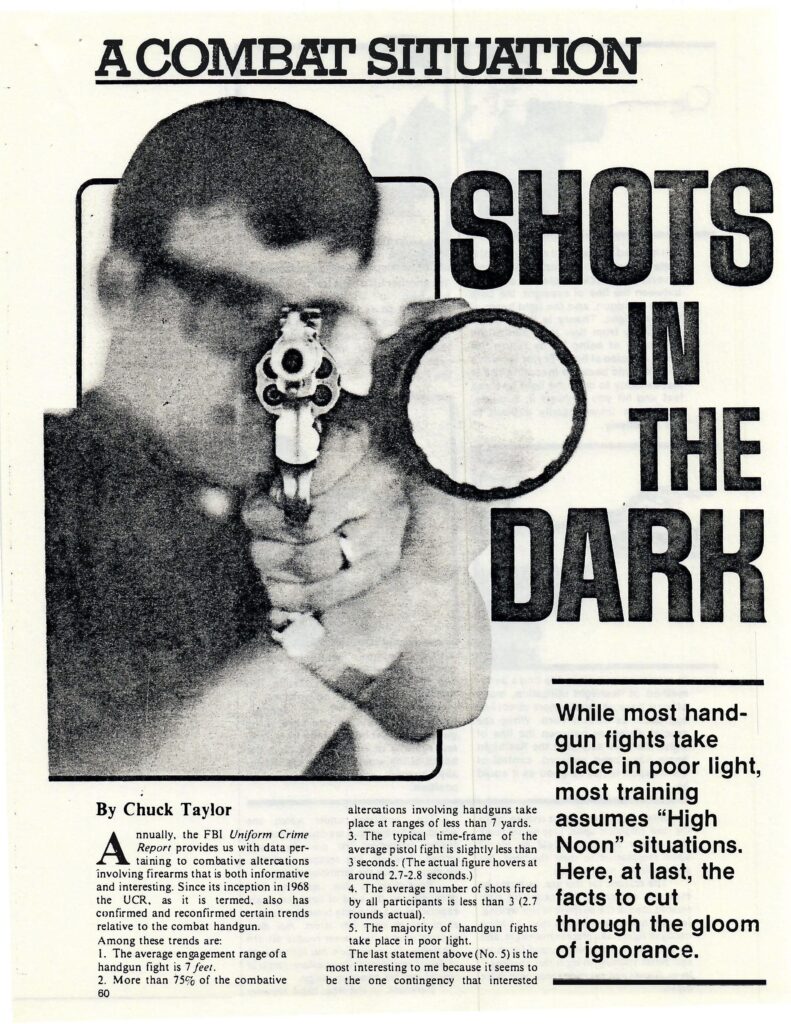
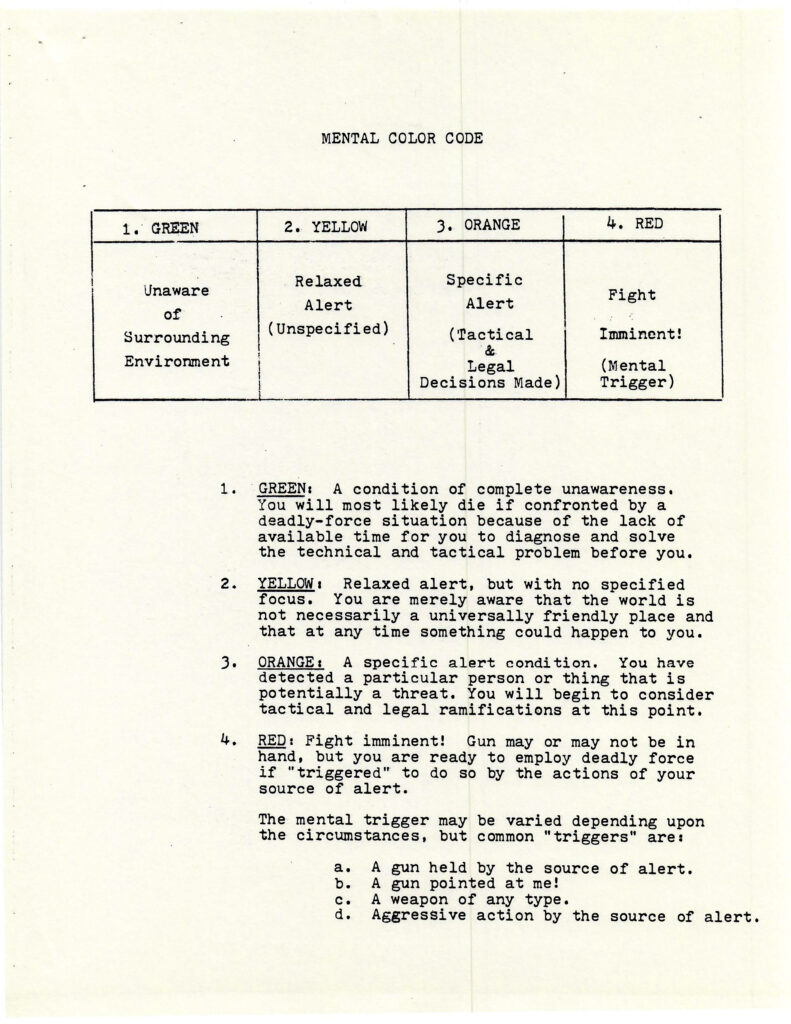
KR Training student Bob Hanna recently gave me his copies of class notes from training he attended with the late Chuck Taylor. Taylor was one of the early traveling trainers who spun off from Jeff Cooper’s American Pistol Institute (Gunsite), bringing that curriculum to a national (and international) audience. In 1980, Taylor had just started offering classes under his own American Small Arms Academy business name.
I’m sharing them here as part of my work exploring the history of pistol training. The full package of scanned notes can be downloaded here as a PDF. Many of the handouts were copies of copies, and are still relatively poor quality after scanning and cleanup. Taylor’s pistol shooting book, published in 1982, is a better place to find much of this material in more readable format.
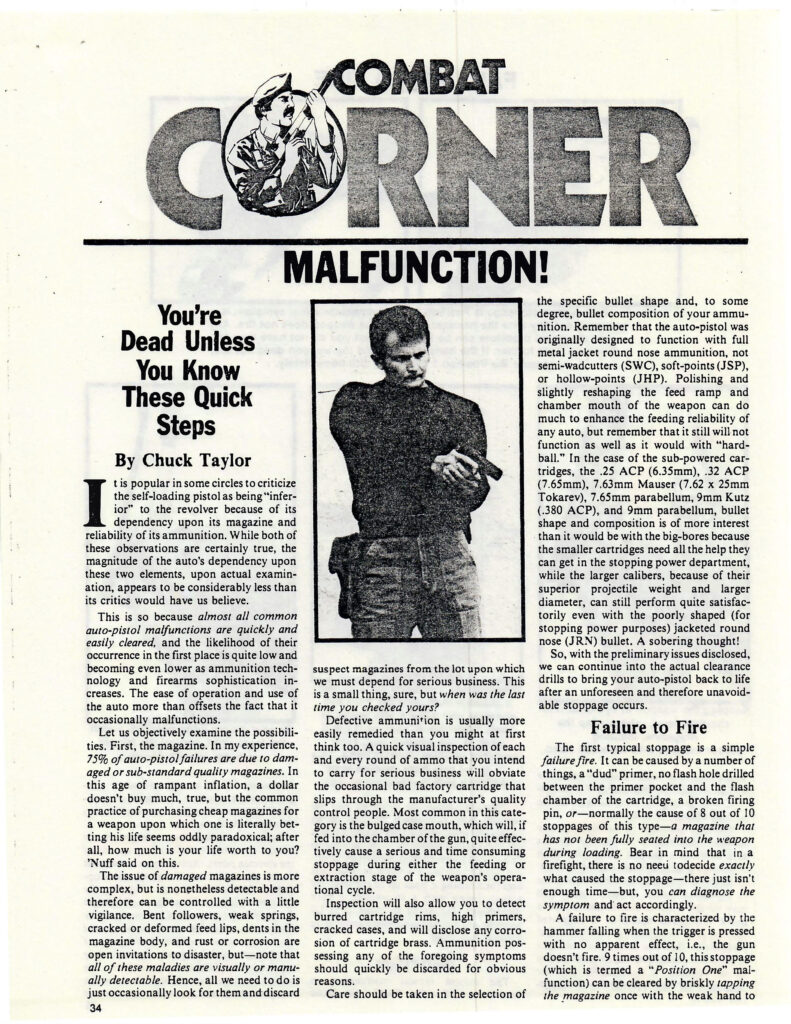
The majority of the notes are copies of magazines articles Chuck wrote for various publications. They provide a snapshot of what the topics of concern were for combat pistol trainers in the early 1980’s.
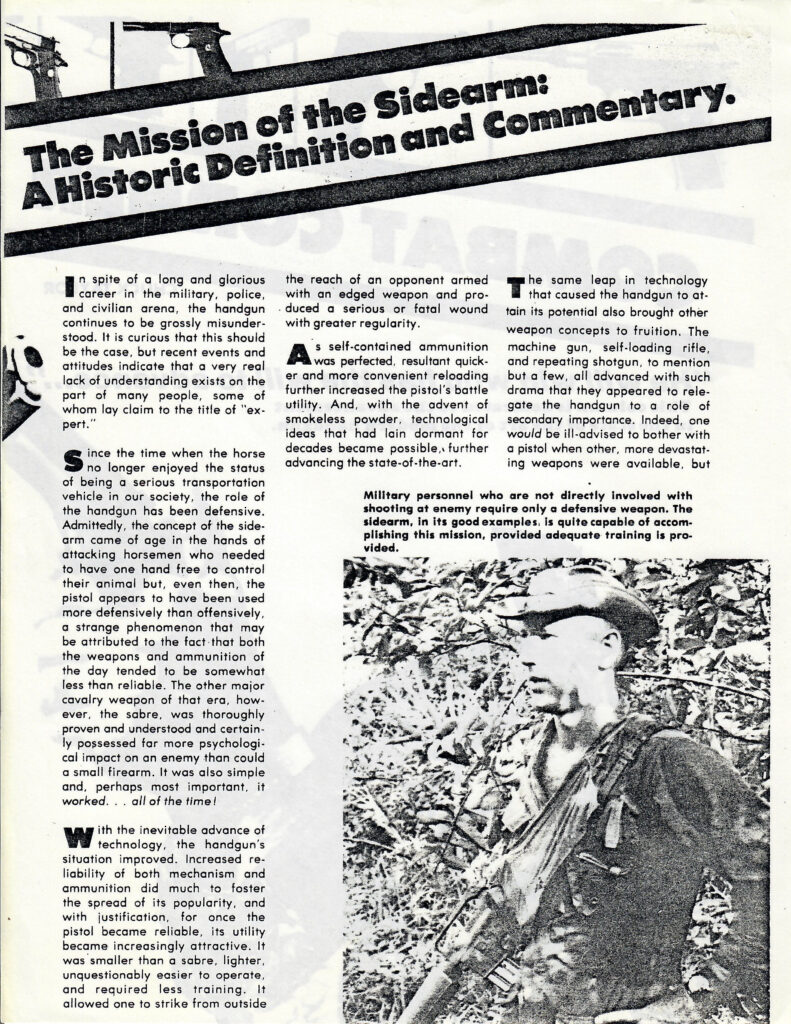
The first article discusses the purpose of the handgun, ending with advocacy for the .45 ACP caliber and its “stopping power” (a major concern and favorite topic of gun writers and trainers in that era).
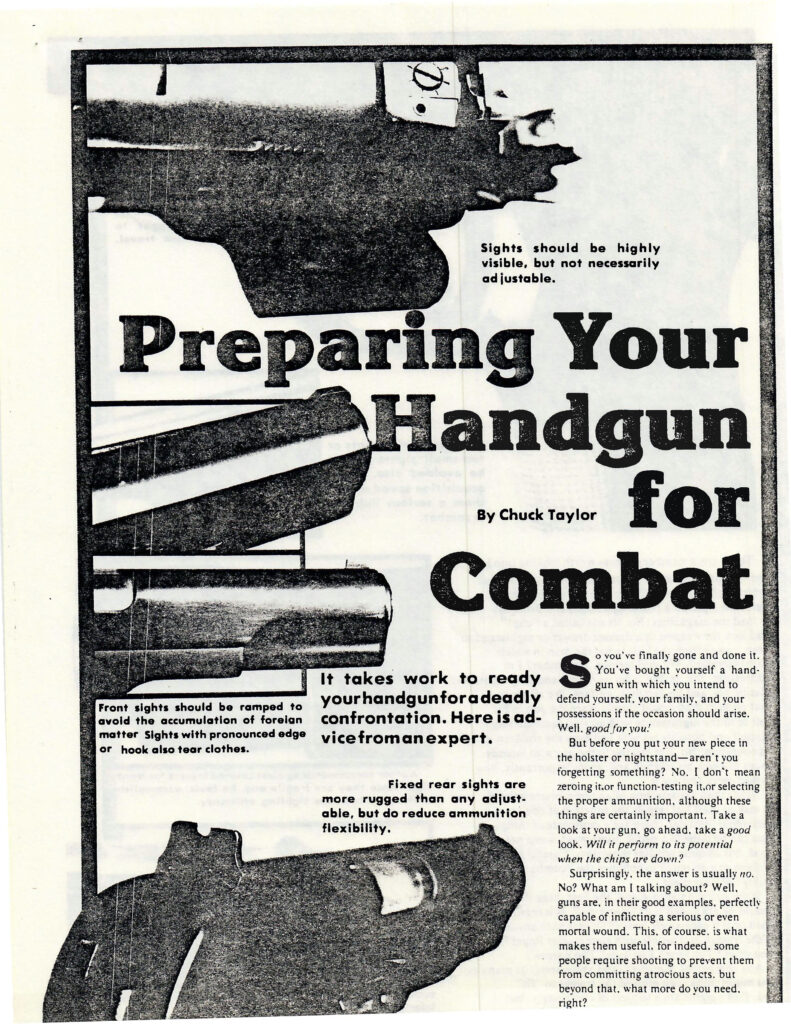
The next articles focus on gun modifications. The late 1970’s and 80’s were the era of the custom 1911 – days in which someone would purchase a stock pistol and have a gunsmith replace most of the parts in it with aftermarket upgrades.
In 2020 language this would be called a “build”, with the only difference between 1980 and 2020 being that the end users are doing most of the work themselves, as pistol designs and manufacturing have made it easier to install drop-in parts.
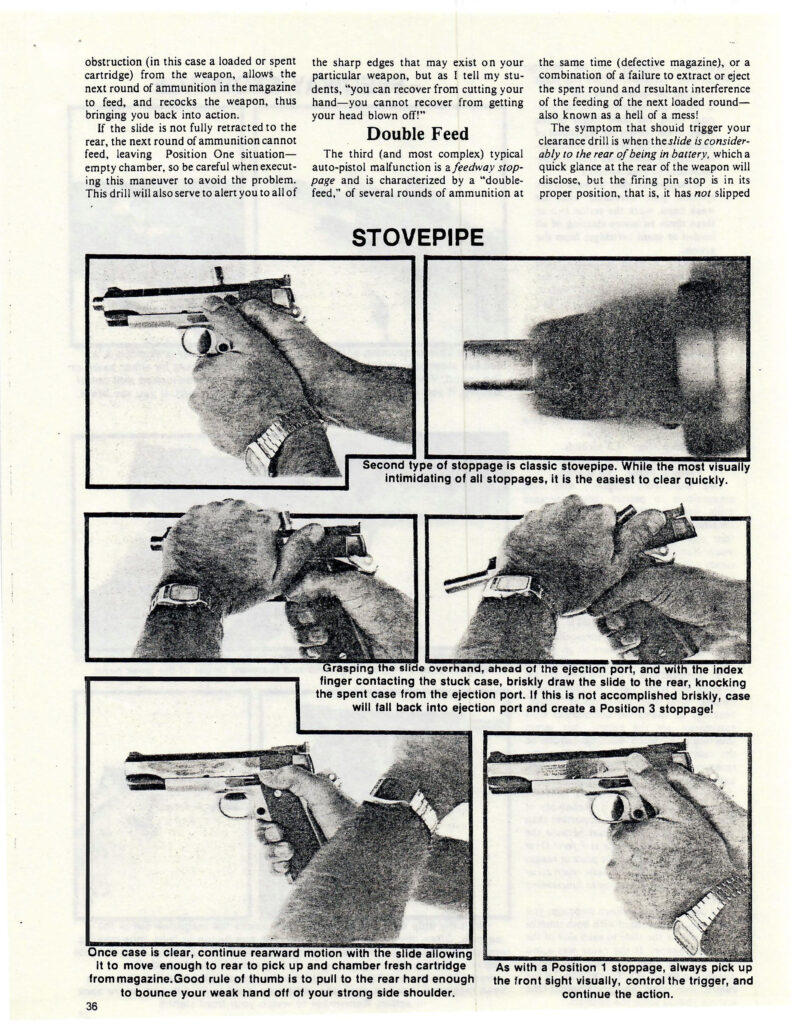
Malfunctions – which were more common in the days of customized 1911’s and mil surplus magazines – was a popular topic for discussion in the 1980’s also. The “sweep across the top of the slide” technique works well with the tall .45 ACP case, but not as well with the short 9mm case, in my experience, which is one reason why that technique is not widely taught any more.
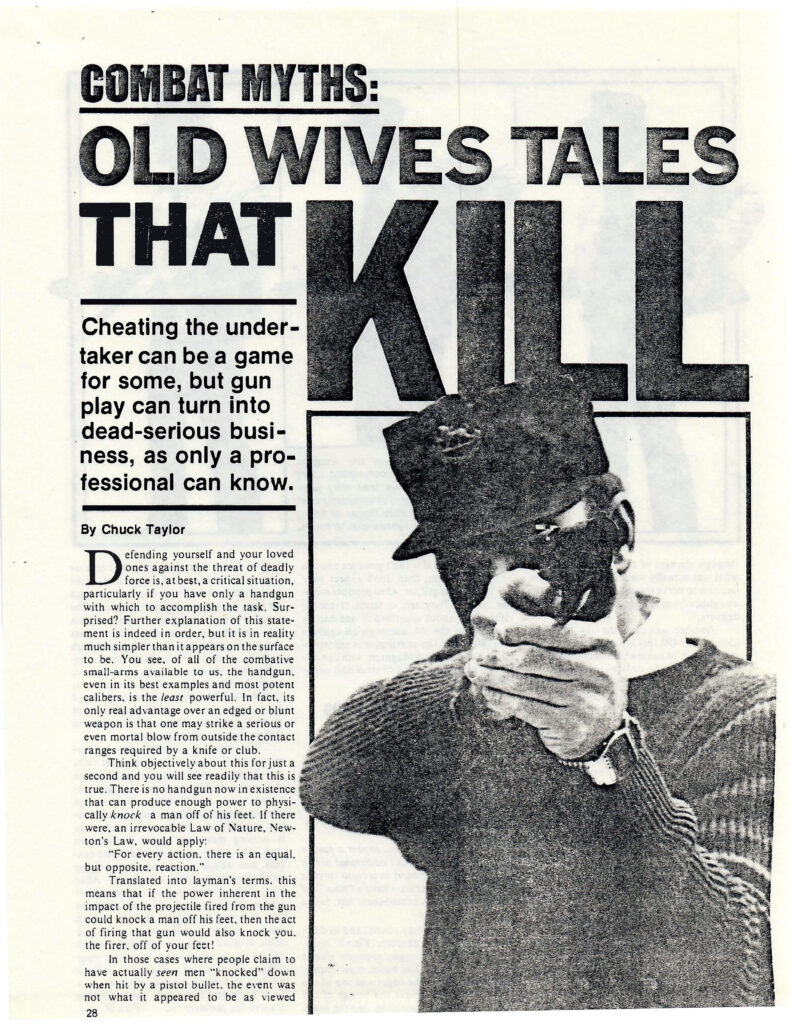
And of course, being “killed on the street” is an evergreen topic as popular on internet gun forums today as it was in the 1980s.
Interestingly enough this article calls stopping power a myth (despite Taylor’s focus on it elsewhere in the class notes). His thoughts on reloads show up in a section called “The Myth of Cover”
This article shows state of the art techniques and gear for low light shooting circa 1980.
Here’s a full length interview with Chuck, recorded in 2018. It includes a summary of his history (why and how he became a trainer) along with a lot of other great insights.
While all the attention has been on the presidential race, there are many down-ballot races of major importance, from Congressional seats to Texas Legislature seats to county district attorney and state judge positions. As always we encourage you to consider the impact of elections on your gun rights. County district attorneys decide whether to prosecute defensive gun uses. Our state legislature and judges set and define policy (campus carry, reduced fees and hours for LTC, open carry, and more). At the national level, the President gets to appoint leaders of all cabinet agencies and major departments – including those that can decide whether AR pistols with shoulder braces are legal, or ban the use of lead for hunting and target shooting – all with the stroke of a pen. Most importantly, the future of the 2nd amendment ultimately lies with the Supreme Court. A pro-gun SCOTUS could overturn bans on AR-15 rifles and magazines holding more than 10 rounds; a SCOTUS “packed” with a progressive majority could overturn the Heller and McDonald decisions, bringing “California-style” gun laws to the entire nation. If you haven’t read, or don’t understand the impact of, the gun control proposals in the Biden/Harris platform, you should educate yourself. We encourage you to make a candidate’s position on gun rights, firearm carry outside the home, and the fundamental human right of self-defense a priority in your voting decision.
2021 SCHEDULE
We have guest instructors scheduled for January, February, March and April. Details are on the KR Training schedule page. We are waiting until after the election results are known and the impact on civil unrest is assessed before announcing additional 2021 courses. That planning also includes a decision regarding a potential 10th annual Preparedness Conference. Those concerned about preparedness should take a look at the 17 hours of video available on our Vimeo channel for a small fee.
UPCOMING KR TRAINING CLASSES
Due to our agreement with range neighbors, we will have no weekend group live fire classes Nov 1 – Dec 31. Weekday private live fire training will be available on a limited basis. We do have some no-live-fire courses available as listed below.
This fall eleven students earned their Defensive Pistol Skills Program challenge coins. Most of the classes we have scheduled in November and December (except the Lone Star Medics courses) are challenge coin program courses.
AFFILIATE CLASSES
Our friends at Bear Arms (Austin) and Greig Shooting (Caldwell/Conroe) have live fire classes scheduled for November and December. Private weekday classes including LTC online completion are also available. Tina Maldonado, Sean Hoffman, and Doug Greig also offer private and a few weekend group courses not listed here.
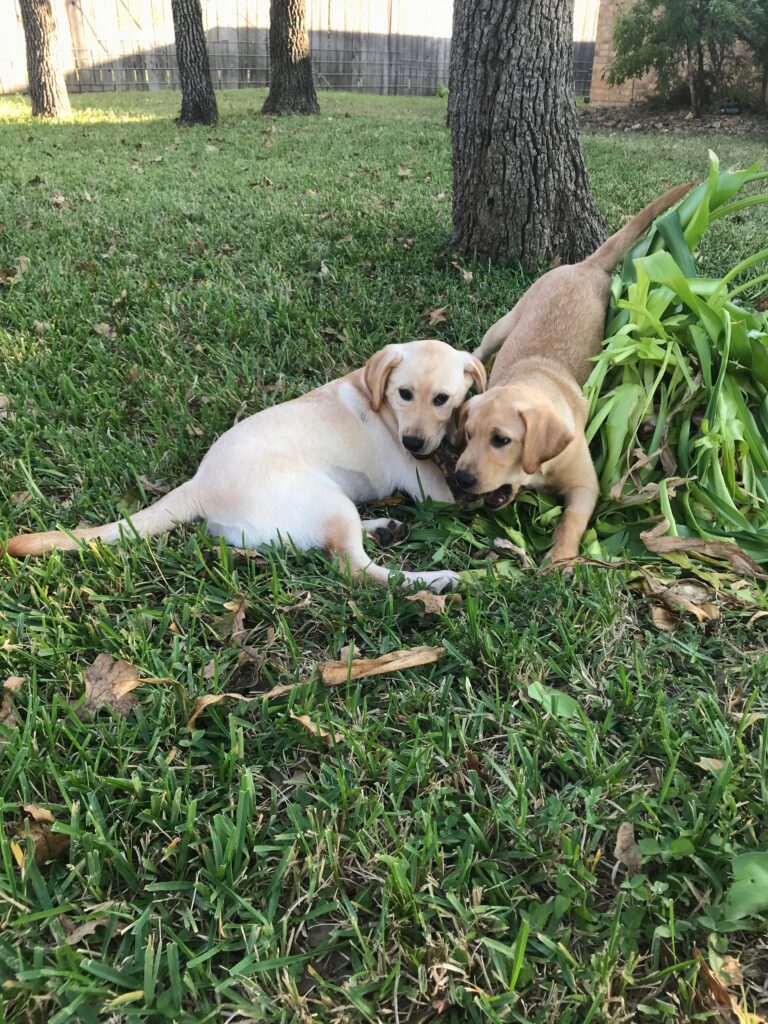
Penny and I have adopted two yellow lab-mix puppies: Scudder (male) and Rye (female), from the same litter. As we get them socialized and trained they will be “assisting” with future classes.
SONG OF THE MONTH
My trio covers “Rockin Pneumonia and the Boogie Woogie Flu” (aka “the COVID theme song”) from back in March, when the bar at the George Hotel was still open and booking live music.
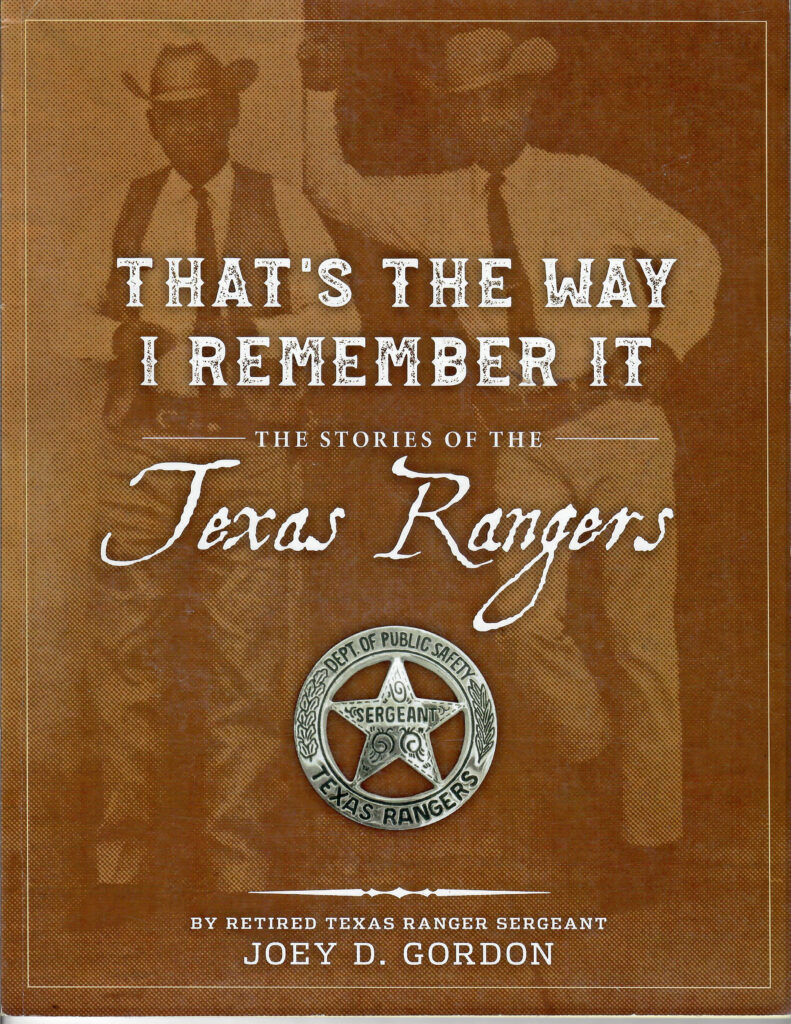
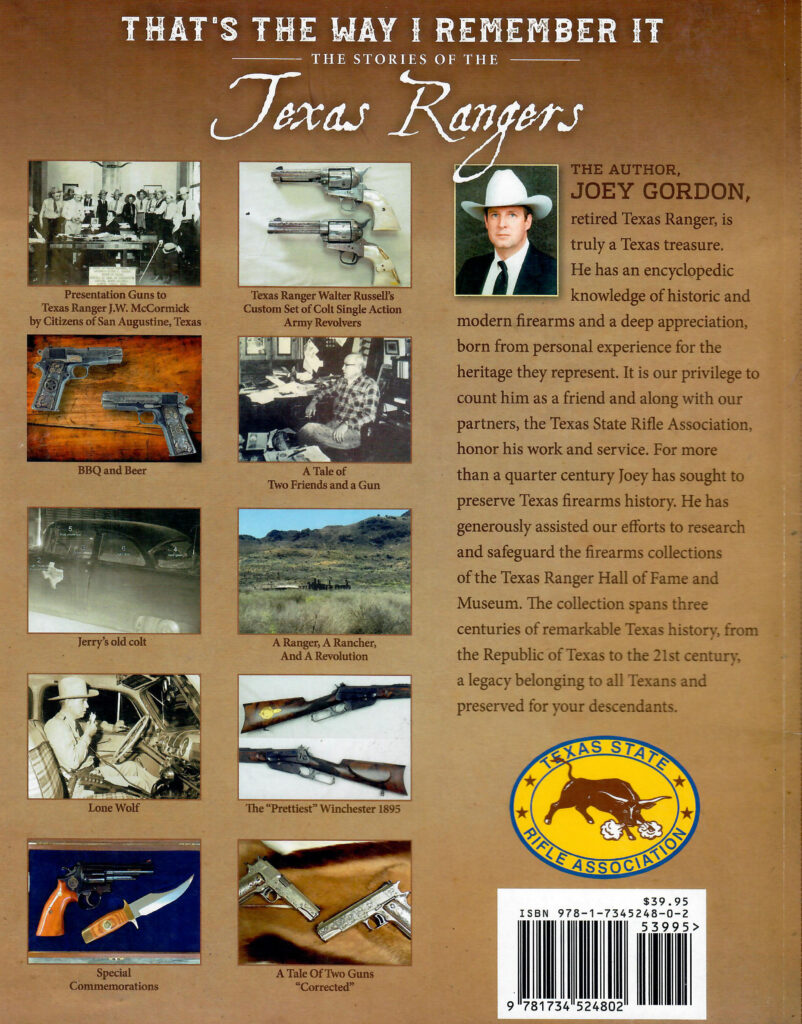
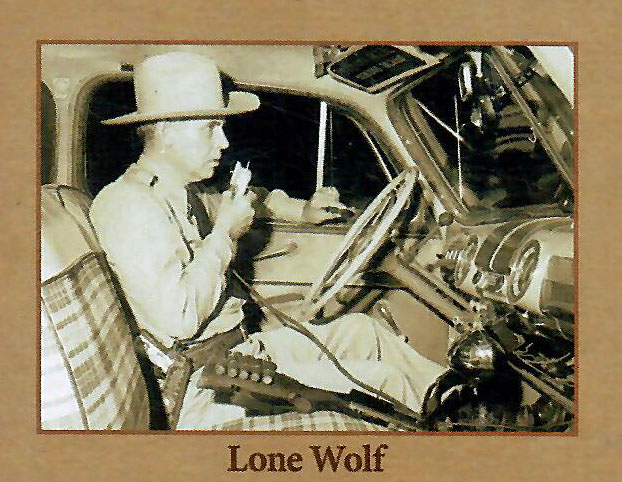
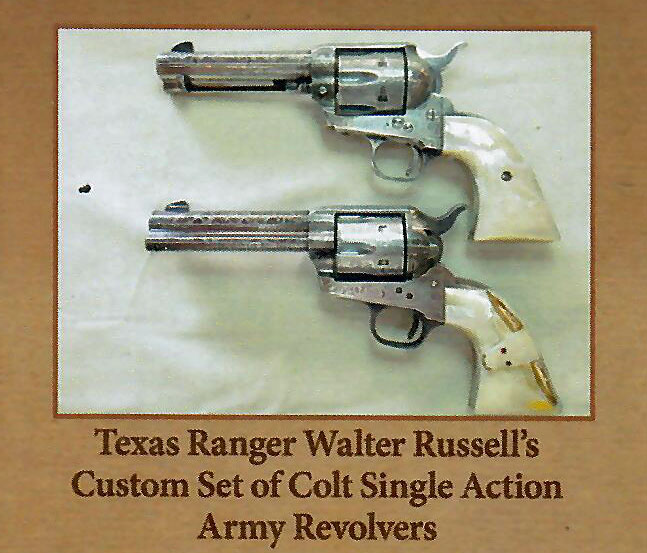
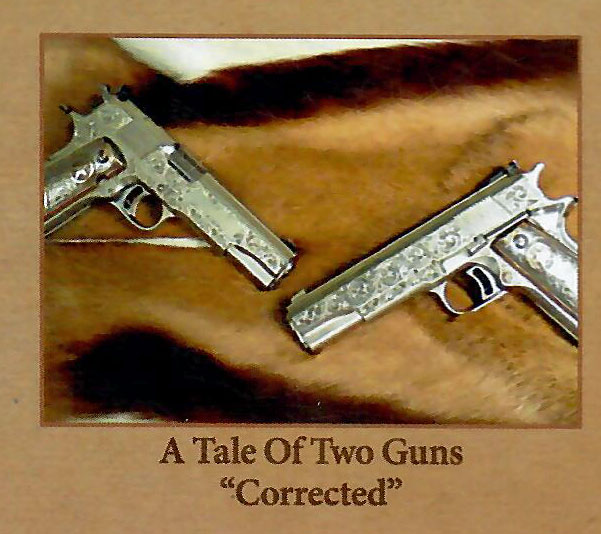
Retired Texas Ranger Joey Gordon is a regular contributor to the Texas State Rifle Association monthly magazine. His articles feature stories about guns used and owned by Texas Rangers. Many of his articles have been compiled into a glossy book available from TSRA as a fundraising item.
A couple sample pages from the book’s chapters, showing more detail about the guns and lawmen featured in the articles.
The book is full of great pictures and great stories from Texas history. The Texas State Rifle Association is under-appreciated and under-supported by Texas gun owners. Much of the work to get concealed carry passed in the 1990’s, and all the reforms and improvements to the law since, was done by TSRA. Money donated to TSRA stays within Texas and is used to support not only lobbying but youth shooting programs like the Scholastic Clay Target and Scholastic Action Pistol programs.
If you are a Texas gun owner or Texas carry permit holder, particularly if you are dissatisfied with the current state of the National Rifle Association, please join Texas State Rifle Association.
As part of the ongoing 2020 Virtual Preparedness Conference Paul Martin and I are presenting this fall, LEO instructor and private sector trainer Lee Weems from First Person Safety contributed this video giving guidance for armed citizens interacting with police.
Like the other videos in this series, it’s available to stream or download, ad-free, for a few dollars.
Gov. Abbott’s policy change allowing businesses to run at 75% capacity applies to KR Training, and we have opened additional slots in October classes to meet unprecedented demand for training. (UPDATE: most of the open slots have been filled!) We’ve added more weekday group classes to the schedule also.
AMMO SHORTAGE & DRY FIRING
Ammunition has become very difficult to find, with prices up as high as 500%. This article from RECOIL magazine explains the cause and answers many questions. The current situation could easily continue into 2021. We have reduced the round counts in some classes, and are offering many no-live-fire courses (marked with ** in the list below).
Dry firing is an essential way to continue maintaining skill. Annette Evans’ Dry Fire Primer book and Ben Stoeger’s dry fire book are excellent ways to learn how to do effective dry fire practice. Training aids such as the SIRT pistol (use code KRT10 for a discount) and Coolfire Trainer (use code REHN20 for discount) can make dry firing more interesting. With 9mm ammo selling for 500 per thousand (or more!), a training gun that allows realistic practice and does not require racking the slide for each shot becomes a much more cost-effective solution. After you have dry fired the training gun 500-1000 times, the “investment” is paid for and all future use of that gun is essentially free. Dry firing doesn’t require leaving the house, ammo, or a shooting range. 10-15 minutes a few times a week can produce significant improvement, particularly if you practice drawing from concealment.
Private weekday classes including LTC online completion are also available. Tina Maldonado, Sean Hoffman and Doug Greig also offer private and a few weekend group courses not listed here.
Paul Martin and Karl Rehn along with guest instructors Caleb Causey and Mark Overstreet have posted new videos for 2020 as part of our ongoing Virtual Preparedness Conference. More videos will be released in October.
If you’ve taken AT-2 scenarios and want more force on force training, the AT-5 Tactics Laboratory class is for you!. This higher level class integrates unarmed skills along with Simunition guns to provide a more realistic simulation experience with full scenario context. Drills integrated unarmed and gun skills for close range encounters are also part of the class. The “shooting from retention” drills in DPS-1 are repeated, this time against live opponents using SIRT guns and other props, to reinforce and build on that skill, practicing against an uncooperative opponent. We only offer this course once a year, so we encourage you to take advantage of this opportunity.
Karl will be attending the (virtual) Texas Bar Association’s Firearms Law seminars this week. Guest instructor Massad Ayoob will be presenting a session. The virtual sessions are open to anyone paying the tuition fee, and the sessions will be available after the event is over for those that want to register and view them later. Texas Bar CLE has also published a new book on the essentials of Texas Firearms Law – highly recommended for any instructor or serious student of armed self-defense. Unlike mass market books on this topic, this book includes references to case law with citations, and has a college-textbook price to match its college-textbook information.
SONG OF THE MONTH
This month’s music video is from summer 2010, when Leannasaurus Rex had a weekly gig at popular biker hangout Yankees Tavern near Iola, Texas. The best performances from those shows ended up on the “Hot Summer Jams” CD (download the remastered tracks for free here). Plans for a 10th anniversary re-release and Leannasaurus Rex reunion show were scrapped due to COVID. This fan-shot phone video for our cover of Matt Schofield’s “Siftin Through the Ashes” seemed appropriate given the fiery riots and civil unrest of the past 30 days.
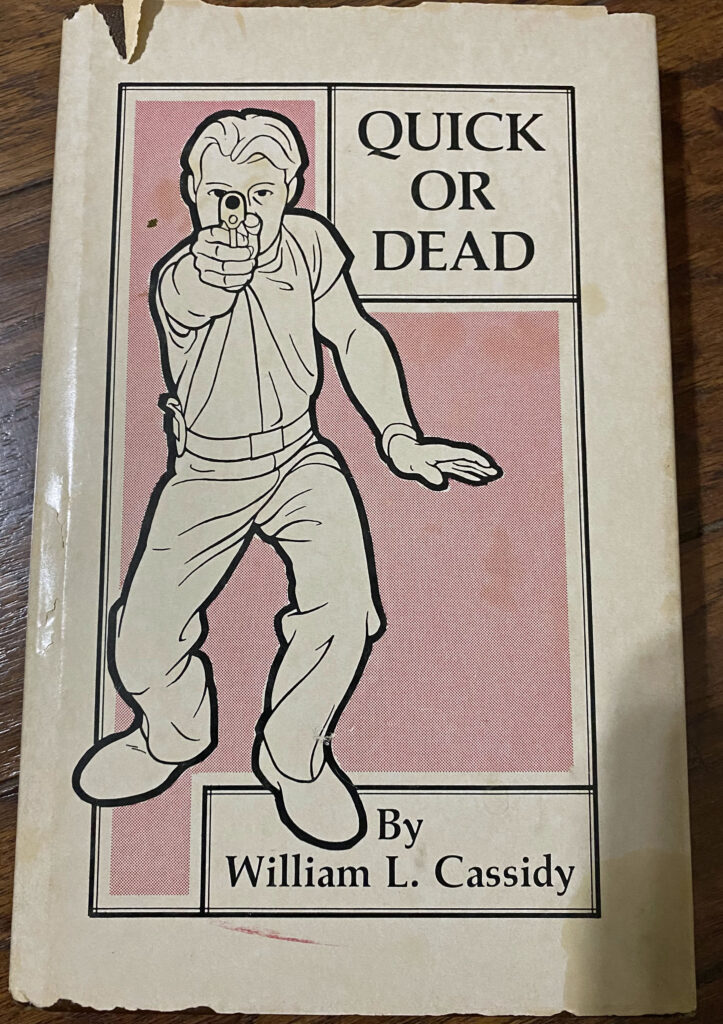
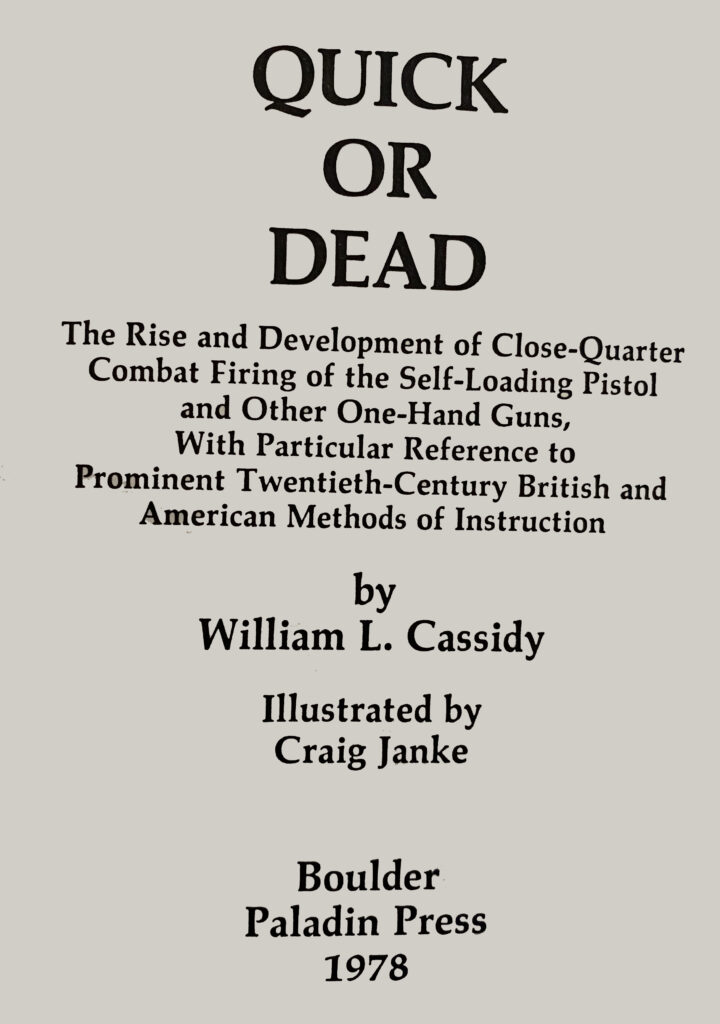
Quick or Dead was published by Paladin Press back in 1978. There are still copies available online, even though Paladin has closed up shop. The title doesn’t tell you as much about the book’s contents as the subtitle on the inside cover page does.
Written during the time when the Modern Technique (Weaver stance and the rest of the program Gunsite taught) was becoming more widely accepted, the book gathers up the best of all the non-Modern Technique material from 1900 to the present. The tone of the book is better than many “point shooting” books (and the book doesn’t specifically advocate point shooting), because it doesn’t insist that the methods it shows are The Way and that the Gunsite/Weaver/Cooper material is Wrong and Bad. Many of the observations and explanations in the book actually align well with where technique evolved in the 80’s and 90’s.
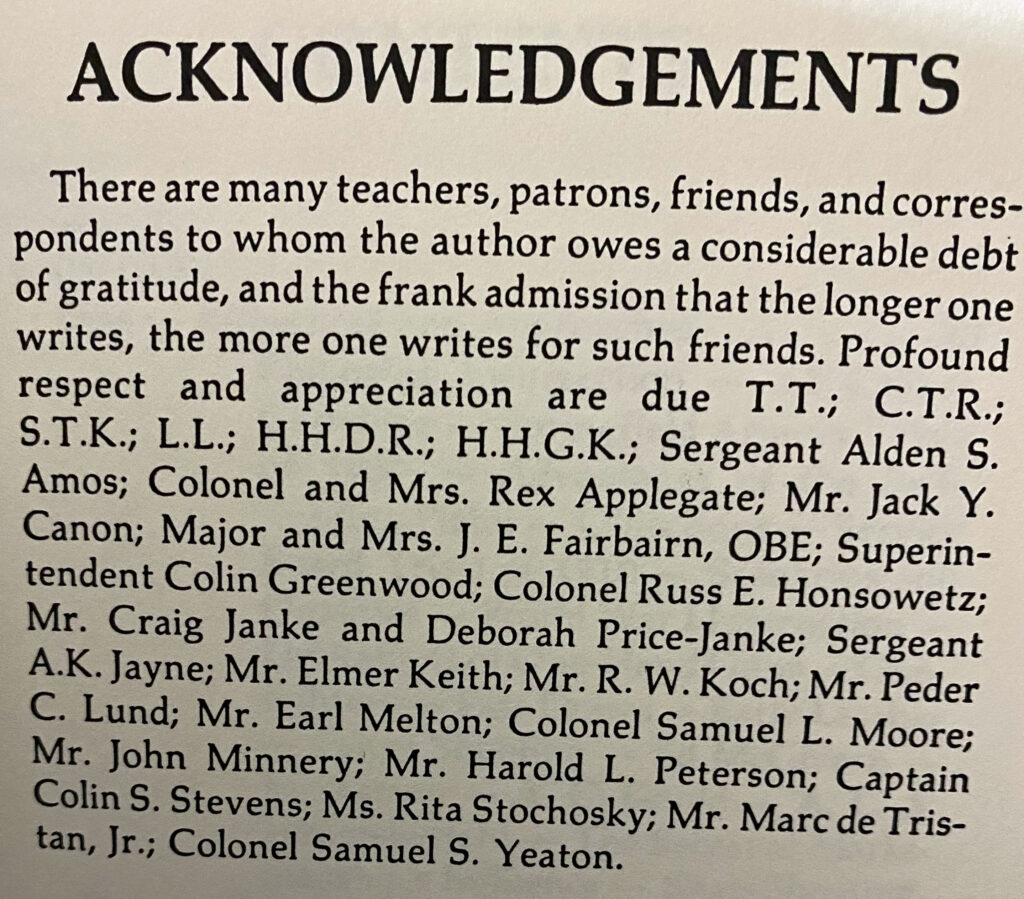
The list of those named and acknowledged (and those NOT mentioned, specifically anyone that was part of the Gunsite community), is a good indicator of the roots of the book’s content, though.
And in keeping with the spirit of many of Paladin’s other publications, here’s a list of other books the author wrote for them. Several of the topics are very 1970’s in flavor.
The best part of the book, for me, as a student of history of handgun training, was the extensive bibliography. Most of the books and articles the author references were familiar to me, including many of the books written by British shooters in the early 1900’s. His frequent references to Pollard’s writing added that name to my “need to read” list. I picked up a e-book edition of Pollard’s “The Book of Pistol and Revolver” for $10 and will review it here at some point. My current stack of “read and ready to review” is over a dozen books, with another dozen or more in the “to read” stack. (The rabbit hole of old gun books is a deep one.)
Pollard is quoted in ‘Quick or Dead’:
“Shooting at a man is quite different to target practice. You are, unless cast in a specifically heroic mold, excited, possibly startled or alarmed. You may have had to run and be out of breath, or you may have experienced that emotional heart acceleration which makes the hand positively dither. In any case, you will be looking at your man, not at your pistol.”
Pollard, according to historical claims, was a “duellist of some repute”, since formal duels were still being fought from time to time post WWI. (I have been reading old books on dueling and will have a separate blog post at some point in the future discussing how the schools that taught young nobleman how to duel have their own place in the history of handgun training.) Pollard is quoted again in Quick or Dead:
“Never advance cheerfully on your late opponent without reloading. You may have used your last shot, and he may not be properly dead and still spiteful. There is one golden rule which should never be broken. If a pistol is carried it must be loaded and ready for instant use. A unloaded, unready pistol is less use than half a brick in an old stocking.”
(Only 1/3rd of pistols caught by TSA in spring 2020 in carry on bags had a round chambered, although most have ammunition in the gun, indicating that a lot of carry permit holders still need education as to what “unready” means and how little time they will have to deploy the pistol if needed. My suspicion is that most of those guns were flopping around loose in no particular orientation within the bag, which might be the reason the owner was uncomfortable having a round chambered. Two wrongs, in this situation, don’t make a right, as a gun carried off body in a bag should be in its own compartment that has an embedded holster that covers the trigger guard…with a round chambered.)
The book includes some good illustrations showing stance, grip, and other fundamentals.
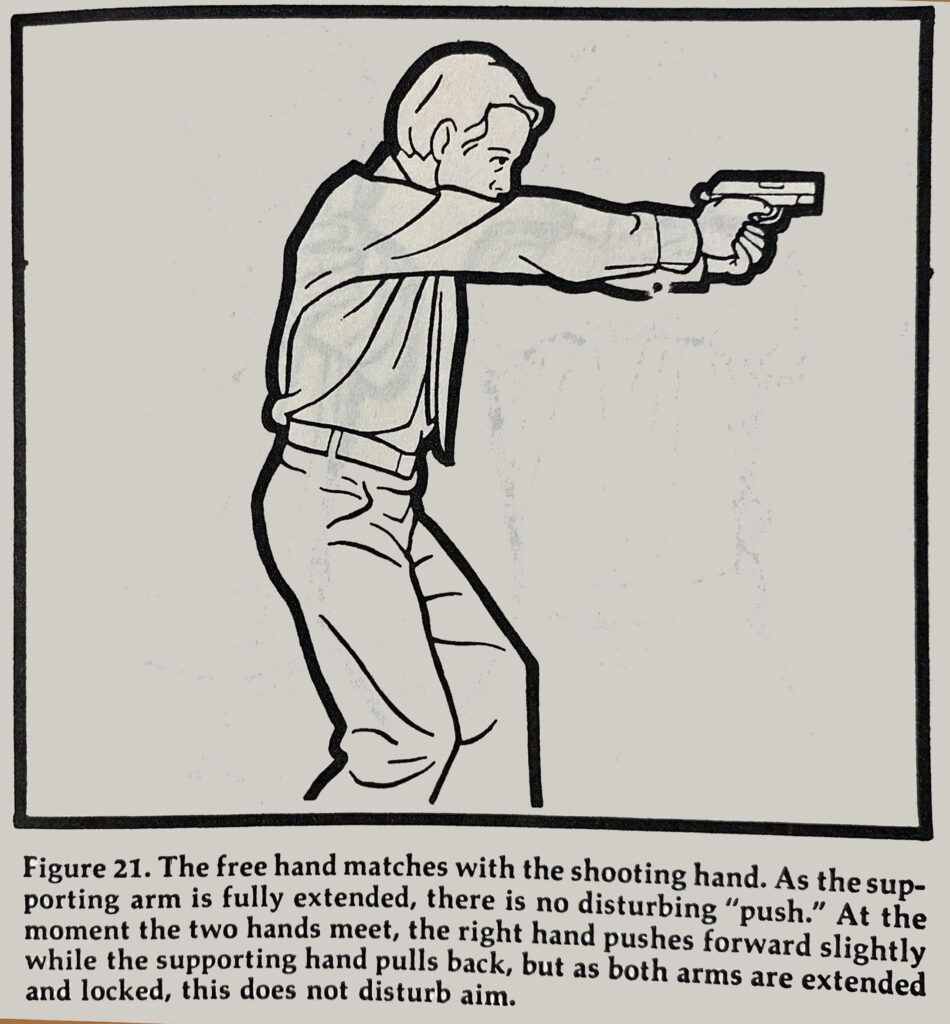
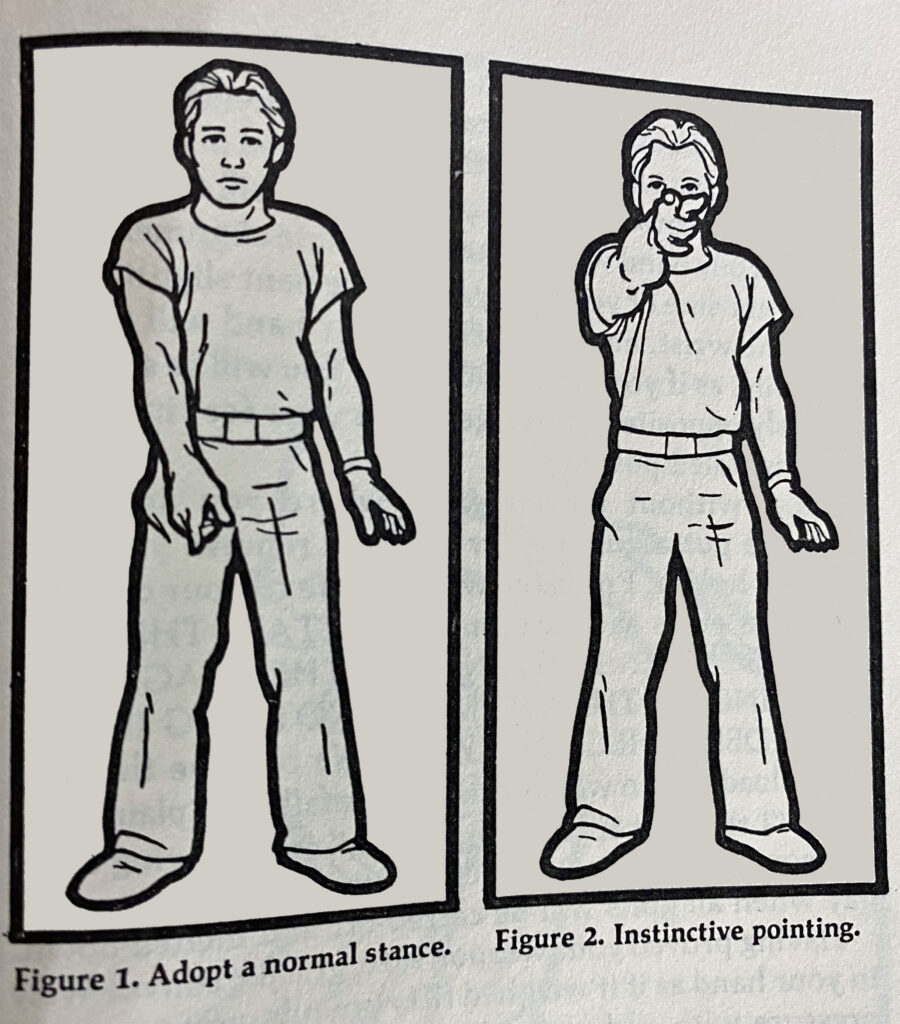
In 1978, very few shooters were using this stance, but it should look very familiar to 21st century shooters, with the gun brought up to the eye target line, gripped in two hands, fully extended with no asymmetric arm bending.
While the author describes this stance as “instinctive pointing”, clearly the pointing is being done by aligning the finger with the dominant eye, which is not the “point shoulder” position nor the hip shooting position some point shooters advocate. In the 21st century, shooting with the gun at eye level, using the sights but a target focus for close range (the author chooses 25 feet, or roughly 8 yards, as his definition), is widely taught, both with iron sights (particularly by multi-time USPSA national champion Ben Stoeger) and with red dots (by basically everyone teaching red dot pistol classes).
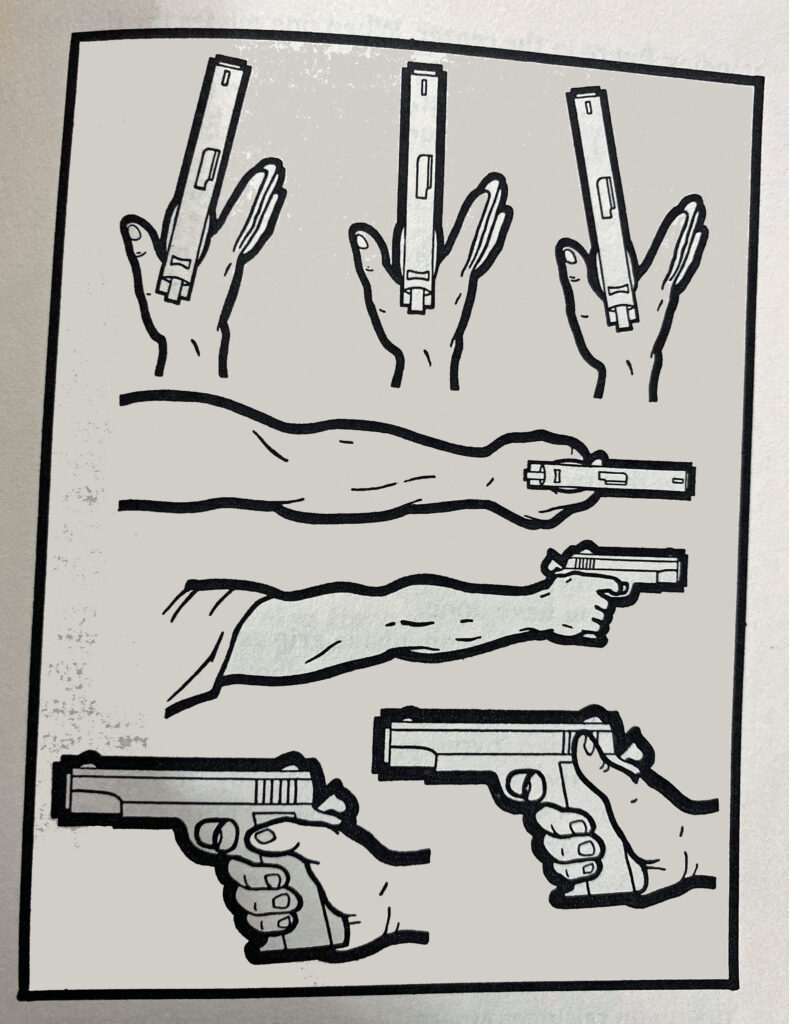
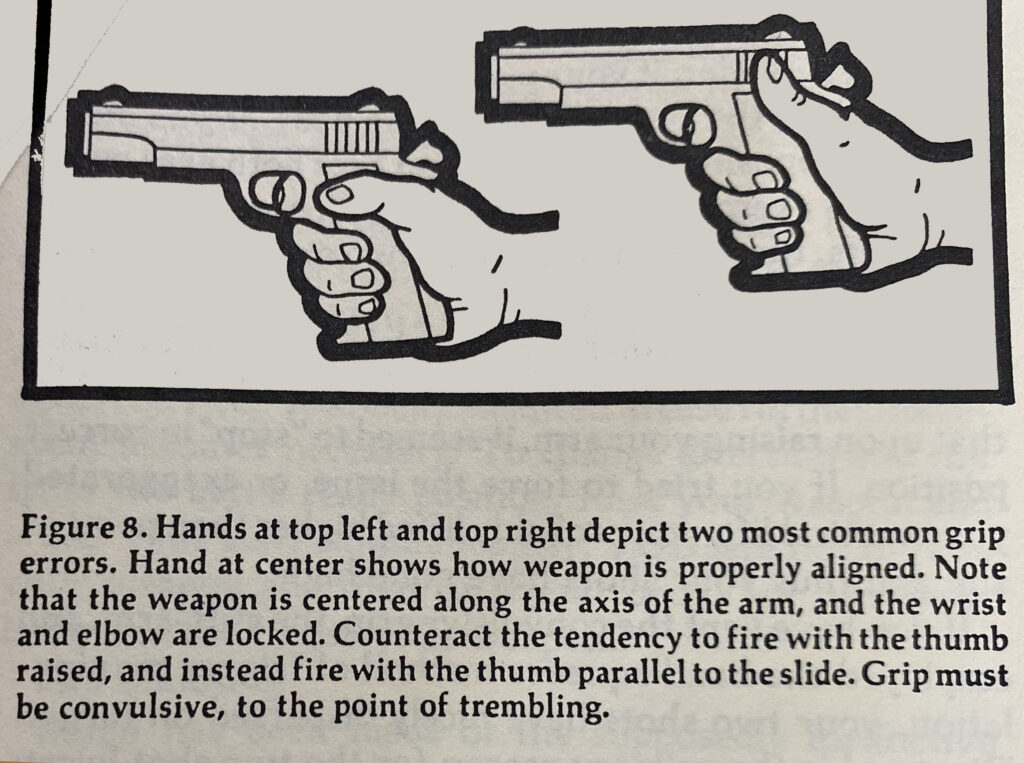
This grip drawing shows proper alignment of the gun with the hand and arm – something that remains valid today. The rise of the wide-body, double stack magazine semiauto pistol has caused many shooters, particularly those with short fingers, to learn to grip the gun with it twisted over their thumb knuckle, as the picture in the upper left shows. The growing popularity of single-stack of narrow guns, such as the Glock 48, M&P Shield, Springfield XD-S and others, has finally given small handed/short fingered shooters better options for guns that fit their hands properly, but based on what I observe with students in classes, understanding of this basic principle of gun selection is poor to nonexistent at the carry permit level. Mis alignment of the gun with the hand also occurs when the grip is built starting with the firing hand fingers, vs. aligning with the web of the hand. Another common source of this error is getting a bad grip on the pistol when drawing from an inside the waistband holster.
The author comments on the importance of keeping the thumb parallel to the slide – something that can be done with a classic thumb over thumb grip, and also with the more modern “thumbs forward” grip. Gripping with enough pressure that the hand trembles is not current thinking, but gripping with significant pressure with the fingers (of both hands) is commonly taught.
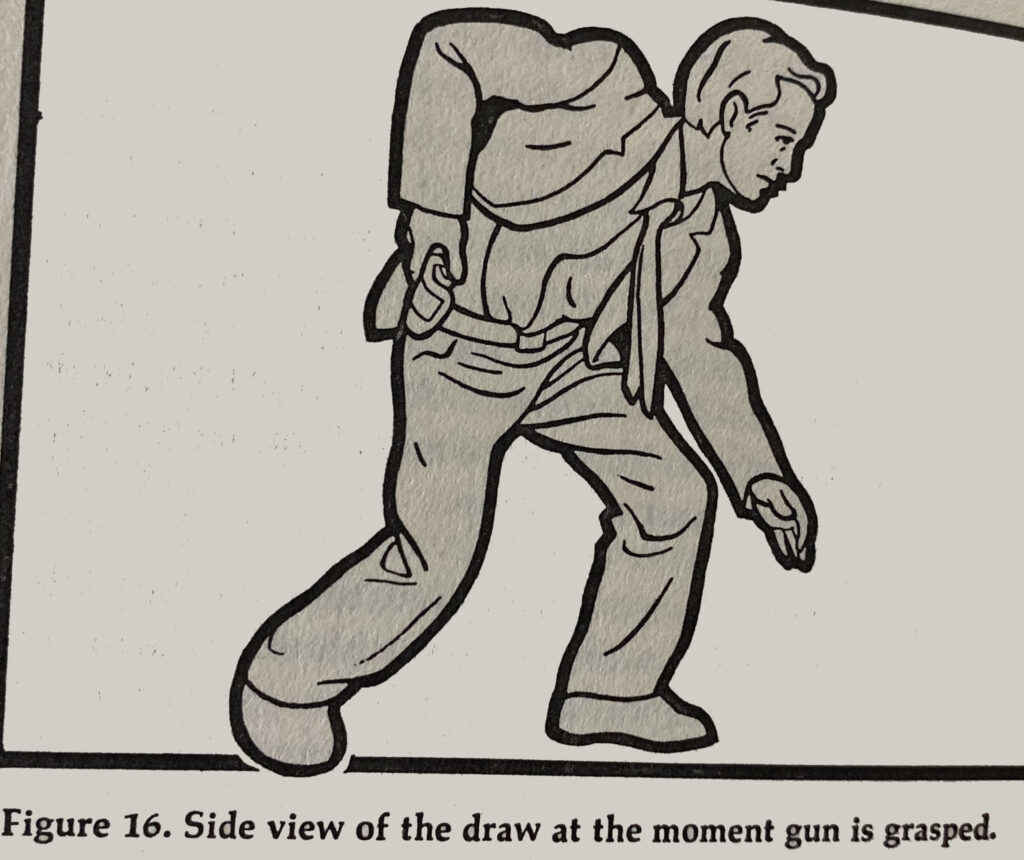
The material on how to draw from concealment is dated, showing the classic FBI “bowling” draw including movement of the head and eyes as the gun is being drawn. Draw technique changed radically in the decades after 1978. The average shooter trained in modern draw technique is faster, and getting better first shot hits, than those using the FBI lean, bowl and crouch technique were getting in their day.
Chapters
A quick overview of the chapters and topics covered:
Influences and approaches – The Moros and the .45 caliber cartridge, advantages of the self-loading pistol, World War I instruction, fast draws, Ed McGivern, A.C. Gould, A.L.A. Himmelwright, and “snap shooting”
The Shanghai Influence – This chapter does an excellent job of presenting the history of Fairbairn’s time in China, and the program of training he developed, particularly his shoot house, scenario based concept of training.
Voices in the Wilderness – Hugh Pollard, William Frazer, J.H. Fitzgerald, A.L.A. Himmelwright, Charles Askins, Fairbairn, Sam Yeaton and Sam Moore — basically a collection of information from all of these influential writers and shooters from the WW2 era.
Specially Employed – Askins, Fairbairn and Sykes, Applegate, and how the FBI got “educated” by the WW2 point shooters.
Post-War Approaches – Cowboy Quick Draw, Cooper, Chic Gaylord, Bill Jordan, Colin Greenwood, Leatherslap – basically 1950’s-1960’s evolution of training and technique summarized nicely.
How to Practice Shooting – this is where most of the pictures of fundamentals in the review came from. From the era before shooting timers were common, there are few courses of fire in this section, just descriptions of how to draw from concealment and shooting using the techniques described earlier in the book.
Technicalities – the final section of the book is mostly a compendium of ballistic studies, mostly dated results advocating for the .45 ACP caliber and the Glaser Safety Slug, with one subsection “All Guns Are More Or Less Equal Except Those Designed by John Browning Which Are Better”, which would have been at home in any late 1970’s gun magazine.
Summary
This book would be a good choice for someone that wants the history of handgun training and technique, 1900-1960-ish, from the perspective of those that did not (or were slow) to get on board with what Jeff Cooper was teaching in the late 60’s and early 1970’s. It shows that some of the things that were later merged with the Modern Technique came from those sources, and would give any shooter a sense of historical perspective. It’s a short read, full of references to related works, making it easy for someone interested in diving deeper into the topics to track down the source material.
Paul Martin and I have been posting new videos as part of our ongoing Virtual Preparedness Conference. These videos are part of the package of On Demand content we have on Vimeo. Each video is a few bucks to stream (3 month rental) or download. The newest video is from retired NRA-ILA researcher, firearms training and national columnist Mark Overstreet. It’s a sample of the material he taught in a recent Gun Rights Seminar we hosted at the A-Zone Range. This particular video discusses the legal history of gun rights and the nuances of the rulings in several critical Supreme Court decisions, as well as the future of gun rights in the current political climate.
Because they are pay-to-watch videos, it appears that Vimeo is blocking embedding, so follow the links to rent or purchase them on Vimeo’s site.
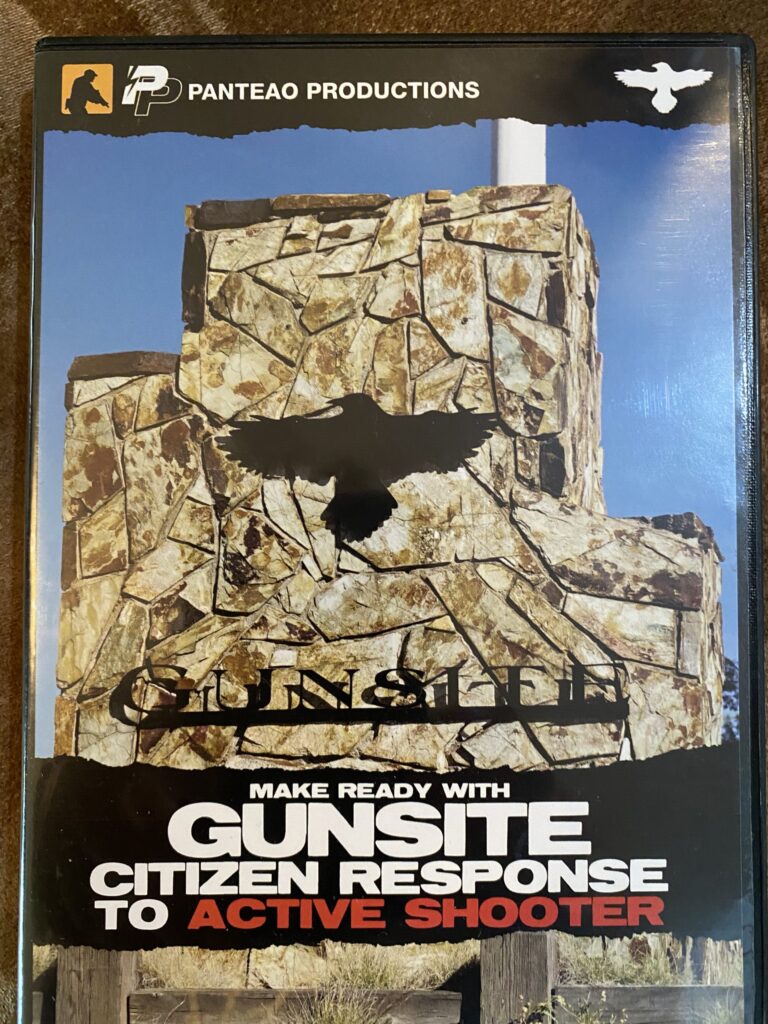
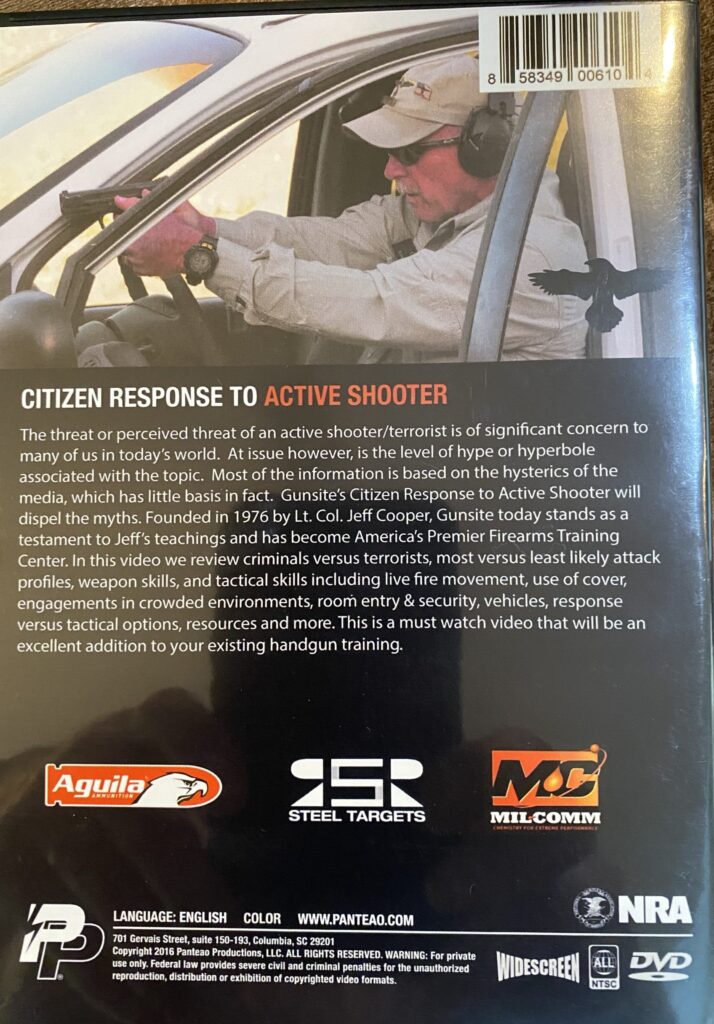
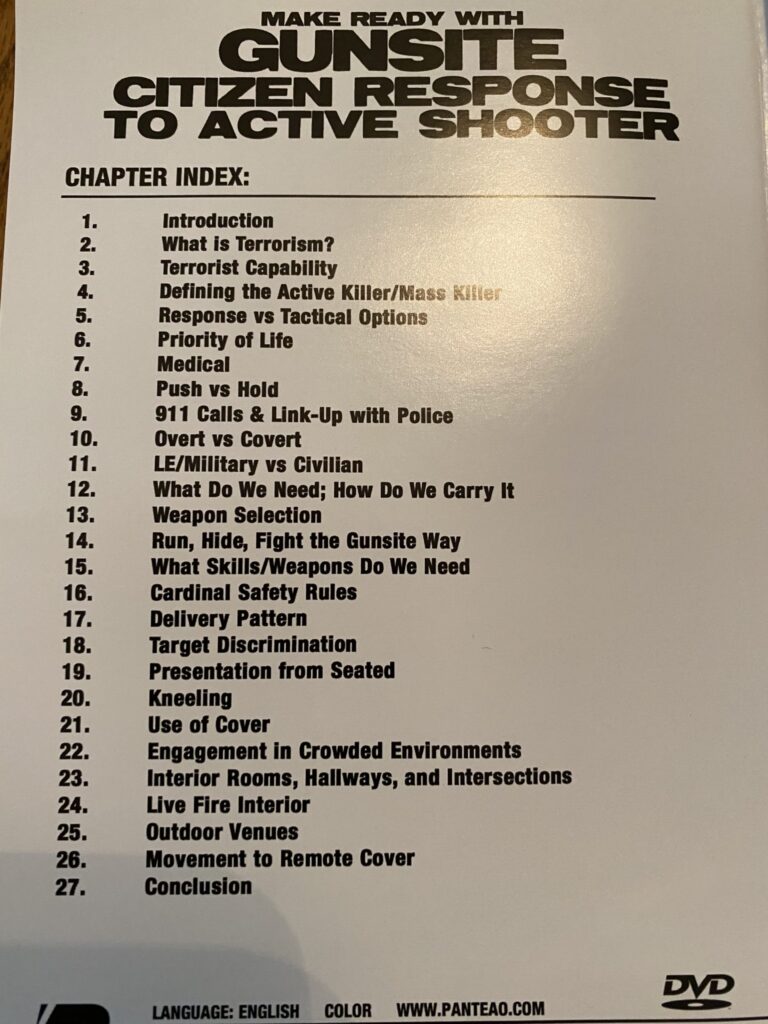
During a recent trip to Gunsite I picked up a physical copy of the Panteao-produced, Gunsite Active Shooter Response video. Since I will be teaching another session of the Texas DPS-certified Active Shooter response course this month, I spent some time watching the Gunsite video as part of my review of class materials.
This 3 hour video is mostly lecture material, presented on the range, but with all the shooting and drills covered in the final hour. It’s a very thorough program (chapter titles listed below) suitable for those at the carry permit level with no training beyond that level. For those with more experience, some of the material in the early chapters will be review.
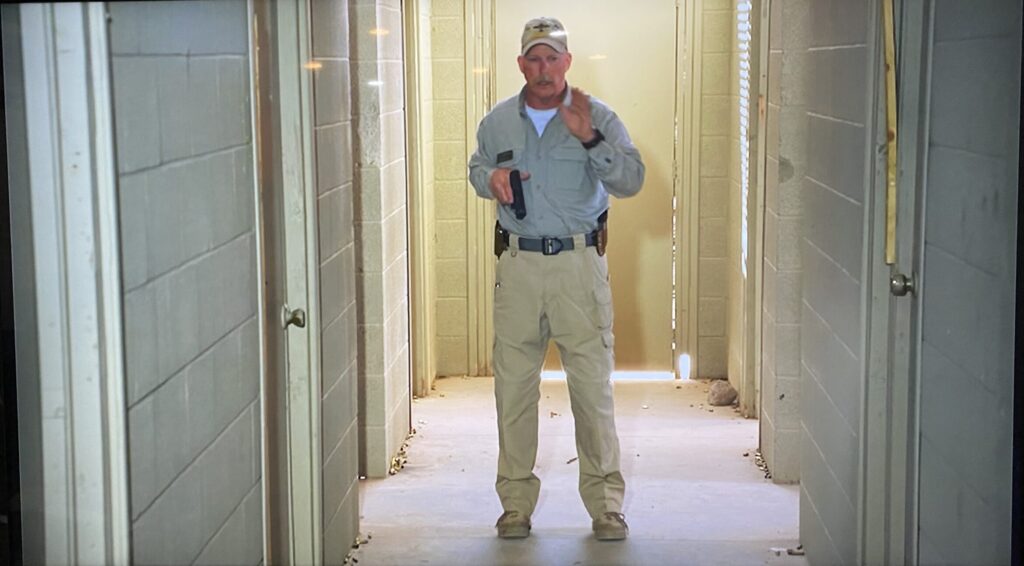
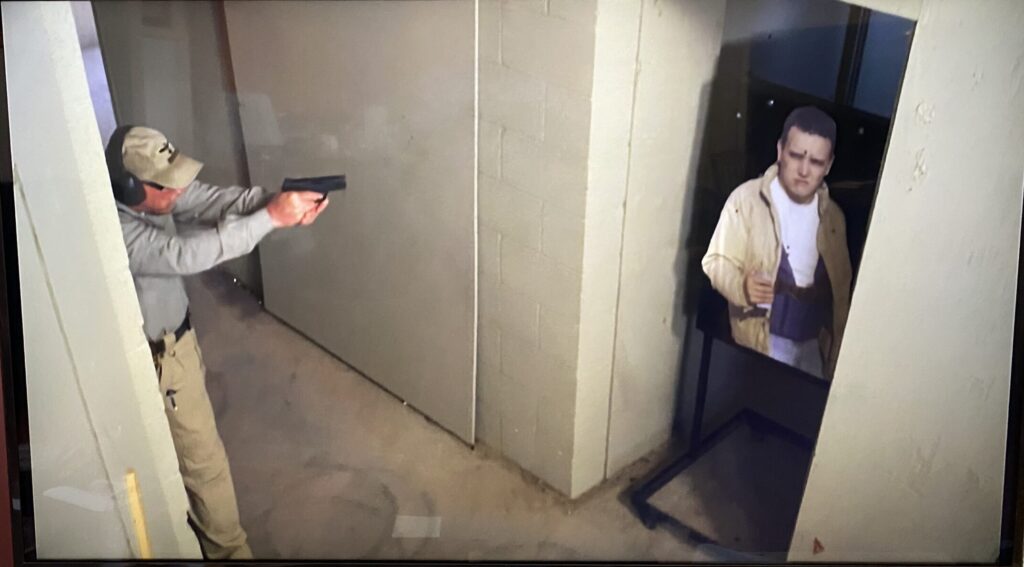
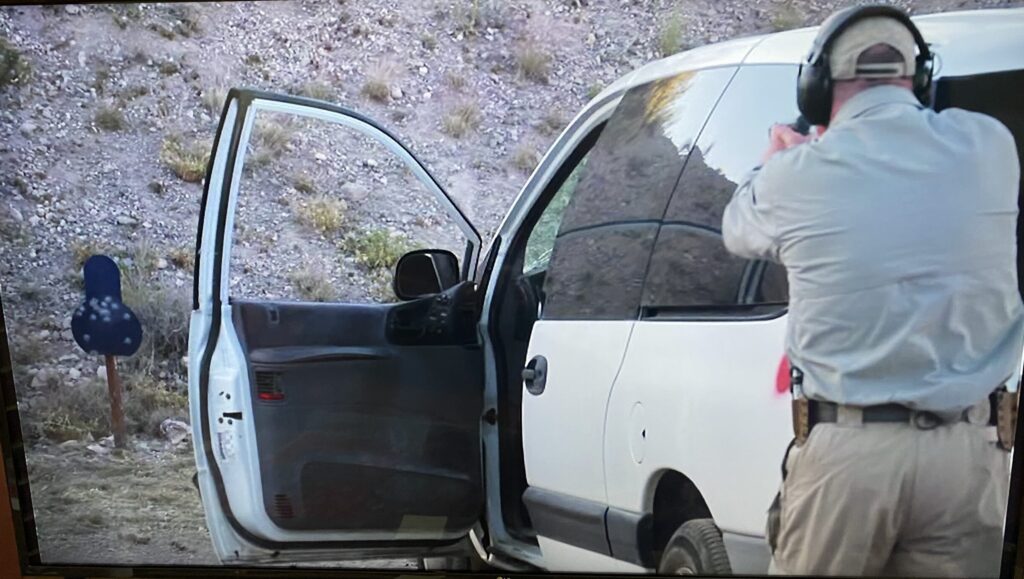
The last hour of the video, starting with chapter 17, gets into live fire drills, shoothouse and vehicle work. The fundamentals of these topics are taught at a relaxed pace, working simple problems in small chunks, which is an excellent approach for teaching these skills to those that haven’t seen them before, or are using the video as review.
Similarly, the vehicle segment focuses on basic skills, engaging targets around vehicles, moving to cover, with acceptable hits.
Medical response is well integrated into the course, as medical gear is discussed in the sections on setting up your bail out bag, and use of the gear is shown in context during the shoothouse drills.
If you haven’t seen any of the Panteao videos, they are all well made: professionally scripted and produced, and a good value for the money. In addition to the Gunsite Active Shooter video, they also have Paul Howe’s Active Shooter video, which is a condensed version of his multi-day active shooter course. I attended that course at his facility several years ago and wrote an AAR of it here.
While there are many videos available on youTube for free, long form, professionally produced videos offering instruction from verified subject matter experts (such as the ones Panteao offers) are worth paying for. They provide a way to get some valuable training without needing a range (or ammo).
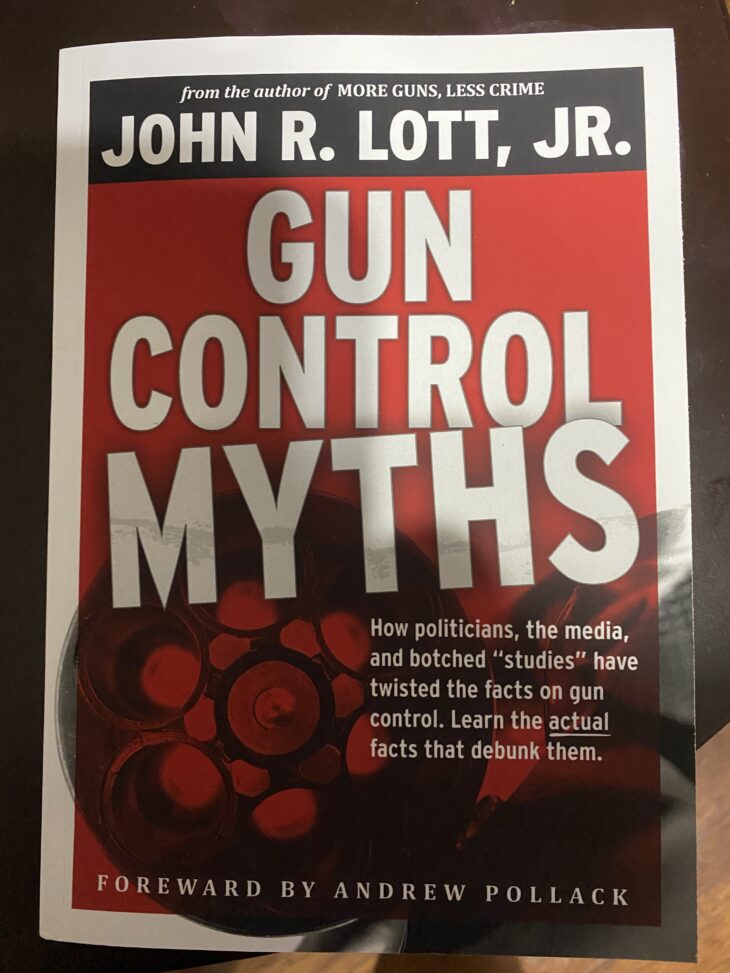
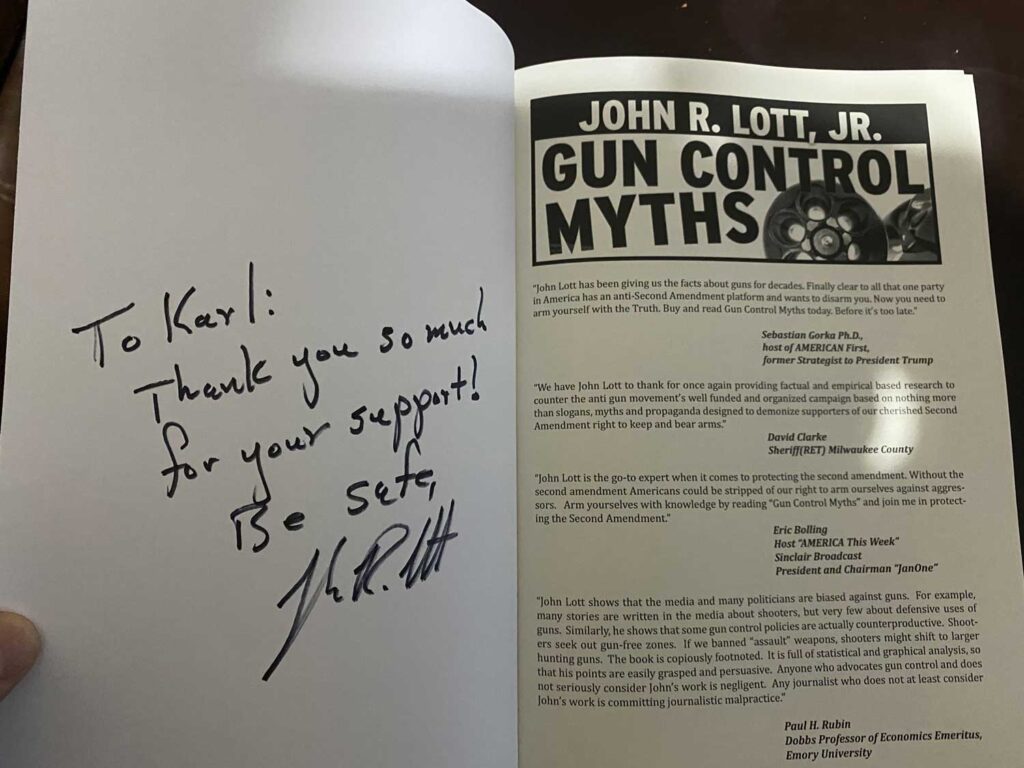
Research John R. Lott, Jr. has a new book out, “Gun Control Myths”. Like all his other work, it’s fact-filled, with higher quality research than the Bloomberg-funded gun control advocates produce. Since Dr. Lott’s conclusions don’t fit the “narrative” of most media, you won’t see his results reported as widely. If you find yourself discussing gun control and gun laws with others during this election season, the material in this book may be useful to you. Lott does an excellent job of providing detailed endnotes for each chapter, referencing back to every article and study he mentions in the book. He exposes the ways that data are misrepresented and manipulated to create statistics widely believed by those that blindly agree with those claims due to confirmation bias, and/or ignorance of technical details about firearms and existing gun laws.
Lott addresses the (false) myths that are widely repeated by anti-gun politicians and media in depth, including:
America has more firearm homicides than Canada and Germany
Developed countries with more guns have more gun deaths
There have been more than 1600 mass shootings since Sandy Hook
Household gun ownership is declining
States with tighter gun control laws have fewer gun related deaths
Countries and states and cities all have differing populations. When raw numbers of events are presented instead of rates per 100,000, and those raw values are compared with no discussion of relative population, incorrect conclusions can and are frequently drawn.
Lott devotes a full chapter to debunking myths about mass public shootings. Incidents that are gun fights between two armed groups, particularly gang-related incidents, which are different from active killer situations, often get counted by anti-gun groups to inflate their numbers. Similarly, incidents in which a potential active killer is stopped before 3 people are killed are not included in some anti-gun research databases (or the FBI’s statistics), making it possible for those opposed to armed teachers or concealed carry or individual armed response to make the false claim that no attack has been stopped by a good “guy” (of any gender) with a gun. He also addresses the issue of magazine capacity and its effect (or lack of effect) on outcomes in mass public shootings, and presents statistics on the number of incidents occurring in “gun free” zones.
Lott uses the correct definition of a gun free zone as one that prohibits individual carry of guns, which includes military bases and many public buildings. Anti-gun propagandists exclude those locations claiming that weapons in an armory, or a location where only on-duty law enforcement are allowed to carry, are equivalent to a public space where legal carry is possible.
Other chapters explore “The Heroes That the News Media Doesn’t Cover”, the politicization of the FBI and their statistics on mass public killers, and how much money Michael Bloomberg has invested in academic programs to do anti-gun research. An old friend is an editor at a major online news website, and I recently explained to him that when a study comes from the “Bloomberg” School of Public Health at Johns Hopkins University, it should not be considered as unbiased research. They are the equivalent of studies on tobacco funded by R.J. Reynolds – tainted by the bias of the funding source. I encouraged him to at least do his readers the service of printing the entire name of the school, not just “Johns Hopkins”, when writing about research results, in the interest of honesty and fairness and clarity.
Lott’s work has been subject to constant media bias and omission, despite him doing far more than the anti-gun researchers to provide transparency in his sources and data analysis methods. He discusses the lack of transparency and selective data omissions other researchers have done to achieve desired results in their work.
I recommend this book, along with all of his previous publications, and encourage gun owners to support his research by purchasing his books. Visit the Crime Prevention Research Center for more information about Dr. Lott and his work.
Caught between COVID restrictions on class sizes and ammo shortages, we are also seeing the highest demand for training we’ve had in 29 years in business. We are offering courses on every weekend between now and end of October, and have multiple instructors teaching private sessions at the A-Zone and at locations from Conroe to Georgetown and Lampasas. Training is available at any level, including LTC online completion. Contact us to request a specific class.
KEEP BUILDING SKILL WITHOUT AMMO
Many of you have shared your frustrations about the ammunition shortage and price-gouging, and we share those frustrations. We added a reloading clinic at the end of August for those of you who asked, and we’re happy to offer that class again if you let us know that you’re interested.
We also know how important it is to have recent and relevant training and practice. If ammunition is preventing you from attending classes or getting to the range (or even if it’s not), it’s a good time to explore options for dry-fire practice that supports and reinforces skills you’ve recently learned.
Our friends with Immersive Training Solutions are offering individual and group sessions using their VIRTRA video simulator in the north Austin/Leander area.
Set up a productive training and practice regimen by taking these steps as soon as possible:
Use Ammoseek.com to find 150-200 rounds of ammunition. Expect availability or shipping delays and higher prices.
Contact us to schedule a private Handgun Coaching session for yourself, your family, or your small group with an instructor closest to you. Several of our instructors offer training at local ranges, as well as at the A-Zone Range.
Take what you learn during that session and apply it to a daily dry-fire routine. Just five minutes a day, even with a “dead” trigger, can help you maintain or improve your skills. You can work on your concealment draw (perhaps the most important skill) without pressing the trigger at all. Work on drawing to a sight picture with the slack out of the trigger.
PAUL MARTIN VIRTUAL PREPAREDNESS CONFERENCE
COVID affected our plans to run an August event, but many have concerns about the current pandemic and volatile political situation. Paul, Karl, and guest instructors Caleb Causey, Lee Weems, and others to be announced will be sharing new videos from now through the end of October (and possibly beyond). These videos are offered as Video On Demand via Vimeo. You can stream them or download them for a small per-video fee. The entire video series can be found here. The older content from the 2018 presentations is still available.
HANDGUNNING BEYOND BASICS
Handgunning Beyond Basics is one of the required courses in our Defensive Pistol Skills program.It’s not a beginner class. Tom Givens teaches that there are at least 3 types of shooting: “quickly, carefully, and precisely”. Quickly is for big targets in the 3-7 yard zone. Carefully is for small targets up close and big targets from 7-15 yards, and Precisely is for anything past 15 yards. Most shooters do not understand or apply those concepts, firing every shot with the same sight picture, with the same speed of trigger press, regardless of shot difficulty. The Handgunning Beyond the Basics course teaches all 3 modes and applies them to single and multiple targets at varying ranges. If you plan to earn your challenge coin, this course is required. If you want to shoot better on harder targets, this class will teach you how.
Legendary trainer Massad Ayoob will visit KR Training Sept 26-27 to teach his 2 day indoor lecture course, MAG-20 Armed Citizens Rules of Engagement. This class goes far beyond the material covered in the Texas License to Carry course and should be mandatory for any LTC instructor. Mas has worked hundreds of cases as an expert witness and has extensive experience dealing with all the aspects of preparing an armed citizen to make good use of force decisions and be able to defend them in court.
Due to COVID this class will be smaller than a normal MAG-20, with limited slots available, but a few slots are still open.
UPCOMING CLASSES
Many of the Sept-Oct classes are already sold out as we continue to operate under COVID restrictions on class size and student distancing (details here). The following classes still have spots available:
View our full schedule to see the 2021 classes that are now open for registration. Due to the agreement with our neighbors regarding live fire during deer season, the only live fire training we will offer at the A-Zone during those months will be mid-day, weekday private or group courses. Other team instructors working at other ranges will have some weekend training available.
TAC MED EDC – MAYHEM! – NOVEMBER 15
Due to recent events across the country there is a demand for skills and tools required to survive violent mob attacks. One of the problems is that these violent mobs are using unconventional weapons against civilians and law enforcement alike; fire bombs, blunt objects (rocks and bricks), chemicals (acid, paint products), feces, pyrotechnics, and lasers that cause blindness. These attacks are not restricted to just downtown areas, they have made their way to residential neighborhoods. As their tactics change, so should yours to protect your family… which includes your own medical responses to such attacks.
This one day course provides solutions to injuries already witnessed as a result of these violent attacks. We’ll be covering the same subjects as previous Tac Med EDC courses, but with a focus on injuries related to mob attacks in your vehicle, your home, and at work.
Students are encouraged to bring their Get Home Bag, any med kit they already have, or other related preparedness gear to class. Scenarios will involve some skills and tools not medically related, but critical to surviving a mob attack.
AUGUST BLOG POSTS
If you don’t subscribe to this blog or follow us on Facebook, you may have missed these articles we posted in August. A very busy month of teaching, with a record number of weekday private lessons has limited our blogging.
Tracy recently attended an indoor, low light/vehicle defense force on force class at the FRC Indoor Range and Training Facility in Baton Rouge, LA. Karl taught two classes for Buck and Doe’s range in San Antonio, assisted by Tim Reedy of TDR Training, was top pistol shooter in his first IDPA match in more than 20 years. Many of our staff instructors have been busy teaching private and small group classes, from Conroe to Georgetown to Giddings, as demand for License to Carry and beginner training hits record levels. DPS reports that they are receiving more than 1600 applications per day. At that rate, the number of permit holders in Texas could grow by 300,000 or more by the end of the year.
SONG OF THE MONTH
This month’s sample video of Karl performing live at Luigi’s in College Station, where he plays every Tuesday night (and occasionally live streams the performances on his personal Facebook page). This is his version of Otis Redding’s “You Don’t Miss Your Water”, in honor of August’s dry weather.
We look forward to training you! Karl, Penny and the KR Training team
Yesterday the news rippled through the firearms training community that Dr. William Aprill of Aprill Risk Consulting had passed away. I’ve known William for close to 20 years, as he and I were regular presenters at the annual Rangemaster Tactical Conferences, and in recent years I had hosted (and co-taught) his “Unthinkable” course.
His “Unthinkable” course was offered all over the country, sometimes as a stand alone package of his lectures, and sometimes as a longer course co-taught with other trainers, incorporating their material with his. The training he offered was unlike anyone else’s: a guide to understanding behavior of violent criminals, and how to interact with (or preferably, avoid) them. He was also a very skilled handgun shooter, and presented some excellent blocks of training on unarmed self-defense at some of the early TacCons.
Another course he co-taught was the “Establishing a Dominance Paradigm” class, with Tom Givens and Craig Douglas. KR Training’s Dave Reichek attended and wrote a detailed review of that class back in 2015.
William and I had talked in the past few weeks, as I scheduled him to teach two 1-day versions of “Unthinkable” in December at the A-Zone. As soon as I put it on the calendar, people began signing up. Earlier in the year his name was top of the list of student requests for guest instructors. His reputation and the quality of the information he shared on many podcasts and videos made the course easy to market.
Recently he was featured on two episodes of Ballistic Radio, sharing his thoughts on recent events. These may be the last interviews he did before passing. He was a frequent guest on that podcast and many other, older episodes are also worth listening to.
William frequently updated his Facebook page with his “they don’t think like us” posts, giving examples from the news of behaviors and situations similar to those presented in his classes. It’s another way to learn from him, even though he’s no longer with us. Hopefully his family or friends will keep his page active, so his knowledge and digital memory will be preserved.
Most of the KR Training team knew William, as many of us were frequent TacCon attendees, or interacted with him in person and online. We were looking forward to having him back at the A-Zone, not just for training but to enjoy his company and catch up with an old friend. We are diminished, and he will be missed, but never forgotten.
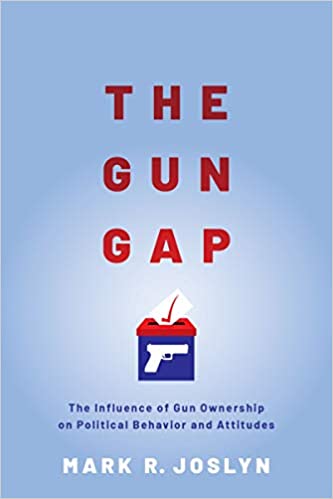
I picked up a copy of this e-book recently. Someone I follow online (can’t remember who, sorry) recommended it. The author, Mark Joslyn, is a political scientist at the University of Kansas who does research on voting trends and demographics, including gun ownership. According to the introduction, the author “has never owned or gun or been involved in gun politics”. That lack of understanding of the history of the gun culture in the U.S. shows in some of the critical points that were missed in his analysis. He read a lot of books on the subject, mostly books written by gun culture outsiders and other academics, and draws conclusions based on graphs and charts and the third-hand conclusions reached by the authors of the books that he read.
It’s a wonky book that analyzes changing trends based on survey and poll data, making the case that political analysts and pundits and academics should be looking at more than gender, age, location and other factors to understand the growing political divide. As someone deep inside the gun culture who deals with these issues on a daily basis, nothing in the book was particularly surprising or new information. The target audience – pundits and academics who are outsiders to the gun culture – will likely find it far more interesting than I did.
Quick summaries of the 7 chapters, with my thoughts on their contents. Direct quotes from the book are in bold, my own thoughts in italics.
1 – Understanding gun culture (and introduction)
National exit polls do not regularly ask voters about gun ownership. Decades of serious research in political behavior have ignored gun owners and gun ownership. (Karl: This is because coastal elites, academics and pollsters all tend to live and work in places and at institutions where gun ownership is rare and/or secret, as cultural norms, bias, discrimination, and divisive attitudes make it uncomfortable for gun owners. I have students that absolutely do not want to be photographed when attending classes, out of concern that their employers or co-workers will disapprove, leading to interpersonal conflict or even discrimination related to job assignments or promotions. The author addresses those issues in chapter 5 of the book.)
Gun owners did not represent a serious political group until the 1980’s and 1990’s. (Karl: This is because until then, gun ownership was culturally “normal”. Prior to the late 1970s there was no significant gun control “movement” in US politics. Starting in the 1980’s, media elites and liberal think tanks began creating the same kind of lobbying/biased advocacy research structure for gun control as they were creating for other social issues. In the 1950’s and 1960’s, movie stars and politicians and presidents (JFK, for example), considered it normal to hunt and target shoot, and riflery was taught at every summer camp and in some high schools.)
The 2004 election revealed an emerging urban/rural divide. (Karl: Not really urban/rural as much as the efforts of the Boomer Left to make gun ownership and appreciation of firearms freedoms as marginalized as tobacco use and drunk driving: wiping out “urban” gun culture via passage of more and more laws making it harder and more expensive for those in major cities to own, shoot or carry guns.That trend may be reversing in 2020.)
Gun owners believed guns improved their sense of control in life and enhanced feelings of safety, confidence, and responsibility. Those believing those things supported arming teachers and concealed carry. Gun owners are increasingly unlikely to tell poll takers that they own guns, making an accurate estimate impossible. (Karl: Another factor the author ignores is that gun and magazine bans in anti-gun states, up to and including laws requiring owners of banned items to turn them in or destroy them, make those in possession of those items, even in states where bans and confiscation orders have not been enacted, very reluctant to admit to a stranger that they might own those items. Yet another factor is that modern technology makes it much easier to block or decline calls or texts from unknown numbers, reducing the potential pool of those willing to answer poll questions even more.)
The author refers to those that own twenty or more guns as “super-owners”, and mistakenly infers that the main reason those people own that many guns is that they have interest in “gun collecting” and belong to gun collecting “clubs”. (Karl: That has not been my experience at all. Most of the people I know that own a lot of guns do so not because of collecting but because of participation in shooting sports, hunting different species, equipping family members of varying sizes, ages and physical abilities, the hobby of building and customizing guns, preparedness and purchasing guns and magazines specifically as a hedge against future bans, for investment or to hand down to family members.Others purchase new guns simply because new models that interest them or that may work better for their needs are introduced, and those that shoot a lot may purchase multiple copies of a frequently used gun or replace a worn out gun.)
The standard observations about the change in gun owner motivation from hunting to self defense (aka Gun Culture 1.0 to 2.0) are made, referencing the usual sources. Also the usual discussion of the NRA is included, with the usual overstatement of the NRA’s influence on gun owners, with the false claim “The NRA is often noted as the singular voice in articulating, refining and forging a gun owner identity.” (Karl: Gun culture is far more tribal than outsider academics realize. There is on singular gun owner identity, and at best the NRA’s positions on issues is a reflection of gun owners, not the other way around. NRA lagged behind the curve on acceptance and growth in interest in the AR-15, USPSA/IDPA matches, suppressors, concealed carry, open carry, and just about every major trending change in gun owner behavior of the past 30 years.)
The widening gap between the two major parties on gun issues is discussed and explored with charts and graphs, showing a result that should surprise no one: as the party platform of the Democrat party supported more and more restrictions on gun ownership, gun owners stopped supporting that party. (Karl: The author points to John Kerry’s failed attempt to pretend to be “one of us” as the last attempt of a Democrat candidate to appeal to gun owners.)
2 – A gun gap in voter choice
In this chapter the author makes the case, using charts and graphs and data, that political scientists should study gun ownership as a factor that separates voting blocks, noting big shifts starting in 2000. Southern Democrat candidates Jimmy Carter and Bill Clinton attracted majority support from households that did or did not own guns in 1976 and 1996, respectively. Donald Trump’s “gun gap” is 3x larger than the gap was in 1976. (Karl: This is largely a function of the Democrat party’s hard left turn and aggressive push for gun control, as well as the growth in popularity of concealed carry and the AR-15 rifle. The GOP pays lip service to gun rights during campaigns but rarely exerts political effort to expand gun rights. The best they can do most of the time is vote ‘no’ on Democrat proposals and give weak excuses to gun owners as to why promises made to repeal or revise existing laws are never kept.)
The gun control-group talking point claiming that poorly educated white men make up the largest block of gun owners is repeated in the book. Gun ownership is, as the author identified, a strong indicator of voting preferences. (Karl: My own experience with three decades as a trainer is that my students come from a wide variety of backgrounds, from construction workers to doctors and lawyers and professors, as well as musicians and programmers and service industry workers. The key point the author, and most academics, ignore, is that each election gun owners must choose between one party intent on taking guns, magazines and the rights to carry and own specific (or any guns) away from gun owners, and another party that at least pretends to support gun owners and gun rights during the campaign, that only votes for gun bans occasionally. There is no “compromise” ever in play, as a compromise would involve gun owners trading some freedoms for others. Instead, when the word ‘compromise’ is used, it always refers to gun control advocates only getting some of their policies enacted today, with others deferred until the next opportunity.)
3 – A gun gap in voter turnout
This chapter studies the gap in voting turnout between those motivated to support gun control and gun rights. Gun owners have the most to lose and unsurprisingly are the most motivated to vote and to urge others with similar interests to vote. The author does a fairly good job of explaining this, and going farther into gun owners’ motivation to be politically active by contacting elected officials, staying informed, and peacefully protesting.
(Karl: If every election posed the risk of new regulations and criminal offenses for academics owning certain kinds of books, or studying certain topics, or being prohibited from using certain words, perhaps they would better understand what motivates gun owners to be as politically active as they are. The upcoming election may pose that actual risk to academics, as “cancel culture” and woke censorship has become a serious concern of the traditional Left, who are under attack from the extreme Left.)
4 – Safer with a gun
People that own guns feel safer because they own them. Those that do not own guns are (justifably) scared of being harmed by a gun, and therefore want fewer people to own guns or carry guns in public. This idea is supported by graphs and charts and poll data, all of which shows what gun owners already understand.
This chapter leads into the next, which explores this idea further.
5 – Feelings toward gun owners
Unsurprisingly (to any gun owner), those outside the gun culture have considerable bias and believe many negative stereotypes. This bigotry and bias affects opinions about gun laws and voting patterns.
From the book: The gun is simply an object. Assailing it and demanding limits can be construed as harassment of gun owners and disapproval of gun culture generally. Gun owners may view criticism of guns as insulting, questioning their judgment and their capacity to carry and operate a gun safely. The resounding message after a gunman claims dozens of innocent lives is “we must regulate guns.” Gun owners may hear this as “we must do something about gun owners”
From the book: If people like gun owners, they also believe concealed carry improves public safety and guns are not threats to personal safety. And this makes sense. If an individual favors gun owners, why would she be threatened if others own guns and carry them in public?
(Karl: There are essentially no portrayals of normal gun ownership presented in modern entertainment media. “Good guy” gun users are always law enforcement or military personnel, typically engaging in very violent behavior, often dismissive of citizens owning guns, parroting the gun control talking point that regular people can’t possibly have the judgment or skill to use a gun for self defense.” Cop shows like Law and Order, set in New York City, mislead national viewers into thinking that NYC gun laws are representative of gun laws in their home state, while false claims made by Democrat politicians mislead non gun owners into thinking that anyone can order a full auto gun over the internet.)
Karl: The only moderately positive examples of citizen gun ownership I can identify are one Simpsons episode where Homer buys a gun, learns that most of the characters on the show are gun owners and members of the National Gun Association. They try to teach Homer gun safety and end up kicking him out for being irresponsible and unsafe. At the end of this episode, Marge takes possession of the gun, using it to thwart a Quik-E-Mart holdup. Similarly, a King of the Hill episode involves Bobby Hill participating in target shooting in a somewhat ‘normal’ setting. And the final season of “Major Crimes” involved a subplot where the gay abused teen adopted by the series main characters is allowed to get a California carry permit, is trained (by his police step-parents) to carry responsibly, and who uses his gun to protect himself from a lethal attack.
The rest of the Gun Gap chapter provides plenty of examples of anti-gun-owner bias in major media. From the book:
Gun owners are often lampooned by media outlets (Kohn 2004). Common labels are “fanatics,” “gun nuts,” “violent hicks,” “rednecks,” and “racists.” Hallman (2017) noted that reporters tended to frame stories in ways that “make it clear they see gun-owning Americans . . . as distinctly other.” The frames effectively separate gun owners from the world where most journalists and the bulk of their audience live. Scholars examined the representation of the “other” in journalism (Furisch 2002). And journalists are now advised to help them become aware of the habit and its consequences (Ordway 2018). Gest (1992) suggested that many journalists grew up in urban environments where guns were uncommon. They acquired a cosmopolitan perspective, which questions gun ownership and leads to antigun bias in the news media.
In 75 percent of the documents, covering typical gun policy debates, gun owners were characterized as selfish, incompetent, and irresponsible, “caring more about guns than people”. In articles that concerned child endangerment, over a third suggested owners were the danger. The characterization is reinforced in headlines such as “Gun owners are responsible for almost as many death annually as motorists” . When referring to gun owners and self-defense, Downs found the most common adjectives describing owners were selfish, incompetent, dangerous, and unreasonable… The most common terms for the NRA were “most feared lobby,” “gun organization,” and “powerful gun lobby.” In a careful study, Steidley and Colen (2017) analyzed the New York Times responses to press releases from the NRA and the Brady Campaign to Prevent Gun Violence. In general, their findings show greater sensitivity toward the Brady Campaign.
Joslyn, Mark R.. The Gun Gap (p. 129). Oxford University Press. Kindle Edition.
Missing from this chapter is a discussion of how research from biased academics, for example those working for the “Johns Hopkins Bloomberg School of Public Health” and the University of California Violence Prevention Research Project – both funded by partisan, anti-gun sources, tasked with the job of generating studies and data opposing gun rights, are treated as impartial and valid sources by major media, while the work of John Lott, another academic whose results typically contradict the work of the anti-gun academics, is consistently presented as questionable or tainted.
6 – How many gun owners
This chapter explores the difficulty in determining how many gun owners there are. (Karl: That number has definitely changed in the past 6 months, as I and many other trainers on instructor forums indicate that the number of new gun owners and new carry permit holders, and demand for training, are all at record high levels – and most of the new gun owners are buying semiauto pistols that hold more than 10 rounds and AR-15 rifles. This means that gun control measures proposed by Democrats will affect a larger number of voters. The question remains whether these new gun owners will fear those new restrictions enough to vote against candidates advocating those new laws.)
7 – A gun gap in death penalty support
Unsurprisingly, gun owners support the death penalty more than non-gun owners. The death penalty is only an option for the most heinous crimes – the same crimes the average gun owner (and their state’s Penal Code) would likely identify as situations in which use of deadly force is legally justifiable. Those uncomfortable with the idea of potentially taking a life to save others while a crime is occurring are far more likely to be uncomfortable with the idea of taking a life as punishment for that same crime.
Summary
Overall the book is a good presentation of reality from the gun owner perspective, showing the different aspects of the gap between gun culture and mainstream media, and the reasons and ways the gun culture separates from the views and motivations of non-gun owners (or casual gun owners with less affiliation or alignment with gun culture values). With the significant numbers of new gun owners, particularly those that are not conservative older white males, demographics and possibly support for new gun control measures may be changing rapidly.
Because of that, it has value for new gun owners and non-gun-owning friends and family of gun owners, as it explains the political landscape in a way that’s accessible to those outside the gun culture.
Classes continue to fill quickly at the A-Zone Range, so we’ve added more training opportunities to the schedule to accommodate more students while keeping classes small. We’re also aware that ammunition can be hard to find, so we have scheduled more non-shooting classes and reduced total round counts in many classes.
Masks are mandatory inside the A-Zone classroom building.
The range is set up to facilitate 6 feet of distance on the firing line and at the safe tables.
Classes remain at 50% of normal capacity per state and Lee County guidelines.
Round counts are lower in many of our classes, but not all.
Registered students will receive updated round counts in their pre-class email.
We recommend finding deals on ammunition at AmmoSeek.com, but read this message from AmmoSeek to understand why your order may be back-ordered, sold out, or delayed significantly.
Although we’ve added many classes, they continue to fill quickly. Weekday lessons are available with Karl for individuals, families, or small groups. Tina Maldonado and Sean Hoffman are available for weekday and weekend sessions in the NW Austin/Georgetown area, and Doug Greig is available in the Caldwell/Bryan/College Station and Conroe area. Training is available at any level, including LTC online completion. Contact us to schedule.
REFERRING NEW GUN OWNERS
Many of the classes we’ve added are entry level classes suitable for new gun owners and those with LTC and no other training. Often new gun owners think that the only training they need are classes in gunhandling and marksmanship. As discussed in Claude Werner’s excellent book “Serious Mistakes Gunowners Make“, the greatest failure area is tactics: taking the wrong actions, at the wrong time. If you recommend our courses to new gun owners, please encourage them to attend not only the basic gun skills courses we’ve added, but the Home Defense Tactics and Personal Tactics Skills courses that teach the non-shooting skills necessary to avoid making serious mistakes.
We do have loaner guns available for beginner classes, including shotgun and carbine classes, for those that want to learn those skills that don’t yet own a firearm, or have had difficulty finding the firearm they want in stock.
UPCOMING LIVE-FIRE CLASSES
We asked for your input into the class schedule, and have responded by adding many of the most-requested live fire classes to the August – October training calendar. Some classes (not listed below) are already sold out.
Due to an agreement with our range neighbors related to deer season, in November and December live-fire training will be limited to private, mid-day weekday sessions. We will also offer some non-shooting group classes on weekends.
For those seeking their Texas License to Carry, our recommended option is to take an online course and do the range completion with us. Under DPS guidelines, completion requires a 1 hour (minimum) classroom block of training and the shooting test. The shooting test is not part of the 1 hour instruction. We are now offering 2 hour LTC Completion weekend courses priced lower than our private weekday completion sessions.
The LTC completion sessions also make excellent refresher courses for those that already have LTC but have not practiced or taken other training since getting the LTC. They are scheduled on days that other courses appropriate for LTC level students are offered, such as our shotgun, carbine and Skill Builder classes, to encourage those attending to use the LTC completion classes as a low cost handgun tuneup session.
These indoor classes are still open for registration at the time of this writing, but there aren’t many slots available. Register soon to reserve a spot.
As you can see from the class list above, one of you still has a chance to train with Lone Star Medics and Tactician Concepts August 1, learning knife and medical skills in Cut and Stuff. Massad Ayoob’s MAG-20 Classroom also has spots available. We’ve also added a Tactics-Based Land Navigation 8-hour class on October 25, and two options to attend Dr. William Aprill’s cornerstone class, Unthinkable, December 12 and 13. These are opportunities you don’t want to miss, so register now and secure your seat in these classes.
AUGUST VIRTUAL PREPAREDNESS CONFERENCE
Paul Martin and I are putting together a virtual preparedness conference, which will offer low cost, short videos on a variety of preparedness topics from us and guest experts. We will announce more about this mid-August when the videos are available to download and stream. We still have over 14 hours of material from the 2018 preparedness conference online for low cost download or streaming. The trailer for that video series is here.
JULY BLOG POSTS
If you don’t subscribe to this blog or follow us on Facebook, you may have missed these articles we posted in July:
Instructor Doug Greig attended and passed the SIG Pistol Mounted Optics Instructor course, held at the SIG Academy in New Hampshire, this month. He joins Karl and Sean Hoffman as SIG-certified trainers in red dot pistol shooting.
SONG OF THE MONTH
Most of the places I used to perform music each week are either closed or operating at reduced capacity with no live music, but Luigi’s Patio Ristorante in College Station continues to have live music every day they are open. Those of you in the B/CS area are encouraged to support them (dine-in and takeout), and everyone is encouraged to support all the family-owned local restaurants near you as they struggle to stay open.
I have started live streaming my Luigi Tuesday performances via my personal Facebook page. Here’s a sample from a live stream a few weeks ago.
We look forward to training you! Karl, Penny and the KR Training team
(From Paul Martin): Last week, the Greater Austin Crime Commission released a Crime in Austin report. Download it here. Citywide, aggravated assaults and individual robberies were up last year. Response times are slower, and traffic fatalities increased. Cutting 100 cops takes us back to 2015 staffing levels. Does that make sense in a rapidly growing city?
The link you will find most interesting if you live in or near Austin is here. Note the summary of the report for the first half of the year:
Murder up by 64%
Auto Theft up by 30%
Robberies up by 16%
Aggravated assault up by 14%
Arson up by 9%
Burglaries up by 8%
Remember – if you think crime happens “to other people,” rest assured that to someone else, YOU are “other people.” Take time this week to:
Honestly and critically evaluate your own readiness and prevention measures for crime, both in and out of the home
Determine what training you need to alleviate those deficiencies. Given the pandemic, you may have to resort to online training – it’s better than nothing
Don’t limit your evaluation to just self defense needs – what first aid training do you need? Do you have enough fire extinguishers at your house and in your vehicle? What can you do to promote health and safety with your neighbors and community?
Make any necessary changes in your habits or daily activities to reduce the risk to you.
If you appreciate the reporting below, consider getting on the Greater Austin Crime Commission’s email distribution list by going to their website It’s free to join. If you can, consider making a donation for the work they are doing. I have provided financial support to the Commission in the past.
(from Karl): Recently the head of the Austin Police Association advised officers to “do the minimum” while on duty, as protest against the attitudes and policies of local leadership regarding police and policing. With crime increasing, police staff reductions, limited response levels and slower response times, the importance of taking steps to minimize your risk and improve your abilities is high.
The KR Training Home Defense Tactics class is coming up August 15th, 2-5 pm. It’s an indoor lecture course (no shooting) that teaches how to do a security evaluation of your own home, and includes instruction on how to handle the “what if” scenarios that are most likely at home.
Lack of training leads to the actions that has gotten a St. Louis couple national attention and criminal charges. Stepping outside the home to confront an angry mob, using an unloaded rifle and fake gun was not good tactics, regardless of the legality of their actions. The Modern Service Weapons blog recently published an excellent article on this issue.
We also have slots still open in our August 8th Personal Tactics Skills class, which addresses all the “what if…” situations that can happen to people when they are away from home, in their vehicle or in a public place. That course includes instruction in selection and use of pepper spray. That course is also indoors, no shooting, no equipment required.
There is more to self-defense than just “have a gun and carry it”. If you read Claude Werner’s excellent book/ebook/audiobook “Serious Mistakes Gunowners Make“, you will learn that the training armed (and unarmed) citizens most need is instruction in tactics, not marksmanship and gunhandling. That’s why we offer these courses in addition to our traditional firearms skills classes.
The tactics courses can be attended by anyone, armed or unarmed, including teens and those with no interest in firearms who just want basic “how to avoid being a victim of crime” instruction.
If you don’t have time or interest in driving out to the A-Zone to attend a class, Lee Weems of First Person Safety is doing an online “Standing your Ground” course Saturday afternoon, July 25. You can register and attend that class by clicking this link.
The Texas Bar continuing education program offers a session titled “Firearms Law: What Every Texas Lawyer Needs to Know”, on September 24-25, 2020.
The session is not limited to Texas lawyers. Anyone can attend. I’ve attended the in-person sessions in previous years and found them very useful and informative. Speakers typically include prosecutors, defensive lawyers, judges, and legal experts. One year Don West, who defended George Zimmerman, gave a full day’s presentation on that case. Last year’s presenters included trainer Massad Ayoob, Gene Anthes, the Armed Citizen Legal Defense Network lawyer that represented John Daub after his self-defense shooting, and a Tyler law enforcement officer who was involved in the pursuit and shooting of the active killer at that city’s courthouse.
My AAR from the 2018 event is here (part 1, part 2).
This year’s topics include
Primer on Basics of Gun Law
Firearms and Family Law – What Every Family Lawyer Should Know
Granny Had a Gun: Firearms in Estate Administration• Gun Trusts
How to Protect Your Law Firm from Violence in the Workplace
Premises Liability and Guns
Hosting a Social Shooting Experience
Understanding and Sorting out the Conflicts in Texas Carry Rules
Defending Our Own: We Stopped the Shooting\
20 Cases Every Lawyer and Gun Owner Should Know
Gun Collecting
The Changing Policies on Use of Force and the Pros and Cons of the Decline in Officer Involved Shootings
Avoiding Malpractice and Ethics Violation in Representing Family and Criminal Law Matters
Understanding Controversial Verdicts
This year’s conference will be purely online, and discounted rates for pre-registration are available. If you can’t watch it live, the sessions will be available to view anytime for a year after the event. Print copy or full PDF of the event notes are included in the cost. Typically the event notes are very detailed (not power point slides but full text documents) and are hundreds of pages long, full of content.
This training far surpasses anything the DPS ever offered to LTC instructors for professional development, and in my opinion this seminar should be essential viewing for all Texas LTC instructors. The topics are broad enough in scope that any gun owner, armed citizen or instructor teaching outside Texas would benefit from the information as well.
The Red Dot Club is a series of first-hand accounts of gunfights – shooting others and being shot (getting a “red dot”) told by police officers, mostly from Southern California. The accounts are very detailed, with emphasis on what the officers thought and felt before, during and after the incidents. It’s not a book that provides “lessons learned” or after action analysis, nor does it discuss tactics for avoidance or tactics for winning in the incidents.
The main theme of the book, if there is one, is to give the reader better perspective on violence and how it affects the participants – physically and psychologically. Author Robert Rangel served 13 years with the Los Angeles Sheriff’s Department and medically retired after multiple on-duty injuries, working executive protection, bank security, and doing civilian investigation work for a police department. That varied career provided him many encounters with those that had been involved in shooting incidents, enabling him to compile their stories into this book.
When we discuss deadly force incidents, I comment to my students that I have never talked to anyone that’s been in one that said “that was exciting and fun and I’d like to do that again”. Their stories are much more like the ones in this book: darker with more regret. Since most of the stories are set in the Los Angeles/Southern California area, it also provides insight about the drug and gang culture of that area, from the police perspective.